


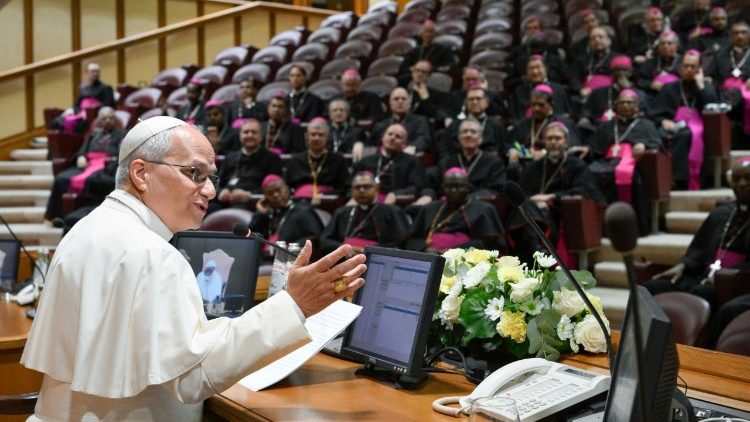
Pope Leo XIV has reminded the recently appointed bishops this Thursday that, before being rulers of a diocese, they continue to be disciples of Christ and that, among the numerous responsibilities they will assume, remaining with Him must occupy the first place. “We are bishops, but above all we are disciples,” he affirmed.
The Pontiff received this morning in the Synod Hall the participants in the formation course «Bishops, servants of communion in the Church and in today’s world», which concludes the formation days held in Rome for 147 new bishops from the five continents. Leo XIV asked them for closeness to priests and faithful, an authentic episcopal fatherhood and a missionary heart, and reminded them that new technologies and artificial intelligence, despite their possibilities, “cannot free humanity from sin and its consequences.”
Read also: 147 new bishops begin in Rome the formation courses of the Holy See
Below, we reproduce in full the address of Leo XIV:
In the name of the Father, and of the Son, and of the Holy Spirit.
Peace be with you!
At this moment, before entering into the theme of the day, we can offer a prayer for the eternal rest of the father of the Pro-Prefect of the Dicastery for Evangelization, Cardinal Tagle, and for the consolation of the entire family.
[Ave Maria]
I am sincerely very happy to meet you at the end of these days of formation intended for the new bishops and I thank the Dicasteries for Bishops, for the Eastern Churches and for Evangelization – Section for First Evangelization and New Particular Churches – for the preparation. Some of those who have worked on the organization are here and I thank them, having known a little what it means to organize this program.
You have lived a singular experience of fraternity: together you have listened, prayed, celebrated the Eucharist and shared the hopes and dreams you carry in your heart for the Churches that the Lord has just entrusted to your care as shepherds. All this will help you to remember something very simple and precious: no bishop walks alone.
Dear brothers, know that you are in my prayer, and with you your Churches: the priests, the deacons, the consecrated men and women, the seminarians, the families, the young, the elderly, the poor, those who suffer and those who still hope to find the joy of the Gospel. All must find a place in the heart of the bishop, because all already have a place in the heart of Christ. Therefore, I would now like to share with you some reflections on the theme: “Bishops, servants of communion in the Church and in today’s world.”
Above all, remain with Jesus. Among the many things you will be called to do as bishops, this is the most important. We are bishops, but above all we are disciples. To speak of Him, we need to be with Him; to guide His people, we must allow ourselves to be guided by Him each day, every day. “He appointed Twelve —the Gospel of Saint Mark tells us— whom he also named apostles, to be with him and to be sent out to preach” (Mk 3:14). This is the order of the Gospel: to be with Him and, from Him, to be sent. Let us never forget it. Therefore, always keep in your heart your time with the Lord: the Eucharist, the Word of God, prayer and those moments when you can be in His presence with the simple heart of the disciple who allows himself to be loved by his Lord. Our ministry is born from there. And when the heart remains close to Him, service also becomes more serene, freer, more fruitful.
A second aspect: to have the heart of Jesus, the Good Shepherd, a heart completely turned toward the Father and, precisely for that reason, totally given to the brothers. Jesus says: “I am the good shepherd. The good shepherd lays down his life for the sheep” (Jn 10:11). This is our model. The bishop is a man who learns each day more to love his people: to know the joys and sorrows of his people, to share their dreams, to rejoice in seeing communities grow. You will ordain priests and deacons, you will meet young people full of enthusiasm, you will see the silent generosity of so many religious, nuns, missionaries, catechists and families, and you will discover more and more how beautiful the People of God are. Love the people the Lord has entrusted to you. Learn their names, listen to their stories, enter, when you can, into their homes, pray with them. Especially in young Churches, often the presence of the bishop says a great deal, even before his words. A visit, a blessing, the time dedicated to a priest, listening to a family, dialogue with a young person: these are small gestures, but they can remain in a person’s soul for a lifetime.
Another characteristic of the bishop is what tradition calls sollicitudo pastoralis, pastoral solicitude. It does not simply mean having many responsibilities. It is something deeper: it is carrying one’s people in one’s heart. Saint Paul called his “daily concern” (2 Cor 11:28) the solicitude for all the Churches. Thus, the Church to which you have been sent becomes more and more part of your life, almost part of yourselves. This is proper to episcopal fatherhood: to have a great soul, large enough to make room for all, carrying within oneself one’s children and presenting them each day to the Lord in prayer. Pope Francis recalled that “closeness is one of the traits of God with his people” (Homily on the centenary of the birth of Saint John Paul II, May 18, 2020). And precisely speaking to the bishops of the formation course, on September 12, 2019, he said: “We exist to make this closeness palpable.” What precious words for us! May people be able to feel, through our presence, something of the tenderness and fatherhood of God! And this is especially true for priests.
In this regard, dear brothers, I recommend that you love your priests. May they find in each of you a father and a brother. Listen to them, encourage them, pray for them, rejoice in the good they do and accompany them with confidence in their ministry. Pay particular attention to the elderly and the sick. Make them feel that they are valuable, that the Church is grateful to them and that the bishop does not forget them. Sometimes a telephone call, a visit, an affectionate word on your part is enough.
Another feature of our ministry that I would like to recall is, according to the beautiful expression of Saint Augustine, that of being an «amoris officium» (In Iohannis Evangelium, 123, 5): a service of love. Our preaching is an act of love, as is listening, prayer, discernment, time dedicated to people, presence. It is pastoral charity, which allows Christ the Shepherd to reach the people He loves through our poor person.
We live in an age of rapid changes. The developments of communication technologies and artificial intelligence have opened possibilities that, until a few years ago, we would not even have imagined. But certainly they cannot free humanity from sin and its consequences: this is tragically demonstrated by the crises we are going through. In a complex and, in certain aspects, disturbing scenario like the present one, the Church last year celebrated the Jubilee of Hope. Perhaps because it lives outside the world? On the contrary, because from Christ dead and risen it is sent to announce to all the Gospel of salvation. And we, the bishops, are the first recipients of this mandate. With the encyclical Magnifica humanitas I believe I have offered, in primis to the pastors of the Churches, a vision and a method to face the great challenge of safeguarding the human in the age of artificial intelligence. I encourage you to promote in your dioceses paths of reflection and dialogue, to form and sustain those who wish to commit themselves to the service of the civilization of love.
Many of you come from young Churches. You know the beauty and also the effort of the mission, of a Church that perhaps possesses little, but is rich in a great faith. Therefore I invite you to keep a missionary heart. It is a precious gift that the Lord has placed in your hands and that can become even greater in your episcopal ministry. The missionary bishop has a heart open to all: not only to those who frequent our parishes, but also to Christians of other confessions, to believers of other religions, to people who do not profess a faith, to all men and women of good will. He listens to and respects all, approaches all and knows how to recognize the good present in the heart of each person.
Saint Augustine, speaking to his people, said: “Vobis enim sum episcopus, vobiscum sum christianus” —you all know it, I think—, “for you […] I am a bishop, with you I am a Christian” (Sermo 340, 1). Let us walk with our people: let us pray with them, let us listen with them to the Word, let us celebrate the Eucharist with them. Let us seek with them each day the face of the Lord.
Dear brothers, as you return to your Churches, carry with you this certainty: the Lord, who has called you, is faithful. He will go before you on the way, He will accompany you during the journey and, with the gift of His Holy Spirit, He will give you light each day. And Mary, Mother of the Church, may she always protect you and the people entrusted to you.
Thank you.