


By Stephen P. White
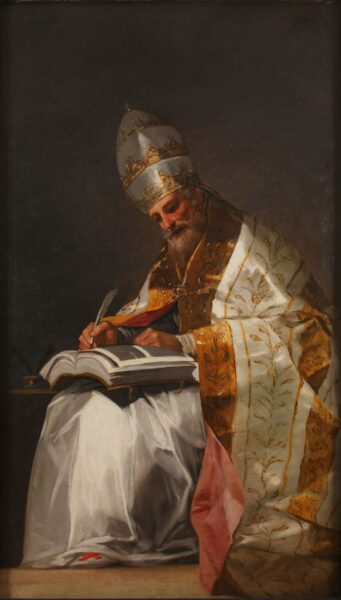
Today the Church celebrates the feast of Saint Gregory the Great, pope and doctor of the Church. He was born around the year 540, just a few years before the death of another great European saint (and co-patron of Europe), Benedict of Nursia. The lives of these two men resemble each other in interesting ways. But the ways in which their lives ultimately diverge also reveal something about how the Lord provides for his Church.
Gregory was born into one of Rome’s great families. Among its members were many senators, consuls, and more than one emperor. Gregory’s father was a senator, and his great-great-grandfather was Pope Saint Felix III.
Rome, in Gregory’s day, was only a shadow of what it had once been. The sack of Rome by the Visigoths in 410 (which prompted Augustine to write The City of God) had been followed by an even more devastating invasion at the hands of the Vandals in 455. The Western Empire collapsed in 476.
Rome itself, which at its imperial height had a population of more than a million inhabitants, had dwindled to barely 30,000–40,000 by the mid-sixth century. War, plague, and the other miseries of imperial collapse had terribly transformed Rome.
By the time Gregory was born, much of the Italian peninsula had been under barbarian control for nearly a century, and the forces of Emperor Justinian (still ruling from Constantinople) were in the midst of a two-decade campaign to wrest the remnants of the Western Empire from the Goths. It was an effort that never fully succeeded.
That was Gregory’s Rome: ravaged by plague, emptied, poorly defended.
In his youth, Gregory served in the city’s administration, rising to the rank of Prefect of the City, but he longed to retire to the monastic life of prayer and care for the poor. After his father’s death, that is precisely what he did: he founded (and entered) a monastery on the site of the family villa on the Caelian Hill. He spent his inheritance in the service of the poor and lived with such strict asceticism that he suffered poor health for most of the rest of his life.
If Gregory’s story had ended there, we might still be telling the tale of a saint: at a time when civilization was collapsing around him, a wealthy young man left behind a promising career and withdrew to a monastery to devote himself to prayer and the service of the poor.
That is, in broad outline, the story of Benedict of Nursia, who wrote his Rule and founded his first monasteries in the decades before Gregory’s birth, and who died when Gregory was a small child.
Much of what we know of Saint Benedict’s life comes from Gregory’s own pen, who devoted a long section of his Dialogues to recounting stories of Benedict’s holiness, miracles, and way of life.
These two men, Gregory and Benedict, thus offer an interesting pair for comparison and study. Benedict, we know, transformed Europe through his renewal and reform of Western monasticism. The monasteries he founded grew and spread to become some of the largest and most enduring institutions of the medieval world.
Gregory, for his part, understood the essential value and importance of the monastic project. But God had a different path for Gregory.
Gregory was torn from the monastic life he so loved and sent as papal representative to the imperial court in Constantinople. The pope needed a reliable advocate to plead for the empire’s military protection, but he also needed someone capable of handling ecclesiastical disputes. The confusion in the empire was compounded and complicated by confusion and division within the Church. The Second Council of Constantinople had provoked great controversy and even schism.
Gregory, the pope decided, was his man.
While Benedict was allowed his monasticism, Gregory was deprived of it and sent to the East to deal with politics and administration. He returned to Rome only to find himself once again deprived of his monastery.
Gregory was elected bishop of Rome in 590. His administration of alms and Church property, in Rome and abroad, was both efficient and focused on the needs of the poor. But the incessant political crises accompanying the Lombard invasion and a distant emperor also demanded his constant attention, which helped save the city from greater destruction.
It was not only in worldly affairs that Gregory’s administration excelled. Gregory did not invent plainchant, but his work organizing and standardizing the Church’s liturgical music is the reason Gregorian chant bears his name. He wrote a rule for the conduct of the clergy and managed disputes between bishops and civil authorities, a distinction that was becoming increasingly blurred in Gregory’s day.
It was Gregory’s piety, prayer, and love for the poor that made him a saint, but it was his prudence and administrative ability—that most unglamorous quality—that made his pontificate great.
Gregory’s genius did not consist in that flashy quality of originality that we so often and so easily admire in great saints. He was not an exceptional theological mind like Augustine or Thomas Aquinas. He was not a visionary mystic. He did not bear the stigmata. He did not travel to pagan lands. (Gregory did famously send one of his own monks as a missionary to England—a certain Augustine, not the saint of Hippo—who became the first bishop of Canterbury.)
But he lived with simplicity and with love. He was obedient to what his Church and his God asked of him, even when that took him away from the monastery he loved. He employed the talents he had, and he employed them with tremendous and lasting effect. In doing so, Gregory laid the foundations of the medieval papacy, foundations no less important for the rise of Christendom than those laid by his brother monk, Benedict.
If there are lessons for our time in the life of Saint Benedict, surely there are just as many in the life of Saint Gregory the Great.
About the author
Stephen P. White is executive director of the Saint John Paul II National Shrine and a fellow in Catholic Studies at the Ethics and Public Policy Center.