


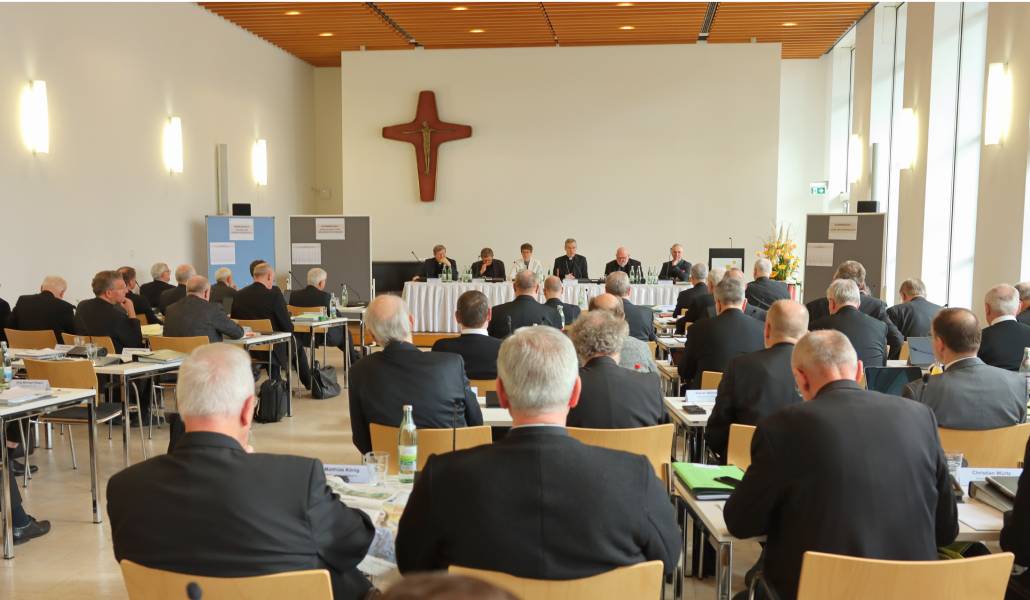
The German Bishops’ Conference (DBK) has announced the main issues it will address at its upcoming autumn plenary assembly, which will bring together 59 bishops from September 28 to October 1 in Fulda. Surrogacy, assisted suicide, organ donation, artificial intelligence, sexual abuse, and synodality are among the topics of a meeting that will be chaired for the first time by Heiner Wilmer since his election to lead the German episcopate.
The plenary will take place while the approval of the statutes of the future German Synodal Conference remains pending in Rome, whose first meeting, initially scheduled for November, has already had to be postponed. On the eve of the meeting, Wilmer granted an interview to the Frankfurter Allgemeine Zeitung (FAZ) in which he defended an «open» Church, once again warned against Alternative for Germany (AfD), and stated: «It cannot be that our Church degenerates into a sect.»
From surrogacy to assisted suicide
One of the main blocks of the assembly will be titled «Life from beginning to end» and will be dedicated to some of the bioethical debates currently occupying the European political and social agenda.
The bishops will specifically address surrogacy, organ donation, assisted suicide, and the use of artificial intelligence in the medical field.
Precisely regarding surrogacy, Wilmer has just reiterated the Church’s opposition. Asked by the FAZ about this practice, the president of the DBK assured that the episcopate’s position is unequivocal: «Our position is absolutely clear. We reject surrogacy.»
The bishop also rejected the notion that the Bishops’ Conference has remained silent on the matter and recalled that it had already spoken out previously. Wilmer considers it unnecessary for the bishops to continually reiterate already known positions of the Church.
Surrogacy has gained renewed relevance in Europe precisely these days. In Warsaw, a promotional meeting of the Ukrainian company BioTexCom is scheduled for next weekend, which offers surrogacy programs for amounts reaching up to 64,900 euros and whose activity has been reported to the Polish Prosecutor’s Office by the Ordo Iuris Institute.
A day on the encyclical of Leo XIV
Artificial intelligence will also occupy its own place in the proceedings. The bishops will dedicate a study day to the central aspects of Leo XIV’s encyclical Magnifica humanitas, dedicated to artificial intelligence, the human being, and the common good.
The objective will be to analyze the consequences of the pontifical document for the Church in Germany. AI will also reappear within the bioethical discussions, in this case due to its growing application in medicine.
The agenda also includes issues related to the «democratic common good» in Germany and the participation of the German bishops in the Commission of the Bishops’ Conferences of the European Union (COMECE).
Abuses, adult baptisms, and synodality
The DBK will dedicate part of its sessions to the investigation and treatment of sexual abuse in the German Church, one of the issues that has profoundly marked the country’s ecclesial life in recent years.
The prelates will also analyze the evolution of adult baptisms in Europe and debate «current aspects of synodality in the Church.»
This last matter arrives in Fulda while the future of the so-called Synodal Conference remains unresolved, the body conceived to give institutional continuity to the German Synodal Path through a permanent structure with the participation of bishops and laity.
The first meeting was scheduled for November 6 and 7 in Stuttgart, but was postponed because the statutes remain pending approval from the Holy See. Wilmer personally delivered the text in Rome on March 31 and later acknowledged that the Vatican needed «some time» to study it.
Read also: Germany postpones the first Synodal Conference due to lack of Vatican approval
The situation prevents the plenary from being held with the new body already on track, as its promoters initially hoped, and leaves pending one of the main issues in the relationship between the German Church and Rome.
Wilmer: «It cannot be that our Church degenerates into a sect»
A few weeks before presiding over the assembly, Wilmer has presented his vision on the situation of the Church in Germany in the Frankfurter Allgemeine Zeitung.
The president of the DBK considers that, despite the pronounced decline in religious practice and ecclesial membership, the Church continues to have the capacity to attract in a society that, according to his analysis, seeks spaces of community.
Wilmer rejects a conception of the Church closed in on itself and defends an «open» institution. «It cannot be that our Church degenerates into a sect,» he stated.
His proposal involves «belonging without arrogance, membership without exclusion, and openness without loss of oneself.» The president of the episcopate also does not consider that the Church’s situation can be measured solely by indicators such as Mass attendance, baptisms, marriages, or formal departures.
The statement comes in a particularly delicate context for German Catholicism. According to the latest official data, corresponding to 2025, barely 6.8% of Catholics attended Mass regularly, while more than 307,000 people formally left the Church during that year.
Read also: Only 6.8% of German Catholics attend Mass while the bishops maintain their synodal bet
59 bishops and the new nuncio in Germany
The plenary will bring together 59 bishops in Fulda under Wilmer’s presidency. The presence of the new apostolic nuncio in Germany, Archbishop Hubertus van Megen, is also planned for the inaugural day.
Internally, the prelates will have to elect the presidents of the episcopal commissions after a reorganization that has reduced their number from fourteen to eight. It is also planned that they will analyze the communication channels and social networks of the Bishops’ Conference itself.
It will be the first autumn plenary directed by Wilmer since he was elected president of the German bishops in February. His arrival at the presidency has not so far meant an abandonment of the reformist issues that have marked the last years of the German Church. Wilmer himself recently assured that issues relating to women, sexual morality, celibacy, and ecclesial participation «are not settled» and «continue to be worked on.»