


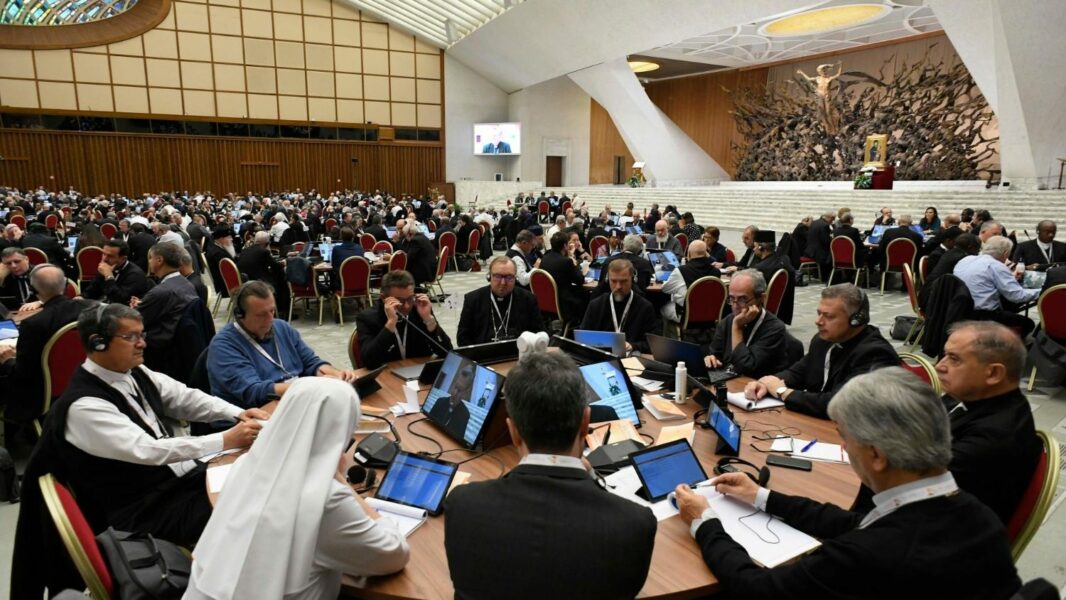
The reports delivered to Leo XIV propose expanding the participation of religious and laypeople in ecclesial structures and reforming the ad limina visits: the People of God would take part in preparing the report that bishops send to Rome, a diocesan delegation could accompany them, and an independent commission would periodically evaluate the process.
The General Secretariat of the Synod published on Tuesday, September 8, two reports containing concrete proposals to modify relations between bishops, consecrated life, and ecclesial groupings, as well as the conduct of ad limina Apostolorum visits.
The documents correspond to Study Group number 6, dedicated to relations between bishops, consecrated life, and ecclesial groupings, and to Group number 7, which examines various aspects of the figure and ministry of the bishop. From the latter, the second part has now been published, specifically devoted to the ad limina visits.
Leo XIV ordered the reports to be published in order to make the results of the work known. The General Secretariat of the Synod has made clear that “these are not decisions already taken”: the competent dicasteries and the Secretariat itself must turn the indications into operational proposals that will subsequently be submitted to the Pontiff.
“Gender equality” in agreements between dioceses and religious
Among the most concrete proposals of Group 6 is the establishment of binding contracts or memoranda of understanding between dioceses and institutes of consecrated life or societies of apostolic life. The document also includes mandatory mechanisms for mediation and conflict resolution.
The report calls for a common model for such agreements and stipulates that issues such as patrimony and remuneration be agreed upon “clearly and fairly.” It then proposes developing “a clear mechanism to implement gender equality in the workplace” and establishes that the resolution of matters related to this subject be subject to defined deadlines.
It also suggests making procedures for resolving conflicts through conciliation committees mandatory, particularly in patrimonial matters. These bodies would include representatives of the bishops and of consecrated life.
The Group further proposes common criteria for discerning the approval of new institutes and societies of apostolic life, as well as strengthening accompaniment for those congregations facing a decline in vocations, closures of communities, mergers, or issues related to their assets.
More religious in decision-making processes
The recommendations are not limited to contractual relations. The report proposes expanding the participation of consecrated persons in the decision-making processes of local Churches.
Among the proposals included is that consecrated life be present in consultative and decision-making bodies at both diocesan and national levels and have representation in episcopal conferences and other ecclesial structures, paying attention to “gender balance.”
The text expressly emphasizes that this participation must be “real and influential, not symbolic.”
It also proposes intensifying collaboration between episcopal conferences and conferences of major superiors through regular meetings and at least one annual encounter between bishops and superiors.
The Group even suggests that both bodies jointly prepare the ad limina visits, with the participation also of pastoral agents, and that upon the bishops’ return a pastoral assembly be organized.
Movements and new communities in pastoral plans
The report devotes another section to associations of the faithful, ecclesial movements, and new communities, whose presence it proposes integrating more systematically into the pastoral structure of the dioceses.
Among the possibilities mentioned are diocesan pastoral councils, consultations of lay associations, commissions of movements and associations, and synodal or diocesan assemblies. The document even includes as an “innovative hypothesis” the creation of a pan-ecclesial conference for bishops and lay leaders.
The Group likewise proposes leadership and decision-making training programs for members of these groupings, formation of seminarians on the lay vocation, and specific formation for bishops themselves on the characteristics of movements and new communities.
The People of God would participate in the report bishops send to Rome
The second document introduces far-reaching proposals regarding the functioning of the ad limina visits, which periodically bring bishops to Rome to meet with the Pope and the heads of the Holy See’s offices.
Group 7 proposes that the preparation of the report on the state of the diocese that precedes the visit no longer rest solely on the bishop and his closest collaborators.
The document invites the bishop to convene the People of God to participate “in a co-responsible manner,” through a process of ecclesial discernment, in its preparation. This process should involve priests, deacons, religious, and lay faithful, especially through the Presbyteral Council and the Diocesan Pastoral Council.
The results would subsequently be presented to the bishops of the ecclesiastical province or of the episcopal conference for a collegial evaluation before the trip to Rome.
If adopted, therefore, the document sent to the Holy See prior to an ad limina visit would incorporate a prior process of participation by various members of the local Church.
A diocesan delegation could accompany the bishop
The proposed changes would also extend to the stay in Rome itself.
The Group considers it “desirable” that a delegation from the diocese accompany the bishop during the visit, giving priority to those who have participated in its preparation. The local Church would be responsible for designating the representatives, and it would subsequently be determined in which of the meetings they could participate alongside the bishop.
The report even contemplates funding mechanisms to prevent dioceses farther from Rome or with fewer economic resources from having fewer opportunities to send representatives.
It also proposes that bishops make the visit in smaller groups and have more time for the meetings. Dialogue with the Holy See, the document states, should develop as an “exchange of gifts” and be “frank, cordial,” and reciprocal “rather than unidirectional.”
Regarding frequency, the Group proposes that visits take place at least every eight years, compared with the traditional five-year interval.
A specific report on abuse
The proposed reform also includes a specific mechanism related to abuse.
The report maintains that the ad limina visit should become the ordinary occasion for evaluating each local Church’s performance in the protection of minors and vulnerable adults.
Before traveling to Rome, bishops should present a specific report on this matter, which would also have to be examined during the visit with the Pontifical Commission for the Protection of Minors. The Group expressly links this mechanism to “transparent, public, and effective” communication.
Bishops would render an account upon returning from Rome
Group 7’s proposal also contemplates follow-up on what occurred during the visit.
The institutions of the Curia should prepare a report and transmit it to the episcopal conferences and to the Eastern hierarchical structures. For its part, each bishop, together with the faithful who may have accompanied him to Rome, would have to inform his local Church of the results through one or more public meetings.
When pending issues remain, telematic meetings could be held or even in loco visits by representatives of the Curia could be organized.
The report finally proposes periodically establishing an independent ecclesiastical commission charged with evaluating the entire process of the ad limina visits.
Leo XIV will still have to decide
The proposals come from the study groups established during the pontificate of Francis to deepen questions that arose during the Synod on synodality. Group 6 worked on the revision of relations between bishops, consecrated life, and ecclesial groupings, while Group 7 was entrusted with various aspects related to the episcopal ministry.
Cardinal Mario Grech, secretary general of the Synod, has summarized the criterion inspiring both documents by stating that “there is no mission without a conversion of relationships” and that between the bishop, religious communities, local Churches, and the Bishop of Rome the same dynamic must be applied: “one listens, one renders an account, gifts are exchanged.”