


The «state of necessity» has been the central argument of the Priestly Fraternity of Saint Pius X (FSSPX) to justify the episcopal consecrations celebrated last July 1 without a pontifical mandate. The issue has occupied a large part of the debate in recent months, but a more precise explanation was still pending of what the Fraternity understands by that necessity and, above all, why it considers that it continues to exist despite the presence of traditional communities in full communion with Rome.
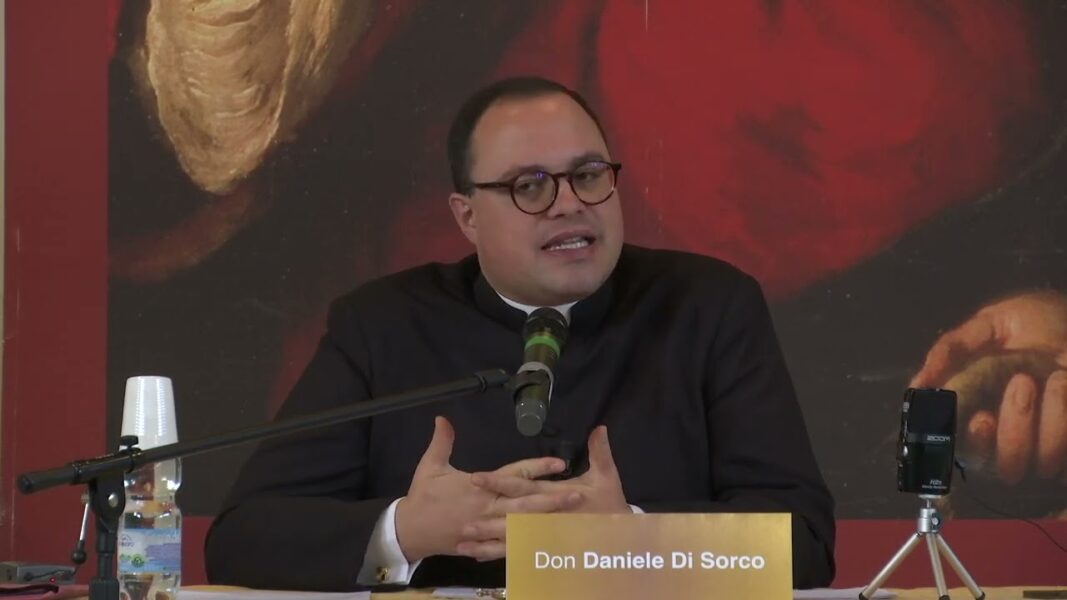
Father Daniele Di Sorco, a priest of the Italian district of the FSSPX, has now specifically addressed those questions in an intervention reported by the Catholic Herald. His explanation develops the argument formulated in February by the superior general, Davide Pagliarani, and responds to one of the main objections raised from the traditional world opposed to the new consecrations.
A danger to the faith of the faithful
Di Sorco starts from a general definition. A state of necessity appears when there is a danger to the body —physical necessity— or to the soul —spiritual necessity—.
The FSSPX maintains that there currently exists a grave and widespread spiritual necessity because, in its judgment, a considerable part of the clergy in regular canonical standing transmits erroneous doctrines or deficient moral teaching.
«They no longer teach the faith as they should,» Di Sorco maintains, specifically pointing to the doctrines derived from the Second Vatican Council and adding that, in the moral sphere, behaviors that would not be licit are sometimes presented as such.
The priest extends his argument to the sacramental and liturgical sphere. Even when the sacraments celebrated according to the reformed books are valid, he affirms, they are administered within rites that, in the Fraternity’s judgment, «no longer adequately express the Catholic faith.»
From this derives the central thesis: a faithful person who ordinarily resorted to those priests could find himself, according to the FSSPX, in danger of having his faith altered.
«It is clear that we are facing a situation of grave and common necessity, which the law assimilates to extreme individual necessity,» Di Sorco concludes.
This concrete explanation thus confirms what Pagliarani had maintained when he announced the episcopal consecrations. At that time he affirmed that «the objective state of grave necessity in which souls find themselves» required guaranteeing the continuity of the Fraternity’s work and went so far as to maintain that in an ordinary parish the faithful no longer generally find the means necessary to ensure their salvation.
And the traditional institutes in full communion with Rome?
The main novelty of Di Sorco’s explanation appears when responding to an argument especially relevant after the consecrations: if there exist priests and traditional institutes fully recognized by the Holy See, can it still be maintained that the faithful find themselves in a state of necessity?
Di Sorco responds affirmatively.
In his judgment, the priests belonging to the former Ecclesia Dei institutes constitute only «a drop in the ocean.» The existence of those communities would not, therefore, eliminate a necessity that the FSSPX considers «common,» that is, a situation in which the danger ordinarily presents itself in the majority of cases.
But his argument does not end with a numerical question.
Di Sorco points out that these institutes, at least in their official positions, have accepted the Second Vatican Council and recognized the legitimacy of the liturgical reform, although their priests habitually celebrate according to the traditional liturgical books.
According to his reasoning, resorting to them would not completely solve the problem denounced by the FSSPX either, because the risk of adhering in some way to what the Fraternity considers doctrinal errors would remain.
«It is clear that the state of necessity does not cease with the presence of a few priests who correctly teach doctrine or celebrate Mass according to the ancient rite,» he maintains.
This statement is particularly significant because Rome has precisely contemplated the traditional institutes in full communion as an alternative for those who wish to preserve the traditional liturgy without following the FSSPX. Before the consecrations, Cardinal Gerhard Müller went so far as to propose in the extraordinary consistory the convenience of recovering a structure similar to the former Ecclesia Dei Commission to welcome priests and faithful who might eventually leave the Fraternity.
Read also: Müller proposes in the consistory to recover a structure similar to Ecclesia Dei
A question that InfoVaticana already raised before the consecrations
The existence or not of that state of necessity was one of the main points of discussion in the weeks before July 1.
Cardinal Raymond Burke then rejected that the situation of the Church met the necessary conditions to justify the consecrations. InfoVaticana pointed out at that time a fundamental distinction between the de iure existence of the means of salvation in the Church and the de facto access that many faithful have to integral preaching, dignified liturgy, and adequate sacramental attention.
Di Sorco’s new explanation moves precisely in that second plane: it does not maintain that the means of salvation have disappeared from the Church, but argues that for a sufficiently large number of faithful it is difficult to ordinarily access them under the conditions that the FSSPX considers necessary.
Read also: The state of necessity, from a cardinal’s perspective
The «state of necessity» remains at the center of the conflict with Rome
The clarification does not resolve the canonical controversy. Rome has rejected the justification invoked by the FSSPX and, after the consecrations of July 1, the Dicastery for the Doctrine of the Faith declared that these had constituted the crime of schism and established grave canonical consequences for bishops, priests, and faithful who formally adhere to the Fraternity.
The FSSPX, for its part, has formally challenged the decree. On July 11 it filed the prior administrative appeal contemplated by the Code of Canon Law, while continuing to maintain that the sanctions are unjust and that the state of necessity must be taken into account to legally assess the consecrations.