


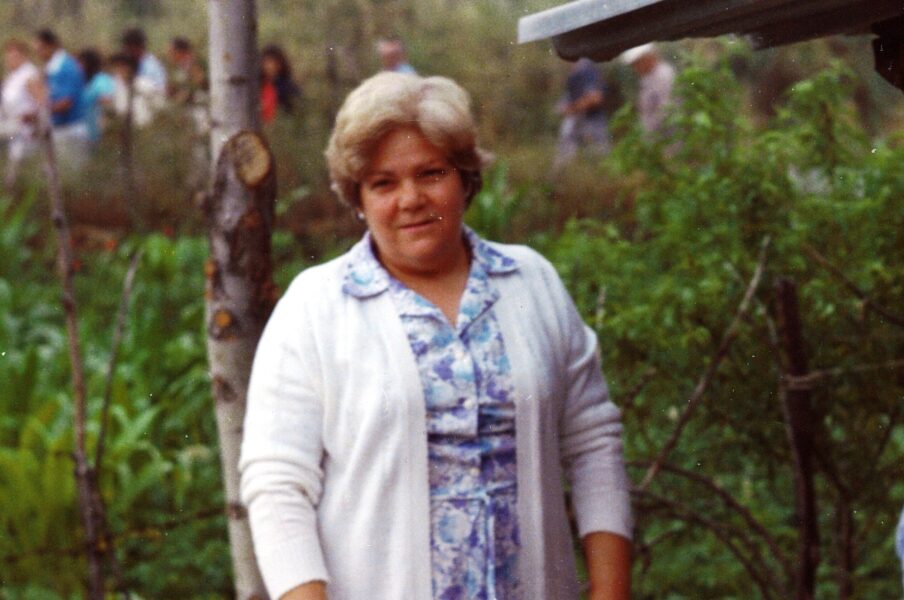
On any first Saturday of the month, in the Ave María nave, next to Prado Nuevo, some 50 kilometres from Madrid, the order of the acts is this. First a message is projected: the recorded voice of Luz Amparo Cuevas, who died in 2012, transmitting what the Virgin of Sorrows told her on another first Saturday twenty or thirty years ago; in April 2025 the February 2001 message was played. Then the rosary is prayed. Then Mass is celebrated, which the Public Association of the Faithful erected by the Archdiocese of Madrid has been authorised to hold there since 2009 and which is preached by the priests of the Work. At the foot of the altar, during that Mass, I have seen the seer’s portrait the size of a painting. On a poster in the same nave it is written that her book of messages is the most important after the Bible. And in the homily, Father Sergio Frades says that Luz Amparo is a saint, although the Church has not yet canonised her.
It is worth retaining the order, because it is the entire argument: the voice, then the Virgin, then Christ; the portrait, then the altar; the book, then the Bible; the priest, then the Church.
Those who cannot go to the nave can go to the official website, which says the same thing with greater candour. In the “Prayers” menu of pradonuevo.es the entries are, in this order, Jesus Christ, Mary, Saint Joseph, the Holy Spirit, the Eternal Father, Saint John Paul II, Angels and Luz Amparo. The last has a page titled without circumlocution “Prayer to Luz Amparo”. It is a regular collect: it reminds Christ that he made his handmaid “a partaker of the sufferings of your Passion and Death”, asks through her intercession for the grace to be faithful to one’s own vocation plus the personal petition each person wishes to add, declares the intimate desire to see her glorified by the merits of that participation, closes with “you who live and reign” and prescribes the Our Father, Hail Mary and Glory Be. The page carries no ecclesiastical licence, no clause of submission to the judgment of the Church, no warning of private use. It carries a linked image to print. The thesis of this column is that nave and website tell the same story: in El Escorial devotion has migrated from the Virgin to the seer, and not through an excess of the faithful but through the internal logic of the messages.
Because in Lourdes and in Fátima the seers disappear, Bernadette in Nevers, Lucia in Coimbra, and the message never speaks of them.
In Prado Nuevo the message speaks of her without stopping. There are more than three hundred texts, transcriptions of dialogues in trance, and in all of them the Virgin or the Lord address Amparo as “my daughter” hundreds of times, give her physical orders and comment on her life. “Kiss the ground, my daughter, in reparation” opens message after message for twenty years. In August 1990 she is ordered to drink a few drops from the chalice of pain and the official transcription notes in parentheses that she is heard swallowing and coughing. In February 1990: “I want you humble, very humble”. Already in 1980, before the first apparition, the Lord had set her the tariff: for each of her pains three hundred souls would be converted, and the stigmata that bled before the pilgrims every first Saturday were the coin of that exchange. And the message defends her. After the assault she suffered in the meadow in 1983, the Virgin speaks to her of “your three executioners”. In the midst of the war with the Town Council that fenced the estate, it asks that this place be watched against ungrateful men. And in 1990, when other seers came forward to compete, it settles the personnel question: “I took an instrument to communicate the universal message to the world”; the others are false prophets. Like the Gospa taking sides for the Franciscans, the Sorrowful Virgin of Prado Nuevo takes sides in a boundary dispute and in a competition of seers. The last message, 4 May 2002, rounds it off: there will be no more, but meditate on all of them, from the first to the last. A text that closes itself and orders its own meditation has done what in theology is called a canon; the Work has since published “the messages meditated”, in which it verifies, it says, their concordance with the Gospel. The text examines itself and approves itself.
And what do they say when they are not speaking of her? Mostly catechism, orthodoxy and phrases that no modern bishop would sign although they are totally Catholic: that Freemasonry has entered the Church; that perhaps one day the Body of Christ will not be consecrated because the priest does not make the intention, that “whoever does not believe in Mary will not enter the kingdom of heaven”; and some others somewhat delirious: that “only seconds remain before the Chastisement comes”, in February 1983, and we have had forty-three years of seconds; that on All Souls’ Day 1996 the souls in purgatory came out through the meadow “in a throng”. And, above all, a catalogue of promised catastrophes, cloudbursts, hurricanes, earthquakes, seas overflowing, spread over twenty years of first Saturdays.
On 9 November 2024, ten days after the DANA in Valencia, with more than two hundred and thirty dead still not fully buried, Father Frades went up to the nave’s ambo with a little book of messages, looked for one from November 2000 that announced cloudbursts and nations buried under rubble, asked the faithful what date it was from, and explained that what happened in Valencia, and the volcano in the Canaries, and some earthquake or other, were purifications that God permits and uses to save souls; that saying so was not politically correct, but it had to be said; that “it is not threatening or frightening, it is a reality”.
The homily is on the official YouTube channel and was reported in the national press in January 2025.
The delirium is not in the messages, which are so vague that twenty-four years of rain in Spain are enough to fulfil them. It is in the use: a Catholic priest replacing the lectionary with a booklet of private revelations to explain two hundred and thirty deaths. But as soon as one enters the Nave it is clear: “The most important book written after the Bible”.
When Christ was told about the eighteen crushed by the tower of Siloam, he said two things: that they were no more guilty than the others, and that unless you repent you will all likewise perish. Frades kept the second half and put the seer in place of the first. The Gospel denies the arithmetic of punishment; Prado Nuevo preaches it with a message date.
The construction of the saint has not needed to be improvised: it is in the official biography. She was baptised Luz and called Amparo by her godmother, and according to her biographers she was unaware of it all her life until in the first apparitions she heard the Lord call her Luz; so that “your handmaid Luz Amparo”, the vocative of the prayer, is a name that exists only if the apparitions are true. The biography lists her charisms as one would inventory a sacristy: bilocation, cardiognosis, prophecy, healing, assumption of others’ illnesses, osmogenesis or supernatural perfume, multiplication of food, thirty-one years of stigmata.
She died, it says, at the ninth hour, the same hour Christ died, and on a Friday, the last of her prolonged passion, and she died in the odour of sanctity, a formula the same page applies to her spiritual director. The death of her son in 1996 figures in the chronology as a martyrdom for the Work, without any judicial cause being recorded. There is a little pocket book of thoughts of Luz Amparo, ideal for daily meditation, and in 2026 a new book of her life whose title repeats the epitaph on the tomb, next to the site of the demolished chapel: “She is the one who taught us to love”. In a Christian cemetery that phrase has only one owner, the one who first loved us, and here it has been given to her. When the family wanted to move the remains after the demolition, in 2020, the followers objected in writing: moving them would harm the direct petition of the faithful before the tomb and the future opening of the beatification process. The page adds, by way of discharge, that it will be the Church that pronounces on her possible sanctity. They leave the Church the decree, which is the least of it.
Here it is worth being exact, because the word idolatry is strong. It is not idolatry in the sense of the catechisms: no one in the Ave María nave adores Amparo Cuevas as God. It is something older and more Spanish: the saint of the house before the saint of the altar, the seer before the Virgin, the voice before the Word. The prophets called idolatry any cult that occupies the place of another. And the law of the Church distinguishes little more. Canon 1187 reserves public cult to those whom the authority of the Church has inscribed in the catalogue of saints and blesseds; a prayer said at home is not public cult, and asking the intercession of a deceased person with a reputation for sanctity is permitted, is in fact the presupposition of every cause. What the Church prohibits before beatification are public signs, the portrait on the altar, the invocation in the liturgy, and it prohibits them to the point that every cause must verify, before anything else, that such cult does not exist.
That is why the prayer on the website is doubly revealing. First, by its genre: it is the typical prayer of the Servants of God with an open cause, without the title, without the licence that praxis requires of images as canon 826 requires of prayer books, and without the clause “if it be your pleasure” that leaves the outcome to God; it does what a cause would do, produce fame and attributed graces, without there being a cause, and it does so from the institution that one day will present them. Second, by its premise: “partaker of the sufferings” admits the Pauline reading, valid for any grandmother, and the Prado Nuevo reading, which are the stigmata; and the merits by which it asks her glorification are those of that participation. The prayer makes whoever recites it affirm, before God and as a premise, that the stigmata were the work of God, which is exactly what the Church says is not established. Each piece is defensible separately: the tomb for the direct petition, the image for the petition at a distance, the biography for the reputation, the portrait for the altar, the homily for the verdict. Together they constitute a cult. And a cult is the only thing that can prevent the canonisation they ask for: if one day a bishop were to open the cause, the first thing he would have to do is order the removal of the painting.
Hence the value of Frades’ phrase. “She is a saint, but the Church has not yet canonised her”. The adverb is the tense of Prado Nuevo. The Work displays a letter from Suquía of 1986 in which the cardinal qualifies his note of 1985: the Church has only said that it is not yet established. It is not yet established that the apparition occurred, the seer is not yet canonised, there is not yet a chapel. The “yet” turns every silence of the Church into a delay and every no into a not yet. And the one who pronounces it from the ambo is not an exalted pilgrim. He is a priest of the Work who has served as parish priest in Santa María de la Alameda, in the same archdiocese, and who preaches at a Mass that Cardinal Rouco authorised in that same nave in 2006 and for all first Saturdays since 2009, in a place to which the Archdiocese allowed the clergy to go in 2010, for an association whose chaplains the archbishop has appointed since 1994 and which acts, by canon 315, under the high direction of the authority that erected it. In September 2024 Cardinal Fernández placed El Escorial in the category of curatur, whose first instruction to the bishop is not to encourage the phenomenon and to seek alternative forms of devotion. The alternative forms of devotion practised in Prado Nuevo are the portrait of the foundress at the foot of the altar and the DANA as the reading of the day. The Archdiocese repeats that it has never recognised anything supernatural there. That is true and irrelevant: what it has recognised is everything else, and two lines would suffice, to remove the painting and the image or to license them with the clause they lack. Neither of the two has been written, as far as is known.
There remains the poster, which is the most serious and the least visible. The Catechism, in its number 67, teaches that private revelations do not belong to the deposit of faith, that they neither improve nor complete the definitive Revelation of Christ and that they serve to live it better in a given epoch. Ratzinger, commenting on the secret of Fátima in the year 2000, summed it up in a textbook phrase: a private revelation is a help that demonstrates its credibility precisely by returning us to public Revelation. A poster that declares the book of messages the most important after the Bible does the opposite: it places the voice of a woman from Peñascosa above the Fathers, the councils and the Catechism I have just cited, in the place where that voice is projected before the rosary and before the Mass, and where a priest reads it instead of the Gospel is the pretension of a second deposit, and a private revelation that says that of itself has answered on its own account the question the Church has spent forty-one years without answering. It is not established that it is supernatural. What is established is what it wants to be.
Let no one read here an attack on Luz Amparo, surely a good woman and her work, of residences and families devoted to a life of prayer, is unquestionable. This is an analysis of the pertinence of the cult, it does not pretend to judge anyone’s sanctity of life.