


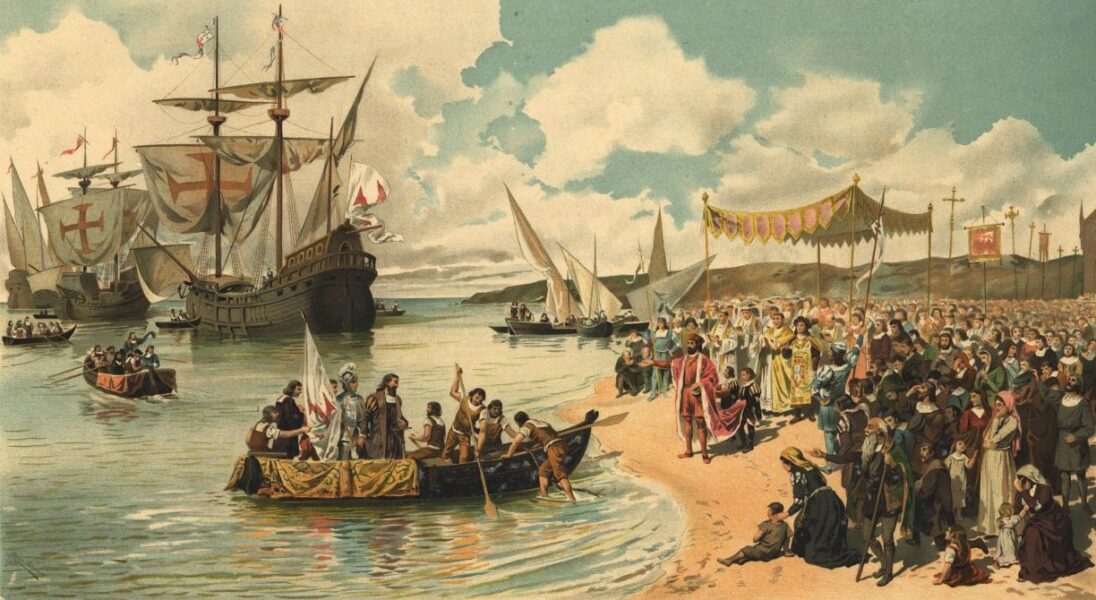
“In August 1415, a Portuguese fleet crossed the Strait of Gibraltar and assaulted the Muslim port of Ceuta, in Morocco, one of the most heavily fortified and strategic strongholds in the entire Mediterranean. Its capture astonished Europe. At the beginning of the fifteenth century, the Portuguese population did not exceed one million inhabitants” (Roger Crowley).
We begin this new section, “Christendom or Modernity: a Christian Vision of History,” with a brief series on the expansion of Portugal into the Indian Ocean, the evangelization of the Portuguese colony of Goa, and the migration of Goans from India to East Africa during the nineteenth and twentieth centuries, with the consequent formation of diasporic Catholic Indo-Portuguese minorities in various African contexts.
The history of events (a technical term coined by the Annales School to refer to the history of occurrences) will be addressed as a historical and geographical framework, in order to treat the underlying ideas, a history of thought, of Christendom, of the irruption of Modernity and of its disastrous consequences.
1.-The Portuguese Crusade toward the Indian Ocean:
Portuguese participation in the Reconquest of the Iberian Peninsula began with the founding of the County of Portugal in the year 868, when it was won by the Christians, and continued until the year 1249, when the last cities under Muslim control in the Algarve were taken. During that time, Portugal went from being a county to becoming a fully independent kingdom in the year 1139, an independence confirmed in 1179 by Pope Alexander III. On the foundations of this small kingdom that looked out onto the vast Atlantic Ocean, the Portuguese Empire would be constituted.
In 1415, while the kingdoms of Castile and Aragon, Portugal successfully undertook its first crusade adventure with the assault and capture of the city of Ceuta, in the Strait of Gibraltar. In a foretaste of what would become the subsequent Portuguese exploratory pattern, the king directed the conquest of the city of Ceuta, through which much of the trade in the strait passed.
The commercial question is cited by most historians to explain Portuguese expansion toward the western and eastern African coasts in the fifteenth and sixteenth centuries. However, once we understand the context in which it occurred and the arguments of the Portuguese themselves at the time, we are in a position to understand that the main factor was the crusading mentality: the struggle against Islam. The peninsular kingdoms were in the midst of the Reconquest. Portugal, liberated from the Muslim yoke before Castile, took to the seas. In this sense, it cannot be considered coincidental that the first objective was Ceuta: not only for its trade, but for its easy access to the Iberian Peninsula from the strait.
History as a scientific discipline is the daughter of the time that saw its birth, the nineteenth century, with a positivist and immanentist mentality that makes it impossible to understand the mentalities prior to the Enlightenment, in which the religious dimension was decisive for actions. That the capture of Ceuta had economic ends would leave unexplained the element charged with symbolism of how King John I of Portugal renamed the mosque of Ceuta, which had first been ritually cleansed with salt, as “Our Lady of Africa,” and there knighted his three sons, the princes Duarte, Pedro, and Henrique.
It is also true that caravan routes from the East and the heart of Africa reached Ceuta.
For all these reasons, the best-selling historian Roger Crowley admits in his work Conquerors that the crusading enterprises against the Muslims in North Africa were deeply interwoven with Portugal’s maritime adventure.
After the capture of Ceuta, the Portuguese launched themselves into the Atlantic Ocean and between 1419 and 1456 made the first incursions into Macaronesia, the collective name for the archipelagos of the Azores, the Canaries, Cape Verde, Madeira, and the Savage Islands. From these islands, the Portuguese, in expeditionary enterprises always sent by the Crown, constantly improving their shipbuilding techniques and the behavior of ocean currents and winds, descended along the western coast of the African continent. In 1460 they entered the Gulf of Guinea and established themselves on the islands of São Tomé and Príncipe.
It appears that the kingdom of Castile, still in the midst of the battle for the expulsion of the Muslims from the peninsular territory, also sent explorers to these African regions, leading to a confrontation between the two kingdoms in 1478, which ended with a Portuguese victory.
Historiography insists fundamentally on the economic motives of the expansion, especially the search for an alternative route for the spice trade, once the land route had been taken by the Muslims after the fall of Constantinople in 1453. However, one may ask whether, as Fr. Javier Olivera Ravasi has well explained in his trilogy Que no te la cuenten: la falsificación de la Historia, Columbus’s idea of entering the Atlantic toward the west was framed in the crusading mentality to reach the Holy Land and attack the Ottoman Turks from behind, this would not also have been the motivation of the Portuguese, since we are talking about Christian monarchies with a similar expansionist idea, although the Portuguese one was earlier: to find an alternative route to the east blocked by the Moors, but not simply to trade, but to eliminate Islam. Very significant details of the account of Portuguese expansion will confirm, as we shall see, this thesis.
The inability of the modern mentality to read situations from the perspective of men of other times, especially with regard to the religious question, is not shared by contemporary Muslim historians, as we can see in the interesting article by Professor Nazeer Ahmed on “the Portuguese devastations in the Indian Ocean,” who clearly states that “the discovery of America and the circumnavigation of Africa were logical consequences of the religious-political rivalry between the Christian powers of Iberia and the Muslim powers of North Africa. As the Maghreb disintegrated, the Christian powers of Iberia, with the cooperation of the maritime powers of Italy, consolidated their positions and projected their power far beyond the borders of the Iberian Peninsula. Religion and profit were the main motivations of the Luso-Spanish thrust. Christian fanaticism was expressed through the Spanish Inquisition.”
Between 1473 and 1482 the Portuguese advanced southward along the western African coast, while making incursions along the course of the rivers into the interior of the continent. Upon setting foot on land, the Portuguese planted on the shore what they called a “padrão,” a stone pillar crowned by a cross on which the year of arrival, the name of the king, and the name of the discoverer were indicated. The monument was carved in Portugal and was carried on the vessels that departed, having carefully considered the latest cartographic discoveries and carefully setting the objectives of the expeditions.
Ptolemy had drawn the Indian Ocean as a sea enclosed between the lands of an African coast that extended eastward, but there were also voices that spoke of the African continent as having a triangular shape from which, once the south was rounded, one could advance by sea toward India. That was the objective of the Portuguese, as the authors emphasize, although they also intended to find the almost mythical Prester John, a Christian king in the highlands of Ethiopia, with whom to ally themselves to penetrate the eastern end of the Mediterranean Sea toward the Holy Land. With this idea the expedition of Bartolomeu Dias set out, which in 1488 succeeded in rounding the southern tip of Africa. Dias reached Kwaaikoek, planted a padrão, and undertook the voyage back to Portugal. Simultaneously, the explorer Pedro Covilhã had been sent by the king of Portugal across the Mediterranean to meet Prester John.
In 1491, the heir to the throne of King John II of Portugal, Afonso, died in a riding accident, leading to a succession crisis. It was soon determined that the crown would go to Manuel, Duke of Beja, cousin of John II, who was crowned in 1495. Three years earlier, Christopher Columbus had arrived, in the name of the crown of Castile, in the Caribbean, after having tried to negotiate for years, without success, with the king of Portugal. And a year earlier, in 1494, in the face of the tension that was developing between Portuguese and Spaniards over the discovered territories, the Treaty of Tordesillas was signed, which was sanctioned by the Pope, with which it was intended to avoid any future friction by having these two Catholic powers agree in advance on who would claim which territories: Portugal had access to the territory east of the imaginary line located 370 leagues west of the Azores, while Spain had access to those to the west. That is: the Supreme Pontiff of the Church made a donation of the territories, since he received the general recognition of Christian sovereigns over infidel territories in which no prior right had been established, by virtue of what the canonists called his “immediate and universal jurisdiction.”
Before analyzing the various expeditions of Vasco da Gama to India, it is very pertinent to pause to consider the ceremony of departure, following the detailed description of Roger Crowley, based on the chronicle of João de Barros: “In the middle of the summer of 1497, the expedition was ready: the sails emblazoned with the red cross of the Order of Christ, the cannons rolled aboard, the heavy guns in position, and the crews assembled. The small flotilla left the shipyards and anchored off the beach of Restelo, a fishing village downriver from Lisbon. In the midst of stifling heat, King Manuel had retired to his castle of Montemor-o-Novo, and it was there that Vasco da Gama and his captains went to receive the sailing instructions and the ritual blessing of the king. On his knees, Gama was solemnly invested with command of the expedition and a silk banner with the cross of the Templars. He was given instructions: to seek the Christian kings of India in a city called Calicut and to establish a spice trade. He had a letter for the king of Calicut and another for Prester John. The mission was both sacred and secular, with crusading overtones mixed with commercial rivalry. Restelo, on the banks of the Tagus, outside the city walls, had been the traditional point of departure for Portuguese travelers since the days of Henry the Navigator; its gently undulating beach offered a broad stage for religious ceremonies and the emotional rituals of departure. At the top of the hill, overlooking the broad escarpment of the Tagus leading west to the open sea, stood the chapel of Henry, dedicated to Santa Maria de Belém (on which the Jerónimos Monastery would soon be erected), in order to administer the sacraments to the departing sailors. The entire crew, some 150 men, spent the hot summer night there in prayer and vigil. Saturday, July 8, 1497, the day consecrated to the Virgin Mary (Saturday), had been chosen by the court astronomers. A month earlier, the Pope had granted Manuel perpetual ownership of the lands conquered from the infidels over which other Christian kings no longer had claims. Gama led his men in a devotional procession from the chapel to the beach, organized by the priests and monks of the Order of the Temple. The sailors wore sleeveless tunics and carried lighted candles. The priests followed behind, chanting the litany, and the people responded with shouts. When they reached the shore, all knelt to make a general confession and receive absolution, according to the papal bull that Henry had obtained for those who died in this discovery and conquest.”
2.-Vasco da Gama in the Indian Ocean. Swahili civilization:
Vasco da Gama’s expedition to India, composed of four ships, set sail in the summer of 1497, following the same route as Bartolomeu Dias. At the beginning of 1498, having crossed the southern tip of Africa by sea, the expedition began to ascend the eastern African coast, and everyone soon realized that the panorama they encountered was totally different from that of the western coast: a more densely populated coastline, with its inhabitants more accustomed to seeing foreigners arrive on their shores, with urban enclaves, in some of which the minarets of mosques stood out. The Portuguese carried Arabic-speaking interpreters, making communication with the locals possible. The Portuguese had reached the southwestern margin of Swahili civilization, part of an Indian Ocean that can be conceived in this period and for many centuries before as a cultural whole based on cultural exchanges and the creation of family ties, partially Islamized and with the presence, at the same time, of different cultures within it. The consideration of the Indian Ocean as a cultural whole is based on the study of coastal urban centers dedicated to trade, politically independent, that developed on the Indian coasts, with shared dynamics, comprising all of East Africa, the Arabian Peninsula, the Indian subcontinent, the Malay Peninsula, Indonesia, and the southern sectors of the Philippines. In this vast zone, between the tenth and fifteenth centuries—as written sources and archaeology have demonstrated—a cosmopolitan civilization had been developing, the fruit of migratory processes and commercial exchange over which no zone held a monopoly.
Before these independent city-states of Afro-Muslim culture, the Portuguese found themselves on the eastern coast of Africa. The first landing took place on the coast of present-day Mozambique, in March 1488. It was a fully-fledged commercial port in which, according to the ship’s log, they found rich Muslim merchants dressed in costly clothes and the finest jewels. The local inhabitants initially thought the visitors were Turks, and the Portuguese, noticing the detail, did not attempt to dispel the misunderstanding. Two expert navigators embarked with the Portuguese to help them sail to India but, once they realized they were Christians, fled to the coast and the word spread like wildfire that they were kafir, “infidels.” Then began the so-called “gunboat diplomacy,” in which the Portuguese advance toward India was marked by incidents and violence. Portuguese ships were far superior in armaments technology to the local populations, so they were able to dock in the various ports to take on water and food, defending themselves from hostilities. Thus they arrived at Mombasa, in southern present-day Kenya, which was then a prosperous commercial city. In mid-April of the same year 1498 they arrived at Malindi, another Islamized commercial enclave. Sailing from there, in a few weeks they reached India, at the end of May. There, the Portuguese found some merchants capable of speaking Spanish to whom they responded, to their question about what they were seeking in those distant territories, “Christians and spices.”
Along the way, the Portuguese lost the opportunity to realize their crusading dream: to assault the Red Sea, take Saudi Arabia, and march to Jerusalem: their ancient enemies, the Mamluks, who had ruled from Cairo, had been deposed by the Islamic Ottoman Empire. With its head in Istanbul (Constantinople), the Ottomans of the late fifteenth century were a force to be reckoned with.
The architect of this empire, which reached as far as Macao, in China, was King Manuel I (1469–1521), who, according to Crowley, “had a messianic vision, believed he was going to be a great Christian king. He was more interested in converting India into a base for attacking Islam than in developing trade,” the historian explains, going on to say that “his plan was to join with the mythical army of Prester John (in the highlands of Ethiopia) to launch a crusade on Mecca, kidnap the body of the Prophet Muhammad and demand in exchange Jerusalem, at that time in Muslim hands; they thought to economically strangle the Ottoman Empire through a naval blockade. But his plan never worked, although Portugal took, throughout the sixteenth century, the main ports of the Red Sea and the Persian Gulf.”
3.-Vasco da Gama’s Arrival in India:
Thus it was that Vasco da Gama arrived at Calicut, on the southwestern coast of the Indian subcontinent, in 1498, becoming the first European to reach India by the route that rounds Africa.
Calicut was one of the main points of the spice trade in India and was governed by a figure similar to a king. After difficult negotiations, as the local ruler did not consider the Portuguese gifts of sufficient quality, Vasco da Gama managed to reach some commercial agreements with the kingdom of Calicut and obtained a letter written on palm leaf by the Indian ruler himself, addressed to the king of Portugal, in which he offered cinnamon, pepper, cloves, ginger, and precious stones in exchange for gold, silver, coral, and purple cloths.
Having succeeded in establishing an agreement and leaving some of his men there in order to establish a permanent trading port, Vasco da Gama set sail back to Lisbon at the end of August 1498. They arrived in Portugal almost a year later, with an exhausted Vasco da Gama who was received by King Manuel I, who granted him the title of Admiral of the Indian Sea and a charter of absolute freedom to trade on his own account.
Now recovered, in 1502, Vasco da Gama embarked again for India.
Bibliographic references
Abellan, P., 2002. “Introduction to the study of the Indian Ocean as a cultural whole. Historiographic revisions and new proposals.” Research for the DEA, 2000/2002.
Crowley, R., 2005. “The Sea Without End,” ed. Ático Libros.
Elías de Tejada, F., 2021. “The Roots of Modernity,” Carlist Studies Collection, Solfanelli.
Iniesta, F., et al., 1989. “Report: Unknown Africa, the Swahili,” Historia16, year XIV.
Olivera Ravasi, J., 2018. “Que no te la cuenten. The Falsification of History.” Vol III. Ed. Katejon