


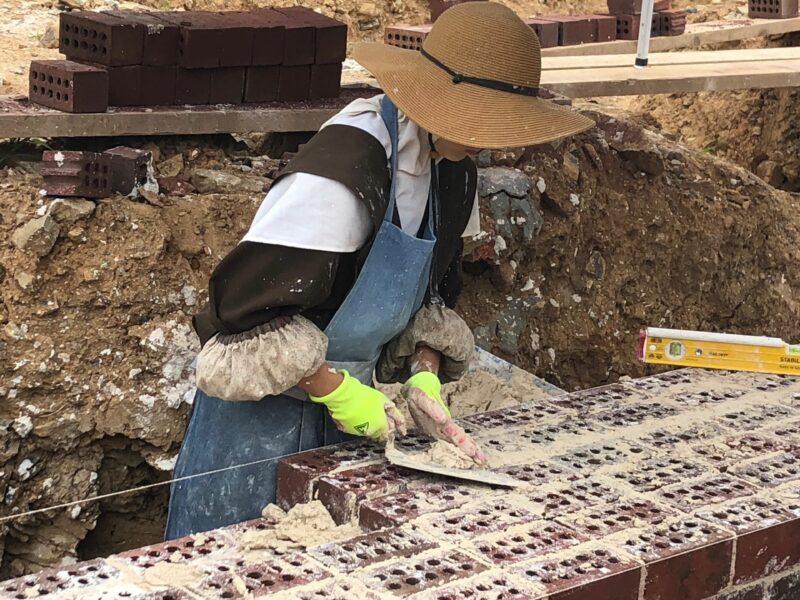
The growth of vocations has led a community of Discalced Carmelite nuns in Fairfield, Pennsylvania (United States), to build a new monastery using traditional construction techniques and designed to stand for generations. The nuns, who maintain a traditional observance of Carmelite life, hope the building will “last a thousand years.”
The sisters of the Carmel of Jesus, Mary and Joseph had run out of space in the 1940s monastery where they previously lived. With the arrival of new vocations, they undertook a project that revives traditional stone masonry and carpentry, with a budget reaching 100 million dollars, as Catherine Bauer, the community’s communications and development officer, explained to EWTN News.
Work began more than a decade ago and is currently about 20% complete. So far, the nuns have raised around 22 million dollars.
A traditional community that ran out of space
The Carmelites arrived in the Diocese of Harrisburg in 2009 from the Carmel of Valparaiso, Nebraska, and initially settled in an old monastery in Elysburg. The community’s subsequent growth made those facilities insufficient.
The Carmel’s own history recounts that the lack of space even forced them to convert work, dining and recreation areas into rooms to house new postulants.
With the permission of the then Bishop of Harrisburg, Ronald Gainer, the community purchased land in Fairfield, Adams County, in 2012. There the new monastery began to take shape; its cornerstone was laid in 2016, and the founding nuns moved in in 2018.
The community follows an observance inspired directly by the reform of Saint Teresa of Jesus and Saint John of the Cross, with strict enclosure, the full Carmelite habit, fasting, mental prayer and a life marked by austerity. The nuns also maintain the traditional Constitutions of the Order and celebrate the liturgy primarily according to the books in use before the liturgical reform.
Stone and wood for a monastery built to last centuries
The construction deliberately departs from many contemporary architectural practices. The nuns have chosen artisanal stone masonry and timber-framing techniques and seek to use natural, locally sourced materials.
“It’s more about the stonework, the authenticity of building from scratch without nails, without glue and without electricity running through the building,” Bauer explains. Water and plumbing systems have also been designed, as far as possible, using traditional methods.
The complex will be relatively modest in size, yet conceived as a monastery capable of sustaining the community for generations. It will include a chapel, refectory, novitiate, quarters for the professed nuns, housing for the chaplain and the spaces necessary for enclosed life.
Some of the stone and timber used comes from the area. The nuns also cultivate their land, keep animals and perform various manual tasks within a Carmelite vision that seeks to recover elements of self-sufficiency as well.
The high initial investment stems precisely from the desire to build for the long term. “The idea is that, during the next twelve or fifteen years it will take to build, once finished, this building will require little or no maintenance for future generations,” Bauer notes.
In this way, the community hopes to avoid having to continually replace roofs, walls and structural systems in the coming decades. The project’s overarching goal is especially ambitious: to erect now a monastery that can serve the Carmelites for the next thousand years.
A historic altar recovered for the Carmel
The commitment to tradition is not limited to the building’s structure. The community is also recovering elements from former Catholic buildings to incorporate them into the new monastery.
One of these is a marble altar that originally belonged to Saint Charles Borromeo Seminary. It was installed in the Carmel’s oratory, dedicated in 2024, and during that ceremony a particular coincidence occurred: Bishop Emeritus Ronald Gainer revealed that decades earlier he had celebrated his first Mass precisely at that altar.
“We are trying to save many of these things,” Bauer explains regarding the recovery of altars, stained-glass windows and other objects intended for worship. The oratory will serve as a provisional chapel while construction of the definitive church continues.
“Their mission is to pray for priests and for the Church”
The project will allow the nuns to maintain their enclosure while providing spaces from which the faithful can attend Mass, receive the sacraments and come to pray without interfering with the community’s contemplative life.
Bauer explains that the monastery is intended to become “a beacon of light” for the area and “a source of grace, consolation and holiness,” even though the nuns remain hidden from the world behind the enclosure.
The community places at the center of this contemplative life prayer for the Church and, in particular, for priests. “The Carmelite charism is to pray for priests,” Bauer states. “That is their whole mission: to pray for priests and for the Church.”
“They are the heart of the Church,” she adds. “They are the ones who keep the blood circulating through the rest of the Church’s body.”