


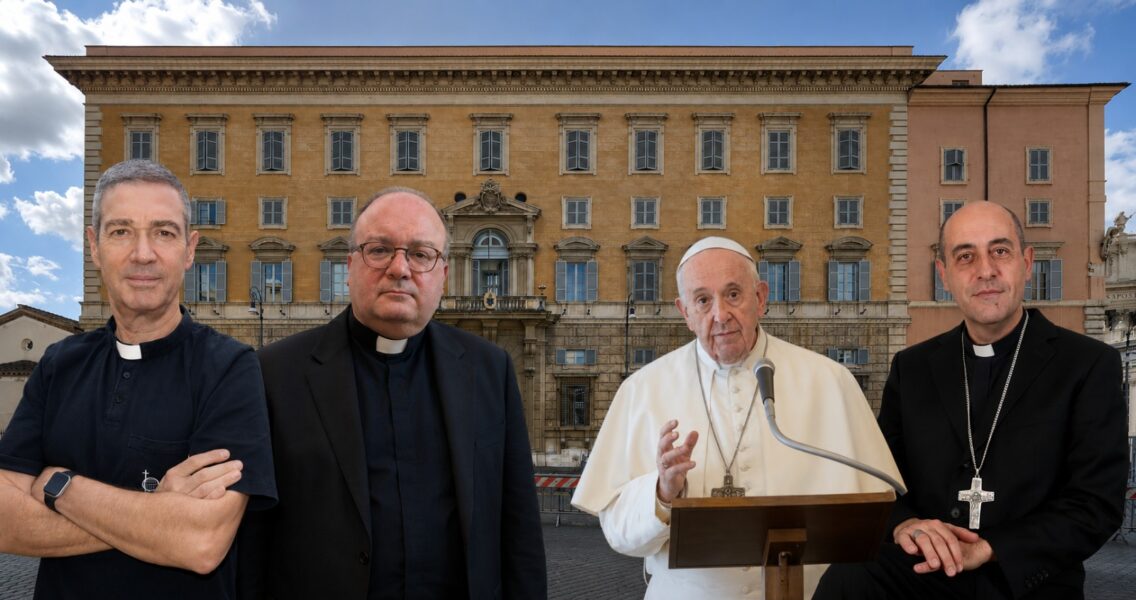
There exists in the Church a way of ending procedures for abuse of minors that does not involve a sentence, does not establish facts, does not hear the victim and leaves no public trace. In my brief period providing legal defense for some victims of sexual abuse by clerics, I have come up against a practice unthinkable in any other sphere. The investigated cleric requests from the Pope the dispensation from clerical obligations; if granted, the criminal process stops there. According to internal data from the Dicastery for the Doctrine of the Faith itself, 1,058 of the 6,236 cases registered between 2012 and 2020 ended this way—one in six. Behind each of these files is one or more persons who reported having been abused in their childhood and to whom the Church never said whether it believed them. Investigating this absurd and scandalous practice in depth, I discovered that it is not a bureaucratic anomaly or an improvisation by overwhelmed dioceses. It has a written doctrinal justification, published in a top-tier academic journal and signed by one of the men who apply it: Monsignor Jordi Bertomeu Farnós, an official of the Disciplinary Section of the Dicastery, Pope Francis’s envoy to Chile and Peru, pontifical commissioner of the Sodalicio, and one of the main promoters of this catastrophic legal concept that, to this day, is being applied (I will explain why I believe irregularly) by the Dicastery of Cardinal Victor Manuel Fernández. His 2021 article is today the theoretical support for a practice that causes scandal even among high-ranking Vatican judicial authorities.
The text is titled “The CDF’s praxis on the dispensation from clerical obligations: n. 157 of the Vademécum” and was published in Ius Canonicum, the canon law journal of the University of Navarra (vol. 61, no. 122, 2021, pp. 733-765; DOI 10.15581/016.122.004). It is open access and continues earlier work by the same author in the same journal. Who writes it matters: an official of the body that decides, with access to figures no one else knows, who describes the practice of his own office and concludes that it is legitimate. That turns the article, more than a study, into the unofficial defense of a system of silence and impunity.
What Bertomeu maintains
The point of support is n. 157 of the Vademécum of 2020, which recognizes the accused, “from the moment notitia de delicto is received,” the right to ask the Holy Father for dispensation from all clerical obligations, including celibacy. The Vademécum stops there: it recognizes a right to request, and says nothing about what happens to the ongoing criminal process. It is Bertomeu who takes the next step, and he takes it in the very summary of his article:
“Although it interrupts the investigative proceedings or the ongoing process without reaching a conclusion regarding the guilt or innocence of the accused, the processing before the Holy Father of this grace is legitimate because of the protection of various legal goods in the delicta graviora from the prevalence of the principle of the bonum commune in the Church” (p. 733).
He reiterates it in the body of the text with the same clarity: the CDF allows the accused to request the grace “at any moment of the investigative or procedural proceedings,” and “the acceptance of said request, moreover, entails the interruption of the ongoing penal procedure” (p. 749). The thesis, therefore, is that the accused can stop his own process by asking to cease being a priest, and that the Church does well to allow it for the “good” of the Church itself.
What Bertomeu knows
What makes the article especially serious is not that it defends this thesis, but that it defends it knowing exactly what it implies. Impunity and victims left unattended without reparation. Bertomeu does not ignore any of the objections; he sets them out himself, with juristic precision, before discarding them. It is worth following the thread of his admissions.
The article begins by acknowledging that there is no law that supports what it describes. The institute “is not expressly contained in any legislative text on the delicta reservata” (p. 741), and the Vademécum on which it is based “does not constitute a further legislative reform” nor is “a normative text” (pp. 740-741). To overcome the obstacle, he proposes that “notwithstanding the non-normative character of the Vademécum, the content of n. 157 can be considered as a praxis with normative value because of the specific endorsement of the Roman Pontiff to each granted dispensation” (pp. 741-742). In other words, a rule that is nowhere acquires the force of law because it has been applied many times with papal signature. No serious legal system, and canon law should be no exception, admits that in penal matters the repetition of singular acts creates law: the law exists when it is promulgated (can. 7), penal norms are interpreted strictly (can. 18) and the praxis of the Curia only fills gaps and never in matters of penalties (can. 19). Bertomeu knows these canons. He cites them. And despite them he constructs the plan of evading the process through dispensation.
He continues by acknowledging what happens to the victims: the interruption “not only avoids reaching an authoritative declaration on the guilt or innocence of the accused, but inevitably entails that the alleged victim cannot see the harm caused by his or her aggressor repaired” (p. 751). Inevitably. The author of the thesis describes its effect on the victim with the word that best defines it, and maintains it.
He also acknowledges that he finds no reason that would justify the grace. Every canonical dispensation requires a just and reasonable cause (can. 90 §1), and Bertomeu himself recalls, citing Urrutia, that without it “it could even be invalid” (p. 742). Despite this, he admits that “the difficulty remains of indicating what the just and reasonable cause may be that allows this gracious concession without prejudice to justice” (p. 751). He therefore maintains the legitimacy of an act whose condition of validity he confesses he cannot identify with certainty.
He also acknowledges that all this occurs in secret. “Unlike other tribunals such as the Roman Rota, the CDF does not publish its decisions,” which “leaves important formal (procedure and processing) and material aspects in the dark” (pp. 738-739). He writes this as an official of the body that does not publish, in a text that begins by invoking the “transparency, responsibility and accountability” of the February 2019 summit, and that immediately afterwards justifies a practice that lacks all three.
And he acknowledges, with figures that few can provide, that this is not an exception. “If between 2012 and 2020 6,236 cases were registered at the CDF, 1,058 concluded with the granting of a dispensatio ab oneribus, with an annual average of 117, that is, 17% of the total” (p. 750); dispensations went from 79 in 2012 to 179 in 2020, more than double in eight years. Translated: more than a thousand cases of abuse of minors that reached the Church’s supreme tribunal have been closed without anyone establishing what happened, and the pace is increasing, including the controversial dispensation of Leo XIV to Eleuterio Vásquez, the priest from Chiclayo whom he himself should have investigated. Behind those thousand files are, at minimum, a thousand people who reported and received no response. Probably more than one per file. Thousands of men and women, in any case, to whom the very system that encouraged them to report later denied them truth and reparation in exchange for a poor legal trick.
Finally, Bertomeu records in a footnote the most devastating objection against his own thesis, formulated by canonist Luis Navarro: “it would be more coherent that a crime not receive a grace; otherwise one could think that, to obtain exoneration, the path is to commit a crime, which would certainly be a cause of scandal among the faithful” (note 65). The citation is devastating, but the author does not answer it. It is difficult to find in canonical literature a clearer example of an author who sets out the argument that refutes his thesis and continues as if he had not read it.
Why his justifications do not hold
Faced with the objection that the praxis injures the principle iustitiam restituere, Bertomeu offers four reasons (pp. 758-760). None withstands analysis.
The first is that the victim “always has the possibility of claiming the injury suffered before state judicial authorities,” which would be “the optimal forum.” The argument is unsustainable from the Church’s own law, and it is so for three reasons the author cannot ignore. The Church reserves to Rome competence over these crimes precisely because it claims to protect its own legal goods; it cannot claim jurisdiction for itself and, when it decides not to exercise it, send the victim elsewhere. The article itself explains, a few pages earlier (p. 752), that the Church extended its prescription periods because victims of abuse take decades to be able to speak and civil periods have usually expired, so the “optimal forum” to which he refers is, in most cases, a closed forum, and Bertomeu knows this when he writes the sentence. And, above all, there is something no state court can judge: the responsibility of the bishops and superiors who received the report and managed it poorly, which since Vos estis lux mundi (art. 1 §1 b) is canonically prosecutable but can only be established on previously clarified facts. When the main case is closed without determining the facts, the responsibility of the entire chain of command remains beyond examination forever. This is the most serious effect of the praxis and the one least explained: it not only frees the accused, but shields those who protected him, transferred him or looked the other way. A practice that produces this result in one out of every six cases is not an instrument of flexible justice. In its objective functioning, it is a mechanism of institutional cover-up, regardless of the intention of those who designed it.
The second reason is that the cleric, by requesting the dispensation, “has implicitly acknowledged himself unfit for the ministry.” But a tacit confession extracted from an act that the Vademécum itself qualifies as a right, without legal assistance and without any proof, is not a declaration of facts nor does it serve anyone: it does not give the victim the truth, it does not give the innocent accused acquittal and it leaves the community with a suspicion that the rescript itself allows the bishop to divulge, “the fact of the dispensation” and “the canonical cause” (note 52), without anyone having judged it. The third reason, that the Ordinary can supervise the dispensed, repairs nothing and moreover presupposes that it is known what he must be supervised for, which is precisely what has not been investigated.
The fourth reason is the one that reveals the core:
“Fourth and last, because it is not trivial to consider that penal cases in the canonical forum do not always conclude with a conviction of the accused. Because of an allegedly excessively guarantee-oriented sensitivity and making use of procedural formalities, there is considered in this regard a certain ecclesial unease over some rulings of the last seven years, in hierarchical appeal, of reformatio in melius when not directly of acquittal or of a dismissory decision” (pp. 759-760).
An official of the tribunal that judges abuses justifies a way to avoid trial because the trial, with its guarantees and formalities, sometimes acquits or reduces the penalty. The process is dispensed with not despite the fact that it may end in acquittal, but because it may end in acquittal. The reasoning is incompatible with the very idea of a process, which exists precisely so that the result is not decided before it begins. And it is, moreover, the confession that the practice does not pursue justice but a result: to remove the priest without having to prove anything. What Bertomeu calls “excessively guarantee-oriented sensitivity” is what in any civilized legal order is called the right to a fair trial. That an official of the Dicastery should describe it as an obstacle should concern anyone, beginning with priests themselves.
What the law of the Church provides
None of this requires invoking principles foreign to the Church. The Code suffices. Dispensation (cann. 85, 290, 3º, 291 and 292) is an act of grace regarding the cleric’s personal status: it frees him from celibacy and causes him to lose clerical state. The causes of extinction of the canonical penal action are limited, and they are prescription (can. 1362) and the death of the accused. Dispensation is not among them, and cannot be by way of practice, because the Code has expressly shielded penal and procedural laws against singular relaxation (can. 87 §1). What Bertomeu presents as “originality of the canonical order” is, in reality, the attribution to an act of grace of an effect that the law does not give it, over an object—facts and their reparation—that is not its own.
The Code also recognizes concrete rights for victims that the practice nullifies. The right to claim before the ecclesiastical forum (can. 221 §1). The right to reparation of damage (can. 128). The right to exercise the action for damages within the penal trial itself (can. 1729 §1), an action that disappears with the trial. And the right to be heard before the authority issues an act that injures their rights (can. 50). In the praxis Bertomeu describes, the victim does not intervene, is not heard, and often knows nothing until informed that everything has ended. Reparation is reduced to the clause of the rescript by which the dispensed person is obliged to repair “onerata conscientia,” in conscience (note 53). An obligation that exists only in the conscience of the accused cannot be demanded by anyone.
And the Code, in its reformed version, points in the opposite direction to the thesis. The article relies on Pascite gregem Dei (2021) for its theory of legal goods, but omits that that same reform turned into a duty what was previously a faculty: can. 1311 §2 obliges to protect the good of the community “etiam poenarum irrogatione vel declaratione” and can. 1341 replaces “curet” with “promovere debet.” The legislator wanted the prosecution of these crimes to be obligatory. The praxis Bertomeu defends makes it optional at the will of the accused. Against all this, recourse to the “common good” and to salus animarum (can. 1752, which is the closing norm for the transfer of pastors, not a clause to extinguish penal actions) proves too much: with the same common good it is maintained that the Church must judge to the end, and with the same salvation of souls it is required that the victim know the truth. A principle that serves for one thing and its contrary justifies nothing.
What the Church has promised
If the contrast with internal law is serious, the contrast with the Church’s external commitments is even more serious, because it affects its given word. The Holy See ratified the Convention on the Rights of the Child in 1990, whose article 19 obliges the establishment of “effective procedures” for investigation and judicial intervention in cases of abuse, and whose articles 34 and 39 require protection against sexual abuse and reparation for victims. In 2014, after examining the Holy See, the Committee on the Rights of the Child pointed precisely to the internal management of cases, the silent exit of clerics without purging of responsibilities and the lack of cooperation with civil authorities, and demanded complete investigations, accountability of perpetrators and superiors and transparency. The Committee against Torture formulated analogous demands that same year. A praxis that closes one out of every six cases without completed investigation, without declaration of facts and without enforceable reparation, at the request of the accused himself, is not a debatable interpretation of those commitments: it is their negation. And Bertomeu, who appeals to the criteria of an “increasingly egalitarian, democratic and guarantee-oriented society” as the horizon of ecclesial reform, does not mention the Convention in thirty pages.
The same occurs with the concordats. States guarantee the Church the free exercise of its jurisdiction, as does the Agreement on Legal Affairs with Spain of 1979 (art. I) after the suppression of the privilege of jurisdiction in 1976, or the Agreement with Peru of 1980 (art. I), which Bertomeu himself invoked in ABC to explain his action in the Sodalicio. That guarantee has a presupposition: that jurisdiction is exercised. States do not recognize autonomy to the Church so that its tribunals can be halted by the person under investigation, nor so that it can refer victims to civil courts it knows are time-barred. When the Church claims the concordat as a shield against interference and, at the same time, uses dispensation to avoid judging, it is employing autonomy in both directions at once: to exclude the State and to fail to do what the State has recognized its right to do.
In 2019 Francis gathered the presidents of the episcopal conferences under three words—transparency, responsibility and accountability; that December he suppressed pontifical secrecy in abuse cases; in 2021 he made prosecution obligatory. Bertomeu cites the first of those milestones as the framework of his article. The practice he defends breaches all three.
A fissure with a name
Through Bertomeu, the Dicastery for the Doctrine of the Faith presents the praxis of dispensation as “flexibility of the law of the Church, whose supreme law is the good of souls.” What his own article documents is an escape route available from the first day of the investigation, activatable by the accused, processed without the victim, decided without motivation, non-appealable (cann. 333 §3 and 1732), unpublished, without recognized legal basis, without identifiable just cause, with a reparation in conscience that no one can demand, that refers victims to a forum it knows is closed, that makes unverifiable the responsibility of superiors and that has been applied to more than a thousand cases with an alarmingly increasing trend. Each of these features, taken in isolation, would already be a serious defect. Taken together, they describe a system that produces impunity for the accused, cover for those who managed him and silence for the victims, and that presents itself as an act of mercy. That the one who theorized it should be the canonist whom Rome sends to administer justice in Chile and Peru, and that he should have done so in a university journal with all academic cautions, does not make it any less scandalous.
High-ranking Vatican judicial officials have maintained to InfoVaticana that the dispensation affects the cleric’s personal status, not the Church’s duty to clarify the facts, repair the victims and purge the responsibilities of those who managed the file. Perhaps the last word has not been said regarding this procedural trick that is causing so much harm to thousands of people. That reading, and not the one in Jordi Bertomeu’s article, is the only one compatible with the Code, with the 2021 reform, with the Convention on the Rights of the Child and with the concordats. And it is the one that should prevail wherever, invoking the doctrine analyzed here, those who reported are informed that their case has concluded because the accused has ceased to be a priest. The dispensation may be the end of a ministry. It can never be the last word on facts that no one has wanted to judge.
Javier Tebas Llanas, lawyer.