


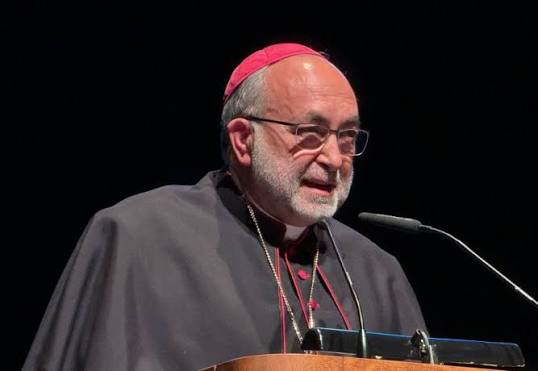
Archbishop of Oviedo Jesús Sanz Montes has backed the demonstrations held this Wednesday across Spain in support of Ceuta and Melilla and has called, from Covadonga, for a “reconquest” against the “Moroccan claim” and the “paralysis of a failed government.”
The Franciscan thus speaks again on the situation in Ceuta one month after the mass entry of illegal immigrants from Morocco, which he already compared at the time to a “new Green March.” This time he does so in line with the rallies that have brought thousands of Spaniards onto the streets to demand a response to the crisis facing the autonomous city.
“Spain staged its show of solidarity with Ceuta and Melilla. Also in Covadonga during the novena to the Santina. A place of reconquest that reminds us we must recover what is worth preserving, what sustains and identifies us against the Moroccan claim and the paralysis of a failed government,” Sanz Montes wrote this Thursday on his X account.
Read also: Spain awakens for Ceuta and not a single bishop in the squares
Covadonga, a “place of reconquest”
The reference chosen by Sanz Montes is no coincidence. His message was published during the novena to Our Lady of Covadonga, which will conclude on September 8 with the feast of the Santina.
The archbishop draws on the historical significance of Covadonga to link the demonstrations in defense of Ceuta and Melilla with the need to preserve what “sustains and identifies us.” Against this he places the “Moroccan claim” and a political response he describes as “failed government.”
The message comes after the emeritus bishop of Córdoba, Demetrio Fernández, opened the novena of the Santina with an equally explicit claim to the historical and Christian meaning of the site. “Covadonga is the cradle of Spain,” he stated during his homily.
Read also: “Covadonga is the cradle of Spain”: Demetrio Fernández opens the novena of the Santina
From the “new Green March” to the “Moroccan claim”
Sanz Montes’s intervention follows the line the archbishop adopted from the first days of the invasion.
After the mass entry recorded on July 30 and 31, when tens of thousands of illegal immigrants crossed the border from Morocco, the archbishop spoke of an “incomprehensible avalanche” and drew a parallel with the operation promoted by Morocco over Spanish Sahara in 1975.
“New Green March in the face of the extreme weakness of a wounded government,” he warned at the time. Later he described what happened as a “sad premeditated invasion.”
One month later, his reference to the “Moroccan claim” maintains the same diagnosis of the underlying events, while directing his criticism at the management of the Executive.
The crisis remains open after the mass entry overwhelmed Ceuta’s resources for days. Although many of those who crossed the border later returned to Morocco, thousands remain in the city, including numerous minors, while difficulties continue in housing and caring for them.
The invasion also left dozens dead and has opened a political debate on Morocco’s actions and the Spanish government’s response.
Spain mobilizes for Ceuta and Melilla
The archbishop’s message refers to the rallies held this Wednesday in numerous parts of Spain in solidarity with the autonomous cities.
The mobilization was especially strong in Ceuta, where thousands of people took to the streets with Spanish and Ceuta flags under the slogan “Ceuta is not for sale, Ceuta defends itself.” The call extended to Madrid, Valencia, Zaragoza, the Canary Islands, Andalusia and numerous other towns across the country.
Asturias also took part in the day. In Oviedo and other municipalities, rallies of support were held and Covadonga joined the expressions of solidarity coinciding with the novena of the Santina.
The public response came after a month in which the situation in Ceuta has also occupied a large part of the ecclesial debate. The president of the Spanish Episcopal Conference, Luis Argüello, went so far as to warn that “the invasion of Ceuta is a test” and that “demography is a weapon,” while from the diocese of Cádiz and Ceuta itself there has been insistence both on humanitarian care and on the need to protect coexistence and accompany a population marked by weeks of uncertainty.
Sanz Montes now adds his explicit support for the demonstrations. From Covadonga and during the novena of the Santina, the archbishop has linked the defense of Ceuta and Melilla to a claim of Spanish historical identity and has summarized his position in a word closely tied to the place from which he speaks: “reconquest.”