


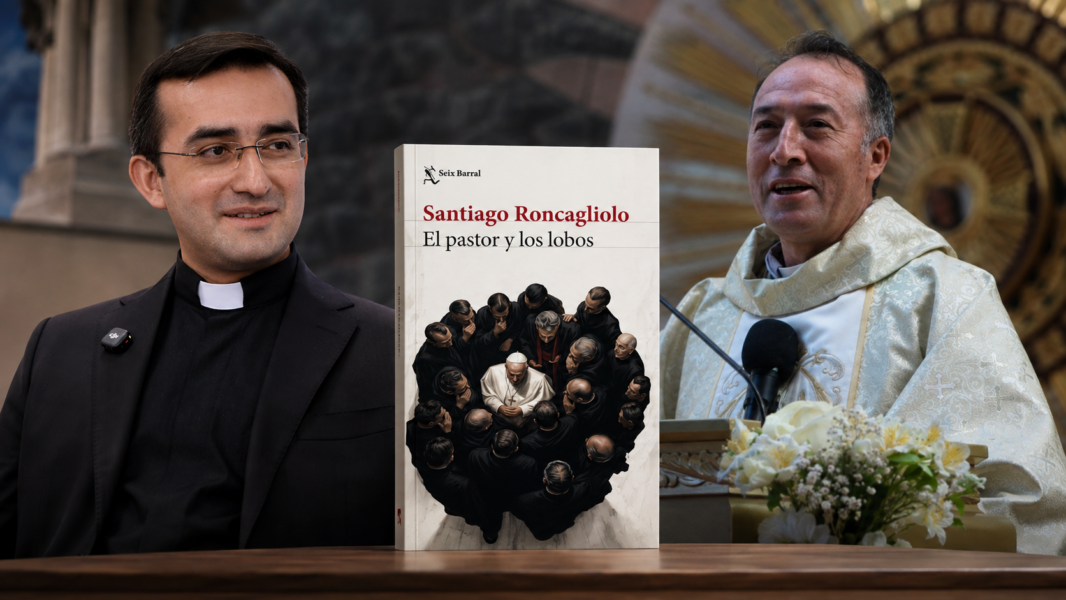
Edgard Rimaycuna, personal secretary to Leo XIV, is a disciple of Father Eleuterio Vásquez, “Lute”, the priest from Chiclayo accused of abusing prepubescent minors aged 9 and 11. This information, previously unpublished, does not come from a media outlet critical of the Pontiff: it is reported in The Shepherd and the Wolves, the book by Santiago Roncagliolo compiled from sources within the papal circle and openly favorable to Leo XIV. The revelation places the Pope’s closest collaborator within the circle of the priest whose case—investigated under then-Bishop Robert Prevost through an inquiry the Church itself describes as a “farce”—remains unresolved today, after a dispensation from the clerical state was intended to bring the canonical process to an end.
The Peruvian writer Santiago Roncagliolo has just published The Shepherd and the Wolves (Seix Barral, Grupo Planeta), a chronicle of Robert Prevost’s rise to the papacy that the author himself presents as the story of a bishop who stood up to abuse within the Peruvian Church. It is not a book hostile to the Pope: Roncagliolo acknowledges that one of his main sources is journalist Paola Ugaz, a close collaborator of Prevost in the Sodalicio investigation and, alongside Pedro Salinas, one of the voices most energetically defending the Pontiff’s management in public.
It is precisely for this reason that the detail casually dropped in the book, which had not been public until now, is so striking: Edgard Rimaycuna, Leo XIV’s personal secretary, is a disciple of Father Eleuterio Vásquez González, “Lute”, the priest from Chiclayo accused of abusing prepubescent minors, in a case whose investigation under then-Bishop Prevost the Church itself admits was “a farce”. A case that remains open and that the Church is determined not to resolve.
What the book says
When recounting the relationship between Bishop Prevost and Father Lute—then the most popular priest in the diocese and promoter of devotion to the Niño del Milagro of Eten—Roncagliolo writes:
“Fighting together brought the bishop and the priest very close. Father Lute kept him informed of everything he did. And Bishop Prevost was proud of his achievements. Lute offered five thousand testimonies of people healed, helped, or saved by the Niño del Milagro. He obtained twenty thousand, which Prevost took to Pope Francis in 2019. At the same time, Prevost relied on Lute’s popularity to evangelize and create priestly vocations. Once pope, he would take one of Lute’s disciples, Edgard Rimaycuna, to the Holy See as his private secretary.”
The passage is doubly significant. First, because it documents a close relationship of trust and collaboration between Prevost and Lute—“Father Lute kept him informed of everything he did,” “Bishop Prevost was proud of his achievements”—in the years immediately before the victims reported the priest to Prevost himself in April 2022. And second, because it places within that orbit, as a disciple of the accused, the person who today shares the Pontiff’s daily life: his first personal secretary.
The priest who manufactured vocations
To understand the scope of the word “disciple,” one must understand who Lute was in the diocese of Chiclayo. He was not just another parish priest: he was, by far, the most charismatic and popular priest in Lambayeque. The “Father of the Child,” the man who filled churches, who mobilized crowds behind the Divine Child of the Miracle, who set up soup kitchens and shrines, who collected twenty thousand testimonies of faith. A priest of direct and overwhelming manner, always surrounded by children and young people, to whom families opened their doors without reservation.
And it is true—acknowledged by the entire diocesan environment—that this charisma bore vocational fruit: Lute encouraged many young men from his parishes toward the seminary. He did so in the same way he did everything: by intervening very directly with families, speaking with parents, personally accompanying the discernment of the boys who stood out in his parish groups. He was, exactly as the book describes, the man whose popularity Prevost “relied on” “to evangelize and create priestly vocations.” In that context, Rimaycuna’s affiliation must be read: alongside other young men of the same profile—diligent, pious, raised in the parishes where Lute exercised his informal teaching—Rimaycuna was very likely encouraged and pushed toward the seminary in those years by the now-accused priest.
This form of direct intermediation with families also has a sinister reverse side documented in the case file itself: it was the same mechanism of trust that, according to the complaints, allowed Lute to take prepubescent girls to the mountains. As Ana María Quispe told Canal N, Father Lute “was very close to her family” and his religious status “allowed him to convince her parents” to let the girl accompany him on a mission five hours from Chiclayo. The same influence over families that opened seminary doors for some opened the road to Cueva Blanca for others.
Who is Edgard Rimaycuna
Edgard Iván Rimaycuna Inga (Chiclayo, 1989) has been Leo XIV’s personal secretary since May 8, 2025, the day after the election. Ordained a priest in Chiclayo in November 2014, he celebrated his first Mass at the parish of San José Obrero in La Victoria, the same parish environment where the victims place some of the reported incidents and where Lute himself had served as parish priest. In November 2025 the Pope appointed him Chaplain of His Holiness, incorporating him into the Pontifical Household. He accompanied Leo XIV on the recent apostolic journey to Spain, and this same month of August he is received with great acclaim in Chiclayo, where he is spending his vacation. In short, he is the person of greatest daily closeness to the Pope within the Holy See.
The disciple as witness
The book’s revelation does not impute anything to Rimaycuna. But it does place him where no one had placed him until now: in the inner circle of a priest whose daily pastoral life—that which a disciple shares by definition—is precisely what the canonical process never managed to reconstruct.
Because those practices were not clandestine. According to the complaints, Lute took prepubescent girls—aged between nine and eleven—to villages in the mountains of Lambayeque, hours from their homes, and spent the night alone with them in a small room at Cueva Blanca, with drivers, catechists, and parishioners as witnesses to the transfers. The victims precisely describe one of those witnesses: the driver who took the priest on those trips, a collaborator of the parish of San José—easily identifiable—who slept in the car while the priest spent the night with the girls in the room where the serious abuses were committed. So superficial was the investigation conducted under Prevost that no attempt was even made to locate and identify that person, a step the victims explicitly demand from the Dicastery for the Doctrine of the Faith, which continues to ignore them with unusual passivity. Ana María Quispe Díaz, the victim who has come forward publicly, also denounces that “there are witnesses who have publicly declared to the media that he frequently took other children to the same room” where the reported abuses occurred, a claim supported even in televised testimonies. The “missionary” trips of the diocese’s most popular priest, with minors and overnight stays, were visible to his parish circle.
It is in that environment that the book places Rimaycuna. No one can say what a seminarian of those years saw or did not see, and this newspaper will not do so. What can be stated more simply is this: someone who grew up pastorally and vocationally alongside Lute knows that world from within and is therefore one of the best-placed witnesses to help reconstruct what the ecclesiastical investigation never reconstructed. At a time when so many religious institutions are paying the price for not having known how to see in time what was happening around their charismatic figures, that firsthand memory would today be of enormous value to the victims. It would be a gesture that would honor the Pope’s secretary—and the Pontiff himself—to place it at the service of clarifying a case that Rome prefers to attribute to conspiracies.
An open case that the Church does not resolve
The victims reported to Prevost in April 2022 the abuses they suffered as girls at the hands of Father Lute. The investigation of that complaint has been disavowed by the Church itself: the ecclesiastical delegate for the case, canonist Giampiero Gambaro, admitted to the victims on April 23, 2025, that the investigation conducted under Prevost’s responsibility was “a farce,” “very poorly done,” with “many errors” and “much superficiality”, and that the accused was “practically not asked anything.” The Dicastery for the Doctrine of the Faith even archived the file citing Peruvian civil prescription, an argument that Gambaro himself described as “most strange.”
The process, however, has not been remedied: Lute requested a dispensation from the clerical state, and Leo XIV granted it on September 15, 2025, a decision intended to conclude the canonical criminal process that was supposed to clarify the facts. A claim that, according to high Vatican judicial sources consulted by InfoVaticana, lacks foundation: the dispensation does not extinguish the process. Regardless of whether the accused returns to the lay state, nothing prevents—and everything recommends—that the investigation continue with a view to clarifying the facts and providing reparation to the victims. This is exactly what the victims continue to demand, with persistent writings and procedures, from ecclesiastical authorities who, for the moment, are not moving. The victims denounce that the decision leaves them “defenseless,” demand from the Dicastery for the Doctrine of the Faith the most basic investigative steps that were never taken, and announce canonical actions against those responsible for the negligence, beginning with “the first person responsible for the case, Bishop Robert Prevost”. To this day, neither the truth has been clarified nor has the promised reparation been fulfilled.
The questions the book raises
Roncagliolo’s revelation—let us insist, an author favorable to the Pope and nourished by sources of his utmost confidence—forces uncomfortable questions. If the Pontiff’s own circle naturally accepts that his personal secretary is a disciple of Lute, to what extent does that personal and affective closeness of the papal circle to the accused priest weigh in the handling of the case? Is it related to the fact that Prevost never suspended the accused from publicly celebrating Mass, and to the shortcomings of the investigation that the Church itself acknowledges?
The book portrays a Prevost “proud” of Lute’s achievements, who took twenty thousand testimonies of his devotion to the Vatican and who “relied on Lute’s popularity to evangelize and create priestly vocations.” One of those vocations born in the shadow of the priest of Eten now works in the office next to the Pope’s, while the case of his victims remains without truth, without justice, and without reparation. None of this had been told until now. Paradoxically, it is told in a book written to portray Leo XIV as the shepherd who confronted the wolves.