


By Msgr. Charles Fink
Why is there something rather than nothing? Why is that something such that it has the remarkable capacity to evolve into the complex and, at the same time, ordered universe we behold—so ordered that predictability and science are possible? Why do even the simplest living cells contain genetic information analogous to complex computer codes?
These are not meaningless questions. Nor is it obvious why the only intelligent answer to such questions should simply be a roll of the dice. Or that things are the way they are, and that’s that. In every sphere of human endeavor we seek reasons and causes that account for how things are. It is hard to see why the hypothesis that underlies all these extraordinary realities should make those who propose it simpletons.
Bumper-sticker philosophy—along the lines of “Atheism is a misunderstood myth” or “Religion stops a thinking brain” or allusions to “flying spaghetti monsters”—may be entertaining, but it certainly does not rise to the intellectually elevated.
The English philosopher Anthony Flew, after a lifetime of scholarship and atheism, came to see the existence of God as a compelling explanation for the apparently miraculous fine-tuning of the universe at its apparent origin.
Alex O’Connor, a contemporary online podcaster, invariably thoughtful and courteous, though still unbelieving, concedes that Thomas Aquinas’s demonstrations of the existence of God and the proofs of Christ’s Resurrection are far more powerful than he had thought, and certainly not to be dismissed as the musings of fools.
I often wonder how rabid atheists, so disdainful of belief in God and inclined to confuse faith with stupidity or superficiality, explain people like the late Fr. Stanley Jaki, who held doctorates in theology and physics and spoke seven languages. Believing geniuses like Jaki may not be plentiful, but they are by no means unheard of, and they suggest that a lack of intelligence can hardly be accepted as a legitimate explanation for religious belief.
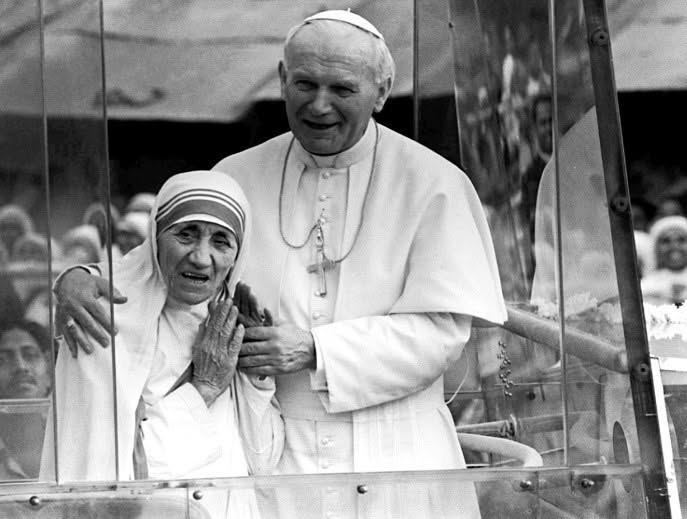
Nor does the notion hold that faith in God is merely a crutch for the weak and for those who would otherwise be unable to cope with the rigors of life—you know, people like St. John Paul II and St. Teresa of Calcutta: the one who helped bring down the Soviet empire; the other who lived among the poorest of the poor in the slums of India. Pathetic weaklings both, we are presumably to think, no match for the brave, brilliant, and muscular atheists who teach in our universities or work in the media or in Hollywood.
Of course, it is true that many believers are simple souls without advanced degrees and that many also need their religious faith to get through another day. There is a moving scene in the film Steel Magnolias in which Daryl Hannah’s character says precisely that to Sally Field, devastated by the death of her daughter. Their dialogue does not minimize the tragedy of that death. But, to bear life, Field needs to believe that God is in charge and that, after death, there is something more.
I have been a Catholic priest for fifty years and have faced some unspeakably wrenching tragedies, including the triple funeral of a woman and her two nieces, killed in a car accident that was not their fault. The mother of the two girls had recently divorced. The girls were her only daughters. I still have the pyx, the small metal container used to bring Communion to the sick, that that mother gave me, engraved with the names of her daughters, whom she described as God’s angels.
Let us grant that this woman’s faith, at that point, was largely a crutch. I presided at her funeral years later, and I know she was never the same after the devastating loss of her beautiful teenagers. Still, she persevered until her death with faith, hope, and love. Would she have been better off without all that? I have known hundreds, perhaps thousands like her, facing unspeakable pain, some barely keeping their heads above water, others astonishingly buoyant despite tragedy, and all largely thanks to their faith.
So here is a question for all who do not believe but cannot know that there is no God: what kind of person goes around kicking the crutches out from under those who stand only with their help? And what do you have to offer as an alternative?
Do you want to change the argument and talk about religious fanatics and the history of the wars of religion? War has been the norm throughout recorded history up to the present. And in the recent past, the greatest wars, persecutions, and massacres of all time have been initiated and carried out by atheist regimes.
Are there bad religious people? Of course. Perhaps even bad religions, a topic for another day. But the religion that teaches that God is love; and that all who abide in love abide in God and God in them; that commands us to love God and one another with all the self-denial and sacrifice of which we are capable; that affirms that God is Creator, Redeemer, and Sanctifier; and that made us in his image and likeness, not to slide into nothingness after a brief span of years, but to live with him forever in another kingdom—that is not stupid or anti-intellectual, nor a mere crutch.
Believers in this God can give reasons for their faith, not convincing to all, but not foolish either. The foolishness lies with those who, unable to know that there is no God and offering ultimate hopelessness as an alternative to belief, persist in mocking believers, in knocking the crutches out from under those who are about to fall, and in pretending that if only everyone were as bold an atheist as they, the world would be a better place.
As long as there are such people, I will continue to feel truly intelligent, and if I am deceived, there will always be plenty of people glad to have fools like me to accompany them on their journey through life.
About the author
Msgr. Charles Fink has been a priest for 50 years in the Diocese of Rockville Centre. He is a former pastor and seminary spiritual director, and lives, retired from administrative duties, at Notre Dame Parish in New Hyde Park, New York.