


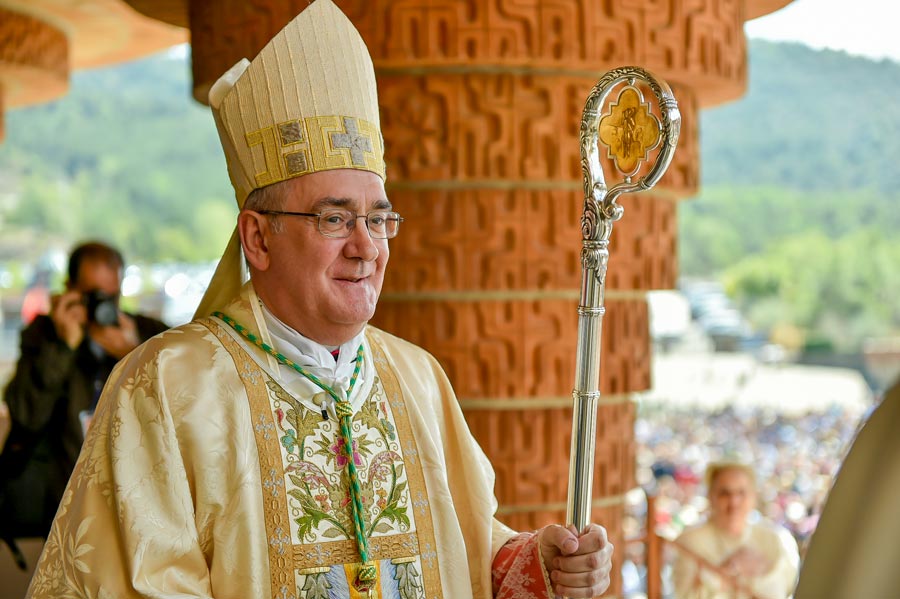
The Bishop of Barbastro-Monzón, Mons. Ángel Javier Pérez Pueyo, has stated that he would offer his resignation rather than sign an agreement that would require relinquishing the original image of Our Lady of the Angels of Torreciudad from its former hermitage. The prelate made public this Monday, August 31, an extensive letter ahead of the temporary return of the statue to the church on September 5, coinciding with the 47th Pilgrimage of the Virgins of Ribagorza and Sobrarbe.
“Rest assured that your shepherd would never sign that improbable plunder of your dignity. In such a case, I would place my office at your disposal out of loyalty to our people,” affirms Pérez Pueyo, who maintains that the image must return definitively to the place where it was venerated for centuries before its transfer to the new sanctuary more than fifty years ago.
The bishop also assures that the diocese has renounced any financial compensation and does not claim “the governance of the new church, nor its assets, nor its accounts, nor the entities or companies linked to its management.”
Instead, he reveals that he has asked Pope Leo XIV to recognize Torreciudad as an international sanctuary directly dependent on the Holy See, so that Rome may oversee its economic and pastoral reality.
“But there is one thing that this Diocese cannot surrender, to which children cannot renounce: their Mother, Our Lady of the Angels of Torreciudad,” he maintains.
The Virgin will return to the old hermitage on September 5
The statement is published just days before the original image temporarily returns to the old hermitage of Torreciudad, in the province of Huesca, Aragon.
It will be next Saturday, September 5, during the 47th Pilgrimage of the Virgins of Ribagorza and Sobrarbe. Pérez Pueyo presents the day as an especially significant event in the history of the diocese.
“After more than fifty years, our Mother returns home,” he writes.
The bishop recalls that the image was venerated there for centuries and that José Escrivá and Dolores Albás with their son Josemaría Escrivá also came to that hermitage to pray for his life when he was a child.
Pérez Pueyo encourages the faithful to come with their families and announces that on that day he will publicly reaffirm his commitment to defend the permanence of the image in its historic location.
The diocese questions how the image left the hermitage
The bishop also introduces an argument regarding the circumstances under which the statue left the old hermitage.
According to him, in recent years the diocese has compiled historical and legal documentation which, in his view, prevents interpreting that transfer as a voluntary renunciation of the custody of the image or its original location.
“Its authorized departure, in accordance with the law, is not recorded in the archives of either the Chapter or the Diocese,” affirms Pérez Pueyo.
The prelate also insists on distinguishing between the pontifical commissariat established for Torreciudad and the governance of the diocese itself.
On October 9, 2024, Francis established a plenipotentiary pontifical commissariat for the Torreciudad complex, entrusted to Mons. Alejandro Arellano Cedillo, Dean of the Tribunal of the Roman Rota.
“This commissariat falls upon Torreciudad; not upon the Diocese of Barbastro-Monzón. This particular Church has not been placed under commissariat,” Pérez Pueyo now emphasizes.
The words Francis addressed to him
The statement also returns to the support that, according to Pérez Pueyo, he personally received from Pope Francis during the conflict.
The bishop assures that Francis became aware of the matter during the ad limina visit in December 2021. Later, in a handwritten note dated July 13, 2023, the Pontiff reportedly wrote in his own hand: “Do not yield.”
Pérez Pueyo also recounts that on September 18, 2024, Francis again asked him personally in St. Peter’s Square: “Ángel, have they brought the Virgin down yet?”
Finally, he recalls another handwritten note from Francis, dated October 13, 2024, in which, according to the bishop, the Pope warned him of “the mafia intrigues that are underway” surrounding the conflict.
Pérez Pueyo had already made these words public during a homily delivered in September 2025. He now assures that those indications “weigh” on his conscience as bishop and shepherd of Barbastro-Monzón.
“Firmness is not the enemy of communion”
In his letter, Pérez Pueyo turns to the biblical figure of Eleazar, narrated in the Second Book of Maccabees, to explain his refusal to accept a solution he considers contrary to the diocese’s rights over the image.
The bishop also criticizes the evolution of the pontifical commissariat, which, in his assessment, would have ended up functioning “as a kind of mediation” between the parties.
At the same time, he expressly acknowledges the work carried out over five decades in the new church of Torreciudad.
“I bless and thank all the spiritual good that, for fifty years, has been accomplished in the church of Torreciudad: the confessions, the conversions, the families, the vocations, and the Marian devotion of pilgrims who have come from so many places in the world,” he writes.
And he adds: “I desire that Opus Dei may develop there its charism and its mission. I desire that Torreciudad be a great universal center of Marian evangelization.”
Pérez Pueyo considers that continuity compatible with the direct dependence of the sanctuary on the Holy See and with the return of the image to the old hermitage.
“Firmness is not the enemy of communion. […] The peace of the Church cannot be built upon the silence of a people asked to renounce its own memory,” he concludes before summoning his diocesans for the day of September 5.
Full statement of the Bishop of Barbastro-Monzón
On the occasion of the return of Our Lady of the Angels of Torreciudad to her hermitage-sanctuary
Children of Eastern Upper Aragon:
I address you all as shepherd of this flock of Barbastro-Monzón, a land of enormous dignity bathed in the blood of martyrs and deeply marked by so many saints who have dwelt here.
There are days when the history of a people seems to pause to remember who it is and where it comes from. September 5 will be one of those days. On the occasion of the 47th Pilgrimage of the Virgins of Ribagorza and Sobrarbe, the original image of Our Lady of the Angels of Torreciudad will once again cross the threshold of her hermitage-sanctuary. After more than fifty years, our Mother returns home.
She returns to the place where for more than a thousand years entire generations of this land visited her. She returns to where our elders could look upon her closely, touch her, kiss her, dress her, sing to her, carry her in procession, and entrust to her the harvests and illnesses, the children, the tears, and the hope. She returns to where José Escrivá and Dolores Albás also brought their young son Josemaría to implore for his life. She returns to the home this people guarded for centuries and whose image they knew how to protect even at the risk of their own lives in times of persecution and war.
We are not facing just another transfer or a simple day of celebration. There is something much deeper. A people is once again encountering a part of its own history, and a Mother is returning to the place where her children learned for centuries to call her Mother. That is why this day belongs to the memory of our Diocese and to the simple faith of so many generations who preceded us.
From that memory also springs the petition this particular Church has upheld with patience and firmness: that Our Lady of the Angels of Torreciudad remain in her hermitage-sanctuary, her millennial home. We are not asking for privileges. We are asking that the Mother remain in her home of always, where she always was for more than a thousand years until she was taken away fifty years ago.
So that no one may confuse this petition with interests of another nature, the Diocese has renounced everything else. We have renounced any financial compensation. We do not claim the governance of the new church, nor its assets, nor its accounts, nor the entities or companies linked to its management. We have asked the Holy Father Leo XIV that Torreciudad may be recognized as an international sanctuary directly dependent on the Holy See, and that the Holy See itself may oversee its economic and pastoral reality. But there is one thing that this Diocese cannot surrender, to which children cannot renounce: their Mother, Our Lady of the Angels of Torreciudad.
Our Mother must return to her home
I must also recall something that belongs to the truth of these facts. On October 9, 2024, Pope Francis established a plenipotentiary pontifical commissariat for the Torreciudad complex. That commissariat falls upon Torreciudad; not upon the Diocese of Barbastro-Monzón. This particular Church has not been placed under commissariat and retains intact the pastoral responsibility that corresponds to it over the faith of its people, its popular piety, and the memory entrusted to it.
During these past years the Diocese has gathered historical and legal documentation which, in our judgment, prevents considering the departure of the image from its hermitage as a voluntary renunciation by this people of its custody and its original place. Before the present church, before the controversies, and before any of us, for more than a millennium this image was united to this land and to its hermitage. And its authorized departure, in accordance with the law, is not recorded in the archives of either the Chapter or the Diocese.
Pope Francis personally became aware of this matter. During the ad Limina visit of December 2021, he received our concern for popular piety and for the ecclesial rootedness of Torreciudad. Later, in a handwritten note dated July 13, 2023, he wrote to me in his own hand: “Do not yield.” And on September 18, 2024, upon meeting him in St. Peter’s Square, he again asked me directly: “Ángel, have they brought the Virgin down yet?” A few weeks later, in another handwritten note dated October 13, 2024, he expressly warned me of “the mafia intrigues that are underway” surrounding this matter, just as I warned in the homily in our cathedral precisely one year ago.
Those words weigh upon my conscience as bishop and shepherd of this people of Barbastro-Monzón. Especially when what is at stake touches the dignity of a small and humble people, which perhaps has no power, but has memory; which perhaps has no influence, but has history; and whose dignity is no less for being small.
That is why I have thought so often of the elder Eleazar. The Second Book of Maccabees recounts that, at ninety years of age, they tried to offer him an apparently prudent way out: it was enough to pretend. He could save his life and avoid suffering. But Eleazar understood that such an appearance would leave the young an example of cowardice, and he preferred to die rather than stain his old age and dishonor the faith he had received (cf. 2 Mac 6, 18-31).
There are moments when a shepherd must ask himself not what is most comfortable for him, but what example he will leave to his people. I cannot sign, approve, or consent to a formula that deprives this people of Barbastro-Monzón of their own Mother, or that turns her into a stranger who makes occasional visits to her children from someone else’s house.
In these months I have watched how the plenipotentiary commissariat over the Torreciudad complex was transformed into a kind of mediation between them and the diocese, as if this people that awaited justice had to accept renunciations instead of defending its rights, which was precisely the reason the commission for Torreciudad was established. Firmness is not the enemy of communion. I bless and thank all the spiritual good that, for fifty years, has been accomplished in the church of Torreciudad: the confessions, the conversions, the families, the vocations, and the Marian devotion of pilgrims who have come from so many places in the world. I desire that this good may continue and grow. I desire that Opus Dei may develop there its charism and its mission. I desire that Torreciudad be a great universal center of Marian evangelization. Precisely for this reason we have asked that the new sanctuary depend directly on the Holy See.
But communion does not imply yielding to dignity. Charity does not oblige one to call just what is unjust. The peace of the Church cannot be built upon the silence of a people asked to renounce its own memory.
On September 5, Our Lady of the Angels of Torreciudad will return for a day to her hermitage-sanctuary. I encourage you to come with your children and your elders. Come as they came for more than a thousand years from every corner of this diocese to that small hermitage to touch the Virgin, kiss her, and entrust their lives to her. That day we will be together, as a diocesan Church, around Our Mother in her home. Our hands will once again touch her and our lips will kiss her. And our serene and prayerful presence will express, without the need to raise our voices, that a people may be small, but it does not lack memory, dignity, or a Mother.
That same day, before all of you, I will reaffirm my commitment to the people of Barbastro-Monzón to honor the memory and dignity of these thousand years of history, and also that of our neighbor who during the civil war protected Our Mother so that she would not be destroyed and later returned her to her home. That commitment leads me in conscience to be unable to deprive our diocese of its beloved Mother, and rest assured that your shepherd would never sign that improbable plunder of your dignity. In such a case, I would place my office at your disposal out of loyalty to our people.
Like the elder Eleazar, I prefer to leave an example of fidelity to our history and our memory, rather than betray what one has the duty to guard.
Truth may suffer, but it does not perish
I commend myself to Our Lady of the Angels of Torreciudad and to your prayers, so that the Lord may grant me to be worthy of this martyrial and enormously dignified land of which I have the honor of being shepherd.
Ángel Javier Pérez Pueyo
Bishop of Barbastro-Monzón