


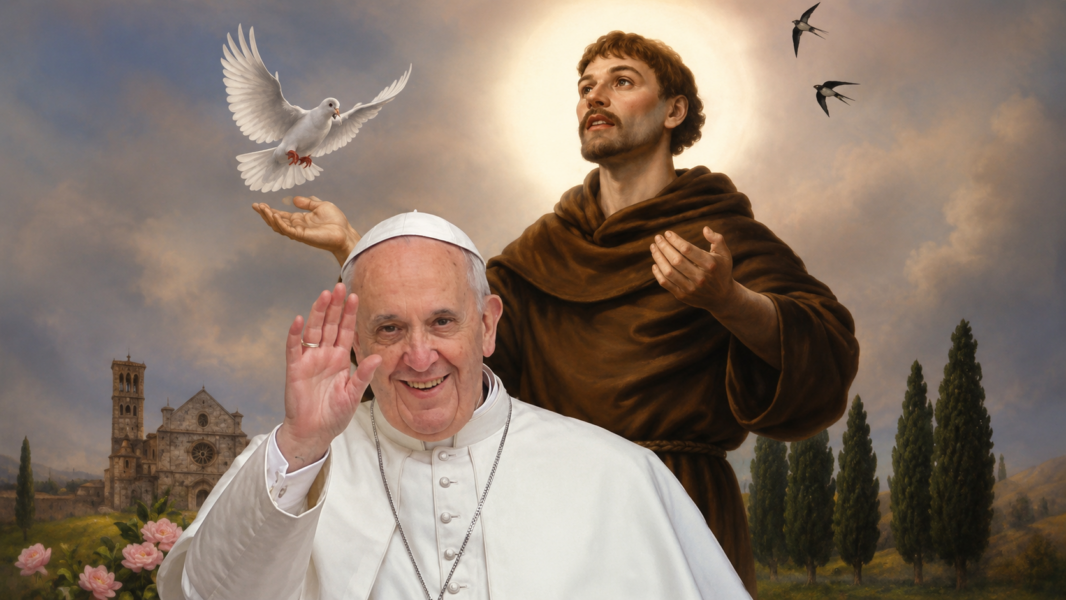
Recently reading the beautiful biography of Saint Francis of Assisi written by G. K. Chesterton, I was thinking about how we have been able to endure the disastrous pontificate of Francis. It is possible that the Lord sent him to test us in the faith and open our eyes, because truly the number and tenor of his demonstrations of a faith alien to the Catholic one have been horrific.
Following the reading, I would like to comment here on how the first pope to take the name of the saint of Assisi manipulated his figure until making it unrecognizable, promoting everything contrary to what the saint of Assisi contributed, by the grace of God, to the Church.
The fact that he already took the name makes it impossible for us to see as improvised how he manipulated the Saint’s work afterwards on repeated occasions; rather, it makes us realize that it was something programmatic. This, in a person of the crudeness of the Argentine pope, convinces me even more of something that has been on my mind for some time: the work of a preternatural intelligence, superior to the human, behind the synodal Church, the one that wants to end tradition, empty the Church of its supernatural content and turn it into an anthropocentric and anthropolatrous entity that follows the fashionable dictates of the world. And with this I do not wish to insinuate anything, but to affirm what we all already know: that Satan attacks the Church, although we have been promised that the gates of hell will not prevail. But Satan also attacks and tempts each of the souls of the baptized, from the simplest to the highest hierarchs, to distance us from God and lead us to eternal perdition. And many fall, even believing they are doing good for the Church and for souls.
I would like to focus attention on three aspects in which Pope Bergoglio manipulated the figure of Saint Francis for deceptive purposes toward the baptized:
1.-The encyclical Laudato Si
Laudato Si appeared in May 2015, only two years after the beginning of Francis’s pontificate. Christopher Rice, of the Laudato Si Movement, summarized it in 2022 as follows: “Laudato Si is an encyclical of Pope Francis that focuses on the care of the natural environment and of all people, as well as on broader issues of the relationship between God, human beings, and the earth. The subtitle of the encyclical, ‘On Care for Our Common Home,’ reinforces these key themes (…). Laudato Si is addressed ‘to every person living on this planet’ (LS 3). Therefore, it is offered as part of an ongoing dialogue within the Catholic Church and between Catholics and the world at large.”
The document refers to “ecological conversion,” the supposed “climate change” caused by human beings, “development,” a “sustainable environment,” the “cry of the earth,” and “oligopolies.” It clearly shows a pontificate concerned with the ecological problematic that has become a “contemporary dogma,” a revolutionary movement led by declared enemies of the Church such as Bill Gates, Mark Zuckerberg, George Soros, Gidom Bromborge, and Daniel Rosenfeld, among others. Note the common denominator in the surnames. The economic benefits of environmentalism are incalculable.
The anti-Christian Agenda 2030, of which climate catastrophism is a part, has been fully assumed and promoted by the Holy See since the beginning of Francis’s pontificate, as we can also painfully observe in the support for the Islamic invasions of all of Europe.
In July 2022, Archbishop Gabriele Giordano Caccia, Permanent Observer of the Holy See to the UN, delivered a copy of the encyclical to the Secretary-General of the same on behalf of the Vatican City State, stating that it adheres to the UN Framework Convention on Climate Change.
There are countless days, movements, and even “years” dedicated to this encyclical and the new ecological dogma in the synodal Church.
However, the Church should here apply the saying “cobbler, stick to your last,” for many scientists of various nationalities, led by the Clintel Foundation, have already disproved the entire “scaffolding” built to create unfounded “climate terrorism,” as they call it. These more than two thousand specialized scientists have declared in a public document that “there is no climate emergency.” Other authors and researchers have joined this rejection due to the inaccurate statements and lack of any scientific evidence set forth in Laudato Si and its continuation, Laudate Deum, where it is claimed that the supposed “climate damage” has been produced by human beings.
In reality, the synodal Church, since Laudato Si, is not dealing with ecology but with environmentalism, a harmful and anti-Christian ideology that implies population regulation. Paradoxically, this tacit approval of population control is given alongside the obsession with the infinite dignity of the human being, another increasingly recurrent theme in the synodal Church, with an approach alien to ecclesial tradition. The evident displacement of God from the center of the Church’s life and message toward the human being only confirms the grave crisis of faith in which we find ourselves and of which Benedict XVI spoke very clearly; a Church whose messages and actions are based on anthropocentrism (if not anthropolatry) and naturalism (or immanentism; the silencing of any trace of supernaturality) currently dominant in the ecclesiastical hierarchy, which occupies the space left by faith, now extinguished.
With Laudato Si, Francis already began to manipulate and caricature the figure and message of Saint Francis of Assisi, presenting him as the model par excellence of “care for creation” and “integral ecology.”
The very title of the encyclical comes from the Canticle of the Creatures, which led the Poverello of Assisi to recognize that God is the Father of all creation. One of its stanzas reads:
Praised be you, my Lord, in all your creatures, especially through my Lord Brother Sun, who gives us the day and who brings us the light.
Therefore, it is the Lord who is praised in all his creatures, and not the creatures themselves endowed with personalistic traits they do not possess. After some natural disaster, Pope Francis even stated on television that the earth “was kicking.” There is obviously nothing in common between Saint Francis of Assisi praising his Lord and an entire Supreme Pontiff of the Catholic Church promoting environmentalism and “care for our common home,” a concept totally alien to ecclesial tradition, which has always spoken, like Saint Francis, of the “creation” and “creatures” of God.
On October 4, 2023, Pope Francis published the second part of Laudato Si, Laudate Deum. In this exhortation, the pontiff considered that integral ecology and environmental issues are a true “global social problem” related to the dignity of human life. He firmly held that the presumed climate change of anthropogenic origin is “one of the main challenges facing the global community.”
2.-The dialogue with Islam
The very word “dialogue,” a talisman of the synodal Church for introducing relativism and doubt into the Catholic faith, is already very dangerous per se. But in the matter of dialogue with Islam, the Argentine pope deceived us by selling us the idea that his 2019 trip to the United Arab Emirates to meet with the Grand Imam of Al-Azhar was analogous to Saint Francis of Assisi’s visit to the Sultan of Egypt to dialogue with him.
Let us see. From the very beginning of his founding of an order of mendicant brothers, Saint Francis of Assisi had as one of his priorities the preaching to the infidels (that is, to Muslims) for their conversion. Not only to pagans, but also to Muslims. In the chapter of 1219, it was decided to send some friars to infidel lands in North Africa. Francis, for his part, had departed for the East. It is a very well-documented story. For long months, Francis remained among the crusaders, where his apostolate at first had wonderful results. He was considered inspired by God. In the camp, he proposed nothing less than going to visit the infidels themselves. Most of the warriors burst into laughter: to speak of charity and fraternity to those Moors, who had just announced that for every Christian head cut off, the fortunate victor would receive a bezant of gold, was madness and provocation. The authoritarian Cardinal Pelagius, who had just arrived with reinforcements, did not hide from Francis that this was also his opinion. He did not dare to forbid the enterprise, knowing that he enjoyed a good reputation in Rome, but openly rejected any responsibility.
The Poverello of Assisi took another friar with him and headed toward the enemy lines singing the verses of Psalm XXII: “Though I walk through a valley of darkness, I will fear no evil, for You are with me.” Of course, as soon as they saw the two friars, the Muslims rushed upon them, dealing them heavy blows. “Sultan! Sultan!” Francis shouted with all his might. The guards believed they were emissaries and, duly chained, took them to their camp. Thereupon, when questioned, the good saint replied with all simplicity that he wanted to see the sultan to explain to him the doctrine of Christ.
Curious and somewhat skeptical, the Sultan of Egypt did not dislike discussing with a Christian scholar the comparative merits of the Qur’an and the Gospel. Therefore, he ordered that these unexpected envoys be presented to him. To demonstrate to the sultan the dazzling superiority of his God, Francis proposed submitting to a test: “Let a great fire be kindled! The three priests and I will enter it, and, by what happens, you will see for yourself which of the two religions is the holiest, the truest.” It cost the sultan much to convince him that, as head of the believers of Islam, it was difficult for him to be baptized, and he had him accompanied back to the crusaders’ camp with the greatest respect.
Such was the dialogue of Saint Francis of Assisi with the Sultan of Egypt. Pope Bergoglio, Francis I, on the other hand, signed a “document on human fraternity, for world peace and living together,” which began by saying: “In the name of God who has created all human beings equal in rights, in duties, and in dignity, and has called them to live together as brothers among themselves, to populate the earth and spread in it the values of good, charity, and peace (…)”.
The first question that arises is: To which God are they referring? Are they saying that the God of Catholics and that of Muslims is the same, a god of the entire human species?
The event and the lie were already exposed at the time; but it is worth recalling, for anyone who might not have heard or may have forgotten. More than anything because the “dialogue” in the way Francis and Leo preach and practice it has nothing to do with the way Catholicism has historically tolerated other false religions.
3.-The encyclical Fratelli Tutti
This encyclical was the result in 2020 of the aforementioned meeting the previous year between Pope Francis and the Grand Imam of Al-Azhar, and saw the light on October 3, 2020, on the eve of the memorial of Saint Francis of Assisi. One of the several displays of Bergoglio’s evil sense of humor, at the expense of the Church. The encyclical appeared titled in Italian and not in Latin, as the norm of the Church ordered (until Leo XIV changed it).
The pope confirmed that the encyclical was inspired by the February 2019 meeting with Grand Imam Ahmad al-Tayyed in Abu Dhabi, and also inspired by Saint Francis of Assisi, as well as by numerous non-Catholic leaders, among others, Martin Luther King, Desmond Tutu, and Mahatma Gandhi.
In Fratelli Tutti, known in various Catholic circles as tutti frutti, basically, the pope proposes an ideal world of relativistic and pantheistic fraternity where all religions and beliefs are on the same level, where all countries can form part of a “broader human family.”
It is enough to see what was said about it from the lodge of the Grand Orient in Spain to understand what this encyclical so attached to the spirit of the Council and its synodal fruits conveys: “Three hundred years ago now the birth of Modern Freemasonry took place. The great principle of this initiatory school has not changed in three centuries: the construction of a universal fraternity where all human beings call one another brothers beyond their concrete creeds, their ideologies, the color of their skin, etc. This fraternal dream clashed with religious integrism which, in the case of the Catholic Church, gave rise to very harsh texts condemning the tolerance of Freemasonry in the nineteenth century. The latest encyclical of Pope Francis demonstrates how far the current Church is from its former positions. In ‘Fratelli Tutti,’ the pope embraces universal fraternity, the great principle of modern Freemasonry.”
Again, the only inspiration from Saint Francis of Assisi seems to be the title, based on a manipulation: “Fratelli tutti” (“All brothers”) is the phrase Saint Francis of Assisi used to address his brothers and sisters and propose to them a life based on the Gospel. It is taken from his Admonitions (specifically, Admonitions, 6, 1: FF 155). Saint Francis of Assisi was speaking to his Franciscan brothers, and that is why he said “Fratelli tutti”: “Let us contemplate, all brothers, the good Shepherd, who suffered the passion of the cross to save his sheep. The Lord’s sheep followed him in tribulation and in persecution and in humiliation, in hunger and in thirst, in weakness and in temptation, and in all the rest.”
It is obvious that Saint Francis of Assisi was not referring to any supposed universal fraternity.
Sometimes one wonders how we have been able to endure the pontificate of Francis, as anti-Catholic as it was. Perhaps it was because of the surprise and incredulity at such audacity, such disobedience to God, such contempt for the Church. Non-Catholics and anti-Catholics saw it much more clearly than we did from the beginning, and they applauded him, until they grew tired and ignored him. It is enough to resort to the aforementioned words from the lodge of the Grand Orient upon the publication of Fratelli Tutti: “The latest encyclical of Pope Francis demonstrates how far the current Church is from its former positions.”
In reality, it is not the Catholic Church that is far from its former positions; it is the synodal Church they intend to impose that tries with all its strength to make a tabula rasa and put an end to the Church of Christ, erasing everything that for two thousand years the Church believed, prayed, and preached.