


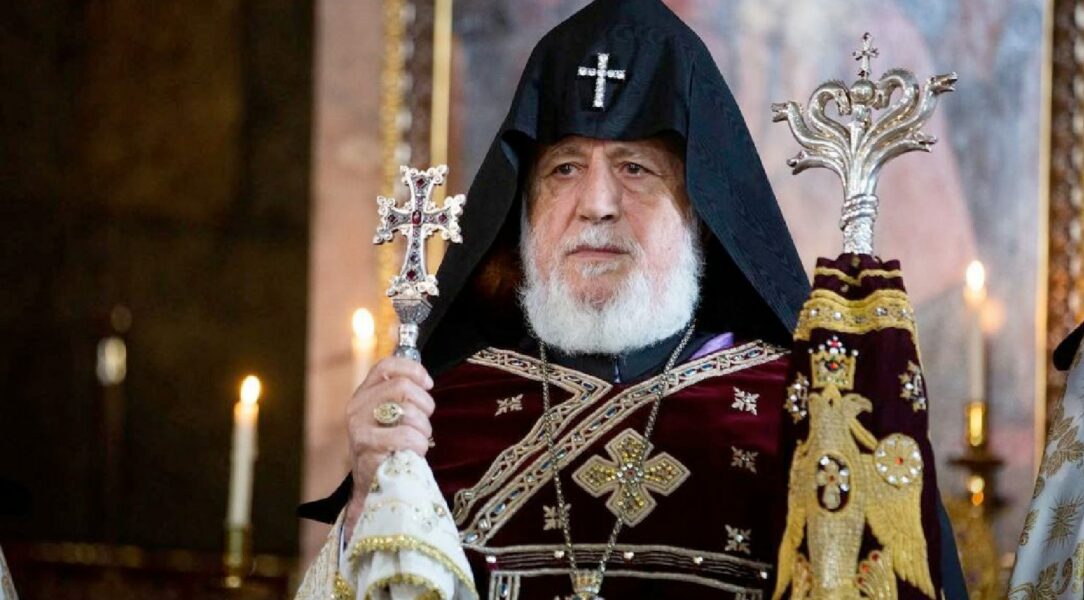
The confrontation between the Government of Armenia and the Armenian Apostolic Church has taken a new leap after the Executive of Prime Minister Nikol Pashinyan has officially incorporated into its 2026-2031 program the dismissal of Karekin II, Catholicos of All Armenians, the appointment of an interim authority, the approval of new statutes for the Church, and the subsequent election of a new ecclesiastical leader.
The program, presented by the Government on August 20 and approved by the National Assembly last Tuesday by 63 votes against 24, justifies the intervention as a «vital necessity» to reform the Church, guarantee its «spiritual security,» and prevent foreign forces from using it as a platform for «hybrid warfare.» The Church has responded by denouncing political interference in matters it considers outside the State’s competence.
Removing the Catholicos and electing his successor
The 2026-2031 government program expressly establishes that the «dismissal (retirement)» of the person it calls the «de facto leader» of the Armenian Apostolic Church must be ensured, a reference to Karekin II, the Church’s highest authority since 1999.
It then contemplates the election, «in accordance with the established procedure,» of an interim authority to assume the functions of the Catholicos.
The Government also intends to promote the adoption of new statutes for the Church that include mechanisms aimed at ensuring «financial transparency and the good conduct of the clergy.»
Once this process is completed, the program foresees the election of a new Catholicos of All Armenians. The Executive also commits to incorporating the clergy into the state social security system and increasing transparency regarding ecclesiastical funding.
The inclusion of these measures means bringing issues directly affecting the internal governance and election of the highest authority of a Church that encompasses the vast majority of Armenian Christians into the government program.
Pashinyan announces a report on a «deep systemic crisis»
Pashinyan raised the tone again during the presentation of the program before the National Assembly on August 24.
The prime minister announced that, by his order, a report is being prepared on what he described as a «deep systemic crisis» within the Armenian Apostolic Church.
The document, he assured, will include «dozens of facts» with which he intends to demonstrate that Karekin II has placed the Church outside the canonical framework.
Pashinyan also referred publicly to the Catholicos by his civil name, Ktrich Nersisyan, instead of using exclusively his ecclesiastical name.
The day after, he stated he was willing to meet with him if he first accepts the government’s reform agenda.
«If Karekin II or Ktrich Nersisyan accepts the reform agenda of the Armenian Apostolic Church, I solemnly declare from this podium that I will sit and discuss that agenda with him with the utmost respect,» he affirmed.
The prime minister has repeatedly questioned the legitimacy of the Catholicos and accuses him of having failed to fulfill his clerical commitments. He has also maintained that sectors of the Church maintain ties with foreign interests, particularly Russian ones.
The Church denounces a violation of its autonomy
The Church’s response came on Wednesday, August 26, after a meeting at the Holy See of Etchmiadzin of the Supreme Spiritual Council, the bishops of Armenia, and the heads of the various dioceses, presided over by Karekin II.
In an official statement, the Council denounced the conduct of the government majority during the parliamentary debate and accused the political power of violating the Constitution and internationally recognized rights.
«The Government does not possess constitutional authority or competence to include issues related to Church reform in its program or to impose on the clergy, at its discretion, proposals or demands,» the Church stated.
The declaration also maintains that the National Assembly «has no authority to consider internal Church matters» and that Parliament does not constitute a legitimate forum for deciding on them.
«The renewal of the Armenian Church cannot be carried out through external pressures, threats, and similar arbitrary actions,» it added.
The Armenian hierarchy also lists other decisions it considers part of the government’s offensive against the institution: the elimination of the subject of History of the Armenian Church from the school curriculum, the suppression of spiritual assistance in the Armed Forces, the suspension of priests’ ministry in penitentiary establishments, and new tax burdens.
A confrontation that has already reached the courts
The new initiative comes while Karekin II and six other bishops face criminal proceedings related to the dismissal of Bishop Gevorg Saroyan, one of the prelates who supported Pashinyan’s agenda to reform the Church.
The conflict arose after a court ordered Saroyan’s reinstatement following his dismissal. Karekin II subsequently responded by stripping him of his clerical status, and the Prosecutor’s Office opened a case against the Catholicos and other prelates for the alleged non-compliance with the judicial ruling.
The accused may face sentences of up to two years in prison.
The Church considers that the procedure constitutes judicial interference in its canonical autonomy. This Friday, August 28, a new preliminary hearing of the case is scheduled, although Karekin II and the six bishops will not appear in person and will be represented by their lawyers.
From Nagorno-Karabakh to control of the Church
The confrontation between Pashinyan and the ecclesiastical hierarchy has intensified in recent years, especially after the Armenian defeats against Azerbaijan and the loss of Nagorno-Karabakh, a territory from which practically its entire Armenian population left following the Azerbaijani offensive of September 2023.
Karekin II and other prominent members of the Church have harshly questioned the prime minister’s management, while Pashinyan accuses ecclesiastical sectors of directly intervening in politics and obstructing his strategy of normalizing relations with Azerbaijan.
The dispute now directly affects the Church’s governance structure. The program approved by Parliament does not merely demand Karekin II’s resignation: it establishes as a government objective his departure, the appointment of a provisional ecclesiastical authority, the modification of internal statutes, and the subsequent holding of a new election of the Catholicos of All Armenians.