


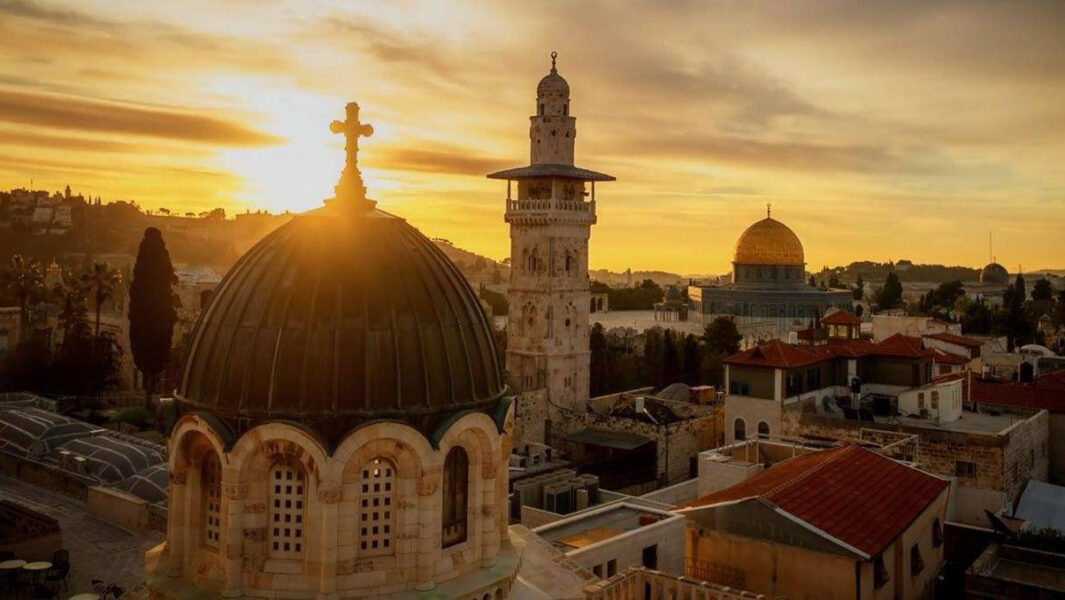
The Latin Patriarchate of Jerusalem has issued an international appeal to support the continued presence of Christians in the Holy Land, amid economic and social conditions that are driving especially young people toward emigration. “The living stones must remain,” the Patriarchate maintains, warning that the Christian presence faces “one of the most critical turning points in its two thousand years of history.”
Under the title Hope Demands Action, the Patriarchate focuses on Christian families in Bethlehem, Jerusalem, the West Bank and Gaza, affected by mobility restrictions, the loss of work permits and the halt of tourism and pilgrimages.
A 54% unemployment rate among Christians
According to data provided by the Patriarchate, Christian communities currently face an unemployment rate of 54%, roughly double the national average.
The impact is especially severe because of the historic dependence of many Christian families on the pilgrimage sector. Artisans, merchants, guides, drivers, hospitality workers and restaurant owners have for generations lived off the pilgrims who visit the Holy Places.
With tourism virtually at a standstill, many of these livelihoods have disappeared.
The Patriarchate particularly highlights the consequences for young people who finish their university studies or vocational training and find few opportunities to enter the labor market.
The lack of prospects makes emigration an increasingly difficult alternative to avoid. For these families, the text warns, leaving the Holy Land also means breaking a historical and religious continuity maintained since the first centuries of Christianity.
“What happens when an entire generation begins to believe that its future lies elsewhere?” the Patriarchate asks.
Only 541 Christians remain in Gaza
The most extreme situation is in Gaza, where the Patriarchate currently puts the number of Christians still in the Strip at 541.
Part of the community has left the territory, while other Christians have died during the conflict or as a result of the deterioration of healthcare and shortages of basic supplies.
Those who remain, the Patriarchate notes, “pray without ceasing,” help one another and resist. “Their presence is a daily act of courage.”
Read also: Christians in Gaza receive the Israel-Hamas agreement with hope
Cardinal Pierbattista Pizzaballa, Latin Patriarch of Jerusalem, had already warned this month of the fatigue and loss of confidence spreading among Christians after years of violence and uncertainty. His concern centers especially on the Holy Land remaining trapped in a prolonged state of “neither war nor peace.”
Read also: Pizzaballa: “Among Christians there is great fatigue” over negotiations that do not bring peace
The risk of the Holy Land becoming “an empty museum”
The Patriarchate warns that the gradual disappearance of Christian communities would not mean only a demographic change.
“What would it mean for the cradle of Christianity to become an empty museum of stones and archaeological sites?” it asks.
The document’s answer is summed up in one phrase: “The living stones must remain.”
The term refers to the Christian communities that have maintained a continuous presence for centuries in the places linked to the life, death and resurrection of Jesus Christ.
The Patriarchate therefore calls for international aid not to be limited to covering immediate emergencies, but to create the conditions necessary for families to continue living in their land.
Schools, jobs and small businesses to curb emigration
One of the priorities highlighted is education. With the start of the academic year, the Patriarchate has launched an initiative to cover school expenses for children from the most vulnerable families in the region.
Keeping schools open—and reopening them wherever possible—is part of a broader strategy to support local communities.
The Patriarchate calls for investment in education, vocational training, the creation of small businesses and community institutions, with the aim of providing families with real opportunities for work and permanence.
“We must give families concrete reasons to stay, not because they are trapped, but because they can build a dignified and sustainable life in their homeland,” it maintains.
The goal aligns with what Pizzaballa recently expressed during his visit to Taybeh, a Christian town in the West Bank, where he assured that the Church will continue to do everything within its reach to preserve the Christian presence in the Holy Land.
“They do not wish to be preserved as a historical curiosity”
Despite the difficulties, the Patriarchate states that “the great majority” of Christians in the Holy Land maintain their desire to remain in the region.
“They do not wish to be preserved as a historical curiosity or reduced to a part of the past,” the document notes. What they demand is the ability to work, educate their children and practice their faith with dignity in the places where Christian communities have remained for generations.
“The Holy Land offered the world the greatest story of hope ever told,” the Patriarchate concludes. “Today, Christians need our help to keep that hope alive in them.”