


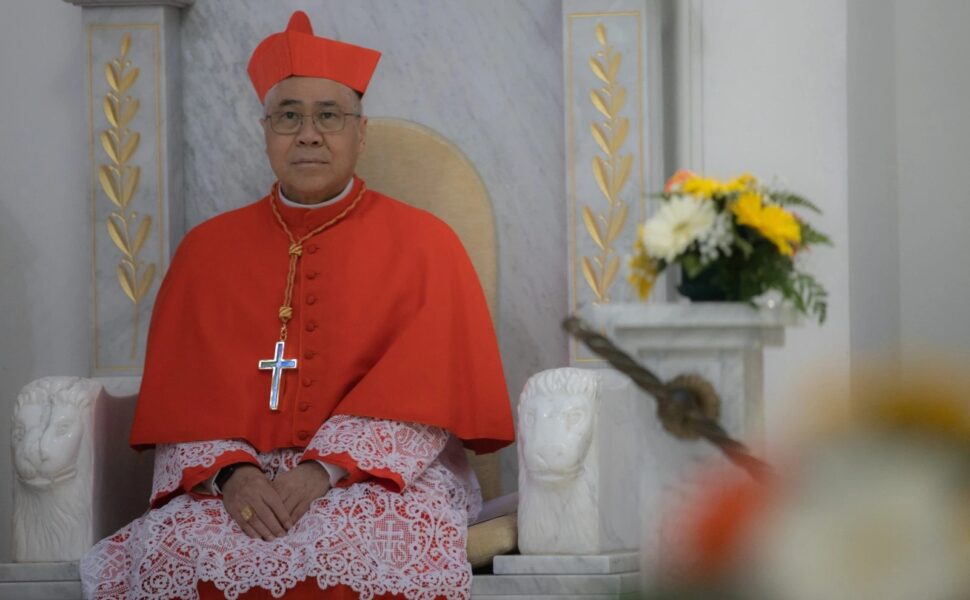
Cardinal William Goh, Archbishop of Singapore, has urged Catholics to distinguish between the Holy Tradition of the Church and the customs, disciplines, and devotions that have developed in different cultures, warning that some end up treating the latter as “the absolute norm” for how faith and the Christian life should be lived.
In his Tuesday, 25 August homily, titled Stand Firm by Keeping the Tradition and Traditions, the cardinal drew on St. Paul’s exhortation to the Thessalonians: “Stand firm and hold fast to the traditions that you were taught, either by an oral statement or by a letter.” Goh explained that this transmission refers above all to the fundamental truths of the faith received from the Apostles.
What “cannot be compromised”
The cardinal recalled St. Paul’s words to the Corinthians about what he had received and handed on “as of first importance”: that Christ died for our sins in accordance with the Scriptures, was buried, and rose on the third day.
Goh also pointed to the institution of the Eucharist as another example of this apostolic transmission, citing the account of the Last Supper and Christ’s command: “Do this in memory of me.”
Among the Church’s fundamental elements, he likewise mentioned the Creed, the sacraments, the institutions of the Church, papal infallibility, and Holy Orders.
“These things cannot be compromised, because they define how the Church understands herself,” he stated.
In contrast, Goh placed other “lesser traditions that are not strictly essential to the Church’s faith,” which have arisen throughout history and can take different forms according to circumstances.
Traditions that depend on culture and context
Among these practices, the Archbishop of Singapore cited Friday penance, abstinence from meat, certain ecclesiastical feasts, celebrations of saints, and expressions of popular piety.
The cardinal did not reject these customs; rather, he stressed that they can help the faithful live their faith concretely without possessing the same rank as what was received from the Apostles.
“Not all of these traditions need to be observed by everyone, since they depend on culture, context, devotion, and relevance,” he explained.
The distinction Goh highlighted is also found in the Catechism of the Catholic Church, which in paragraph 83 differentiates apostolic Tradition from the “theological, disciplinary, liturgical, or devotional traditions” that later arose in local Churches. The latter, the Catechism notes, may be “retained, modified, or even abandoned under the guidance of the Church’s Magisterium.”
“They try to impose these cultural and personal traditions”
Goh warned of the consequences of equating the two kinds of tradition.
“Unfortunately, some do not distinguish between Tradition and traditions, considering the latter as important as the former,” he noted.
According to the cardinal, this confusion leads to a failure to differentiate “between the essential doctrines of the faith and the cultural practices developed in different societies.”
In some cases, he added, a further step is taken and an attempt is made to “impose these cultural and personal traditions on others, treating them as the absolute norm” for determining how faith and the Christian life should be lived.
Goh cited as an example the popular devotions associated with certain saints or with Marian and Christological apparitions.
The archbishop specifically mentioned the Philippines and Latin America, where Catholic religiosity has incorporated expressions proper to local cultures, and recalled that traditions of this kind also exist in European countries with a long Catholic heritage.
Far from denying their value, Goh acknowledged that these forms of religiosity help to incarnate the faith in a given society. His warning was directed against turning them into obligatory models outside the context in which they arose.
“Although such popular religiosity helps to make the faith concrete locally, one should not attempt to export or impose these devotions on another country,” he stated.
“Justice, mercy, and fidelity”
The cardinal linked this distinction to the day’s Gospel, in which Christ reproaches the scribes and Pharisees for scrupulously paying the tithe of “mint, dill, and cumin” while neglecting “the weightier matters of the Law: justice, mercy, and fidelity.”
Goh explained that the Mosaic Law had been given to order the life of the people of Israel, regulate worship, and guide their relationship with God and with others. Later, secondary provisions were developed to apply its principles to concrete situations.
The problem, according to the cardinal, arises when these rules end up receiving the same importance as the ends for which they were established.
“In the end, all laws exist to guide our relationship with God and with our fellow human beings, helping us to live justly and, beyond justice, with mercy and compassion toward the poor, the suffering, and the weak,” he noted.
Fasting, abstinence, and external observance
Goh applied the same principle to the external practices of religious life, drawing on Christ’s words against those who clean the outside of the cup while leaving its inside impure.
“The external observance of cultural and hygienic practices is good when it serves as an expression of the interior heart, but this is not always the case,” he stated.
The cardinal specifically mentioned Friday penance, abstinence, fasting, and the one-hour Eucharistic fast. He warned that these disciplines can lose their purpose when the faithful’s attention is reduced to external compliance.
“Some become obsessed with the number of days or hours required for a devotion to be ‘valid,’ acting as if God were concerned primarily with external things,” he explained.
“What matters most to God is the interior of our hearts: our sincerity, our devotion, and our love for Him,” he added.
“Let us be faithful to the Holy Tradition of the Church”
The Archbishop of Singapore concluded his homily by returning to the distinction between the deposit of faith handed down from the Apostles and the various forms in which the Church has expressed and lived it throughout the centuries.
“Let us be faithful to the Holy Tradition of the Church—the deposit of faith handed down from the time of the Apostles—and appreciate the traditions that the Church has developed over the centuries to make faith concrete and real in our lives,” he stated.
Goh thus insisted on preserving both realities in their proper order: apostolic Tradition as the foundation that cannot be compromised, and ecclesial and devotional traditions as forms that can help live that faith in specific cultural circumstances.
The cardinal concluded by directing attention toward Jesus Christ and God the Father, asking that what Christians have received strengthen them “in everything good that we do or say.”