


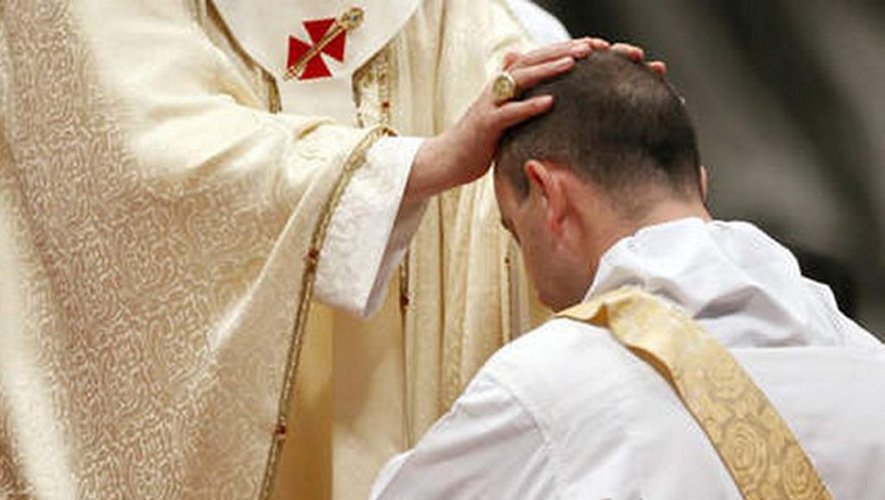
The 22% of U.S. Catholic bishops surveyed stated they would be willing to ordain a man with a “deeply rooted” homosexual attraction provided he is firmly committed to celibacy. Within that group, 10% declared themselves “totally in agreement.” This stance contrasts with the Holy See’s 2005 instruction, which excludes from admission to the seminary and holy orders those who present “deeply rooted homosexual tendencies.”
The data come from a national study conducted by the Center for Applied Research in the Apostolate (CARA) and are analyzed by priests and formation specialists Thomas Berg and Timothy Lock in Do You Know Them to Be Worthy?, published in July by the McGrath Institute for Church Life at the University of Notre Dame in the United States. The study also addresses, in addition to homosexuality, the discrepancies between bishops and formators, the psychosexual maturity of candidates, the use of psychology, and the conditions necessary for assuming priestly celibacy.
Bishops more favorable than those who form seminarians
The difference between those responsible for deciding on a vocation is significant. Compared with the 22% of bishops, only 17% of mental-health professionals, 16% of rectors, 12% of formators and spiritual directors, and 9% of vocation directors were willing to recommend for ordination men with a deeply rooted homosexual attraction, even when committed to celibacy.
The divergence is not merely theoretical. Berg and Lock note that those who have worked for years in seminaries are aware of cases in which rectors and formation teams have received pressure to advance candidates against their own judgment.
The problem also affects other candidates whose suitability raises reservations. Among the specialists consulted, there is a perception that some dioceses may place too much weight on the need to have priests available. The authors expressly warn against the temptation to prioritize the number of seminarians over the quality of those ultimately ordained.
For this reason, they propose that the bishop—while retaining ultimate canonical responsibility for ordination—should ordinarily accept the judgment of the rector and the formation team, unless he has moral certainty that their evaluation is substantially erroneous. The reason is practical: while a bishop may interact with the candidate occasionally, his formators live with him and observe for years his human, spiritual, intellectual, and pastoral development.
The authors recall that failing to heed the negative judgment of those who have accompanied the candidate closely has at times caused “great suffering” both to the priest himself and to the local Churches. Their conclusion is explicit: it is necessary to “overcome the fixation on numbers” and attend to the quality of the men selected.
An “emerging consensus” on candidates with stable homosexual attraction
The predominant position among the experts gathered by Notre Dame was more restrictive than that expressed by the 22% of bishops. In their discussions emerged what Berg and Lock describe as an “emerging consensus”: a seminarian who manifests a stable attraction to persons of the same sex should not advance to the configurative stage, the advanced phase of formation that precedes ordination. The authors themselves endorse this position.
For a candidate in that situation, they even suggest that it may be necessary to temporarily interrupt his formation. That period would allow assessment of how he understands his identity, his capacity to assume celibacy, his affective life, and the self-giving proper to priestly vocation. They acknowledge that, in many cases, this process could end with the decision not to advance the candidate toward holy orders.
They also call for especially rigorous discernment when the candidate’s history includes homosexual relationships, promiscuity, prolonged sexual experimentation, or promotion of the so-called “gay lifestyle,” even if those behaviors belong to the past and repentance has occurred.
The capacity to abstain from sexual relations does not by itself resolve the issue. Berg and Lock recall that priestly celibacy does not consist solely in remaining single and continent, but is related to spiritual fatherhood and a spousal gift to the Church. Among the questions they raise is whether a man with a stable homosexual attraction can live that reality in a way that is “honest, inwardly integrated, and theologically coherent.”
What Rome established in 2005
The then-Congregation for Catholic Education established in 2005 that the Church “cannot admit to the Seminary and to Holy Orders” those who practice homosexuality, present “deeply rooted homosexual tendencies”, or support the so-called “gay culture.”
The instruction distinguishes these cases from a homosexual tendency linked to a transitory problem. In the latter case, it requires that the tendency have been clearly overcome at least three years before diaconal ordination.
The majority of those involved in priestly formation consider this criterion useful. This was the response of 68% of bishops, 68% of rectors, 63% of formators and spiritual directors, and 57% of vocation directors. Among mental-health professionals, however, only 36% viewed the current formulation positively.
Read also: Why James Martin is wrong to defend the ordination of homosexual priests
More than five years of attraction: a proposal to define what is “deeply rooted”
One of the difficulties identified is precisely determining when a homosexual attraction should be considered transitory and when “deeply rooted.” These terms come from the language of Church documents, not from clinical categories commonly used by psychologists and psychiatrists.
Berg and Lock report a practice beginning to be used among Catholic mental-health professionals: attending not only to the intensity of the attraction, but also to its persistence over time.
According to this criterion, a homosexual attraction that persists for more than five years should be considered “deeply rooted”—unless there are indications that it is beginning to disappear—even if it initially appeared mild or superficial. The authors note that there are cases in both directions: apparently superficial attractions that lasted for years and others that were initially intense but later diminished while a stable attraction to the opposite sex emerged.
To enable such follow-up, they propose recording in the seminarian’s file the date on which he first reports experiencing attraction to persons of the same sex.
23% of newly ordained priests admitted to having concealed information
The difficulties in determining suitability do not depend solely on the criteria of bishops and formators. A figure cited by Berg and Lock shows that 23% of newly ordained priests later admitted to having concealed during their seminary years personal realities that they should have disclosed to their formators.
Candidates, the authors maintain, have the duty to make themselves sufficiently known to the Church, just as the Church has the right and obligation to know those it is preparing to ordain. Spiritual direction and psychological accompaniment should help the seminarian bring to the external forum those personal aspects relevant to determining priestly suitability, without confusing this process with the protected sphere of confession.
Among the problems that may not come to light early enough, they mention sexual compulsivity, unresolved traumas, immature dependencies, boundary issues, and deeply rooted psychosexual confusions. They also warn that some seminarians advance through successive stages without yet having reached the levels of psychosexual maturity required.
Two psychological evaluations during formation
To reduce these risks, Berg and Lock propose that each candidate ordinarily undergo two complete psychological evaluations: one before admission and another at the end of the discipleship stage or at the beginning of the configurative stage.
Their argument is that the usefulness of a psychological evaluation usually does not extend beyond three years, whereas the current priestly formation process can last seven years or more. By the time decisions close to ordination are made, the evaluation conducted at entry may be outdated.
There is also a gap between the importance attributed to these examinations and their actual use. 100% of rectors and 94% of formators and spiritual directors consider the initial evaluation necessary to identify areas in which the seminarian must grow. However, only 48% of rectors and 51% of formators said they actually use it to develop a personalized plan; among mental-health professionals, the percentage drops to 36%.
Gaps also appear in subsequent treatment. 57% of mental-health professionals stated that they had known men in their seminary who were referred to therapy but ultimately received little or no attention. Hence the proposal that, when the size of the center permits, there should be a full-time director of psychological services.
One year of continence before the diaconate
Sexual maturity occupies another prominent place in the recommendations. Before advancing to the configurative stage, the candidate should have lived several months of stable sexual continence without relapses. Before being called to the diaconate, the period should normally be twelve months or more.
External continence would not be sufficient if not accompanied by interior freedom, affective stability, and the capacity to establish healthy relationships. Persistent doubts about the capacity to live celibacy chastely, affective integration, or relational functioning appear among the factors that must be resolved before ordination.
The title Do You Know Them to Be Worthy? comes precisely from the ordination rite. When the candidates stand before the bishop, he asks the priest presenting them: “Do you know them to be worthy?”. The response certifies that, after consulting the Christian people and those involved in their formation, they have been deemed suitable.
For Berg and Lock, reaching that conclusion cannot become a mere formality at the end of seminary. The judgment on the suitability of a future priest is, they note, an act of pastoral responsibility that commits the candidate, the faithful who will be entrusted to his ministry, and the priesthood itself.