


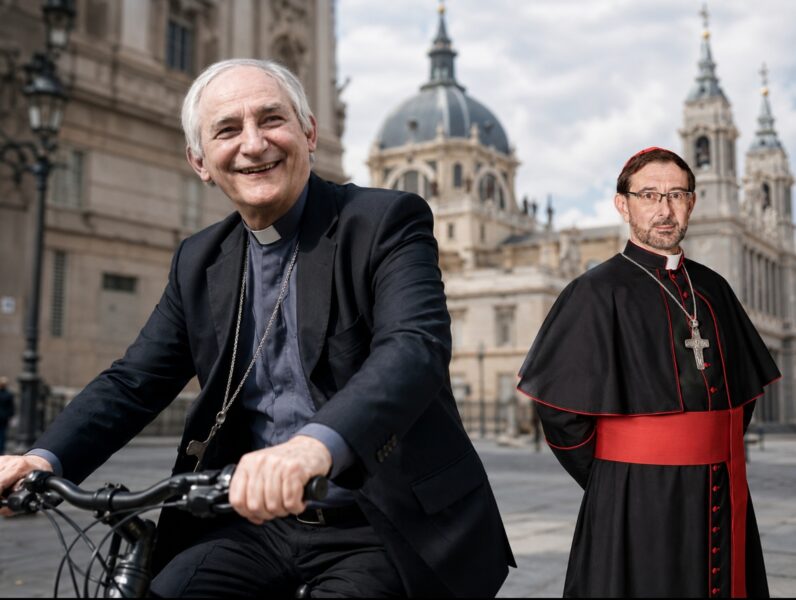
There are two ways to be a progressive bishop. One is Zuppi’s: progressive yet transversal, not very sectarian, genuinely tolerant. The other is Cobo’s: progressive and monolithic, polemical and hard. If the cardinal archbishop of Madrid were wise, he would opt for something closer to the style of governance of his counterpart in Bologna.
Matteo Zuppi is not a conservative in disguise. He comes from Sant’Egidio, has written the foreword to James Martin, and is the friendly face of Italian ecclesial progressivism. Yet the traditionalists of Bologna do not regard him as an enemy. He has confirmed according to the ancient rite, has allowed communities attached to the traditional liturgy to live in peace when others used Traditionis custodes to settle old scores, and has written sympathetically about liturgical authors who are not exactly of his stripe. That is why even those who do not share his ideas respect him. Anyone can govern well for their own; a shepherd is proven by how he treats the others.
Cobo, by contrast, seems to want a diocese in his own image and likeness: a kind of perpetual convivium where everyone sings catchy pop hymns, the kind that thrill the cardinal. But life is more complex than a refrain. Madrid does not fit into a single songbook, and governing a diocese like Madrid requires balance.
Cobo is making enemies at a pace he cannot afford. He is already paying—perhaps clumsily—for broken dishes that belonged to Parolin: the infamous betrayal of the Valley has been entirely laid at his door, with all the wear on his mitre and the gain for other offices. But if you have decided to shoulder the bills of the Secretariat of State, you cannot afford, on top of that, to manufacture free adversaries at home.
You bring Crismhom into the seminary and provoke a major scandal? Compensate for it: for example, allow your seminarians who wish to learn the traditional Mass; it does not burn. You want to make a progressive mark? That is your sensibility and no one will dispute it at this point. But do not slam the door on the faithful who respectfully request the ancient rite with signatures in hand, nor turn the seminary into a filter of uniformity that will end up emptying it. A bit of stick and carrot, Your Eminence; not stick and stick. Give us the lime if you wish, but carefully: without the sand, quicklime burns. And no cardinal, however progressive, wishes for a burned-out diocese.
A fact, in case it has not yet reached the archiepiscopal palace: the faithful of Madrid attached to the traditional Mass fill every Sunday a small chapel in a former nursing home that had to be purchased, and where, despite five Sunday Masses, they cannot fit comfortably. The response to a petition, made respectfully and with signatures in hand, for a few more Masses in some parish has been a violent door slammed in the face of the faithful who requested it in writing from his vicar, using Traditionis custodes as a pretext and without a single word of welcome.
Zuppi understood long ago: one can have an editorial line in one’s writings and not be sectarian in governance; one can be unequivocally of one sensibility without reading every traditional community as a threat and every disagreement as disloyalty. Breadth is not lukewarmness: it is catholicity. And besides—this Cobo should note—it is profitable.