


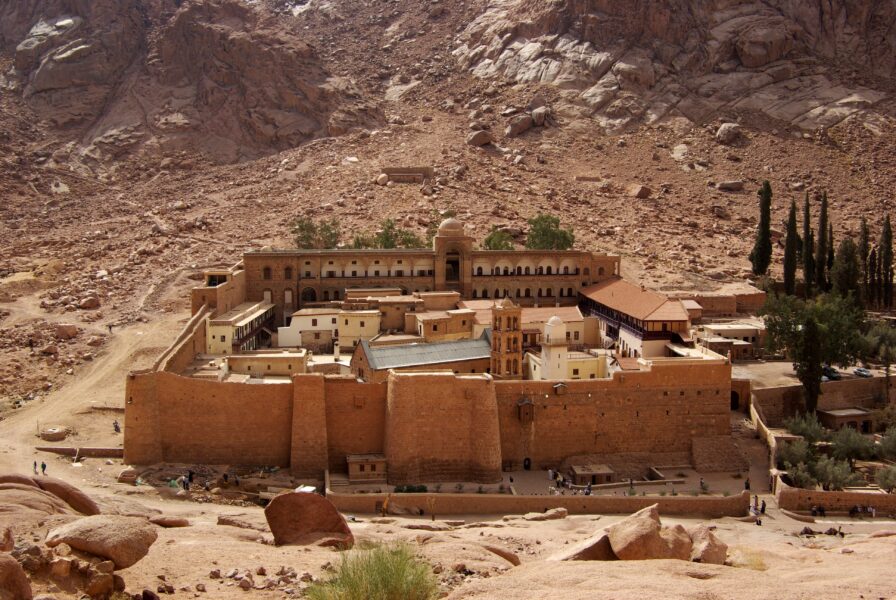
The State claims lands linked to the world’s oldest continuously inhabited Christian monastery, while the monks defend their historical rights over them. With two appeals pending before the Court of Cassation, the parties are negotiating a formula that would guarantee the complex’s perpetual «religious possession,» but not necessarily its full ownership.
The monastery of Santa Catalina in Sinai, Egypt, and the country’s authorities are negotiating a resolution to the legal conflict that has pitted the monastic community against the State since 2015 over the ownership of dozens of plots and assets linked to the historic Christian complex. While the Court of Cassation reviews the appeals filed by both parties, talks are moving toward a formula under which the facilities would be designated archaeological sites but remain under the monastery’s perpetual «religious possession.» Negotiations have not yet concluded, and rights over chapels, hermitages, gardens, and other nearby properties remain to be resolved.
The dispute affects a community established at the foot of Mount Sinai for nearly 1,500 years. Santa Catalina was built between 548 and 565 by order of the Byzantine emperor Justinian I and is considered the world’s oldest continuously inhabited Christian monastery. The litigation does not currently threaten the continuation of worship, but rather a legal question with major consequences for the community’s survival: who owns the lands and buildings that the monks have historically possessed or used, and under what title they may continue to do so.
A lawsuit that began in 2015 over 71 plots
The current proceedings date back to 2015, when Egyptian authorities filed civil case no. 24 before the South Sinai Court of First Instance.
The State then sought the recovery of 71 plots held by the monastery and demanded financial compensation for their use. The government’s position was that some of these lands belonged to the State and that the community lacked sufficient legal title to possess them.
The monastery, by contrast, argued that its possession was historical, that numerous plots were inseparably tied to its religious function and heritage, and that it held contracts and documents supporting its rights over various properties. During the proceedings, court-appointed experts individually examined the plots and their relationship to religious, archaeological, and protected sites.
On May 30, 2022, the court of first instance ordered the eviction of 29 plots and their return to the State. Neither party was satisfied, and both appealed.
Three years later, on May 28, 2025, the Ismailia Court of Appeal issued a ruling that distinguished between different types of properties: some, because of their connection to the monastery’s religious or historical function, could remain in the community’s possession; others fell under a different regime due to their archaeological status or location within protected areas.
The conflict then reached the Court of Cassation, Egypt’s highest judicial authority.
Egypt and the monastery both appeal the same ruling
Both parties have appealed the appellate decision, but they pursue different objectives.
The Egyptian State seeks to reverse those aspects of the ruling that prevented the recovery of certain properties. The government maintains that there are state lands whose possession by the monastery lacks sufficient legal basis.
Santa Catalina, for its part, seeks broader recognition of its ownership and possession rights over assets historically linked to the community.
The government’s appeal was registered on July 23, 2025, under number 24838/95, while the monastery’s appeal is listed under number 24962/95.
The Cassation Prosecutor’s Office leans partially toward the State
Before the Court of Cassation issues its ruling, the Prosecutor’s Office attached to this court has issued two legal opinions on the appeals.
Its position does not constitute a judgment and is not binding on the court, which may follow or depart from it. However, it provides insight into the preliminary legal assessment of the case.
The Prosecutor’s Office recommended rejecting the monastery’s appeal and partially accepting the State’s, although it did not endorse all government claims or propose automatically handing over the 71 plots to the authorities.
Specifically, it deemed it necessary to re-examine certain aspects of the appellate ruling and some plots whose legal status or expert evaluation showed deficiencies.
The Prosecutor’s Office also did not fully accept the government’s thesis regarding 28 sites considered religious. According to information published by the Egyptian outlet Ghad News, it held that the absence of conventional ecclesiastical elements in a given place does not necessarily suffice to deny its religious character.
The recommendation thus leaves a complex situation open: it neither recognizes all the monastery’s claims nor grants the State full recovery of the disputed lands.
Parallel negotiations outside the courts
While the judicial proceedings continue, the monastery and Egyptian authorities are seeking a negotiated solution.
Sources familiar with the talks cited by eKathimerini maintain that the parties have already reached an understanding on a general framework, although technical details must still be agreed upon before a final pact can be announced.
The proposed solution would distinguish between legal ownership of the assets and the monks’ right to use them permanently.
Under the proposal, all monastery facilities would be designated archaeological sites and remain under its perpetual «religious possession.»
The talks aim to extend similar protection to small chapels and hermitages historically linked to Santa Catalina.
More delicate is the situation of other lands and the gardens near the monastery, considered essential for sustaining the community’s life in the desert environment of Sinai. For certain assets, the preferred option would be a long-term lease at a symbolic price.
This formula would guarantee the monks stable use of the properties, but would not necessarily equate to recognition of the full ownership they are claiming in court.
Allegations of pressure on the monks
The negotiations are not without criticism.
The Egyptian Initiative for Personal Rights (EIPR) denounced this month that authorities are pressuring the community to accept an agreement that would replace its property rights with a form of religious tenure.
According to the independent Egyptian outlet Al Manassa, the organization claims the government intends to legally restrict the monks’ historical rights over the lands and alleges that the official approval of the new archbishop of Sinai has been used as a tool of pressure during the talks.
These are allegations by EIPR that have not been judicially established. The organization asserts that the Egyptian Presidency conditioned the decree recognizing the new archbishop on the signing of the land agreement and also questions the possibility of replacing the traditional regime of the prelate with a renewable residence permit.
These allegations contrast with previous public guarantees offered by Egyptian authorities regarding the continuity of the monastery and its religious character.
The tourism project that concerns the monastery’s defenders
The property dispute is compounded by the transformation taking place around Santa Catalina.
Egypt is developing the tourism project known as the «Great Transfiguration» in the area, designed to expand tourist and pilgrimage infrastructure around Mount Sinai.
EIPR maintains that the works threaten the integrity of the monastery’s historical and natural surroundings. According to Al Manassa, the UNESCO World Heritage Committee adopted a decision in July calling for the works to be halted until a technical impact assessment is carried out. The organization also cited a report by the International Council on Monuments and Sites warning of serious and permanent damage to the site’s integrity, authenticity, and natural surroundings.
The Egyptian organization also recalls that when Egypt nominated Santa Catalina for inclusion on the World Heritage List at the beginning of this century, official documentation recognized the rights of the monastery and the archbishop of Sinai over lands, gardens, and buildings in its vicinity.
Nearly fifteen centuries of Christian presence
The monastery stands on the Sinai Peninsula, in Egypt, at the foot of the mountain traditionally identified as the place where Moses received the Tablets of the Law.
Emperor Justinian I ordered its construction in the 6th century around an earlier Christian place of worship. Since then, the monastic presence has continued uninterrupted.
Santa Catalina is administered by the autonomous Orthodox Church of Sinai, of Greek tradition, and preserves an exceptional religious, artistic, and documentary heritage.
The monastery and its surroundings were inscribed in 2002 as a UNESCO World Heritage Site, recognizing both its importance to Christianity and its connection to traditions linked to Judaism and Islam.
Greece closely follows the outcome
The monastery’s situation has long transcended the strictly Egyptian judicial sphere.
Greece is closely following the negotiations due to Santa Catalina’s historical and ecclesiastical ties to the Hellenic world. Athens, according to eKathimerini, considers that the final legal details must be resolved directly between the monastic community and the Egyptian authorities.
The United States has also shown interest. Massad Boulos, advisor to President Donald Trump, recently reaffirmed the U.S. president’s support for preserving the monastery’s historic status quo.
The talks are thus taking place while the Court of Cassation’s decision remains pending. Sources cited by eKathimerini do not rule out that the judicial ruling may be delayed, which would give the parties additional time to reach an agreement.
After more than a decade of litigation, the outcome will determine not only who legally holds rights over dozens of plots, but also the conditions under which the community of Santa Catalina can maintain a monastic presence dating back to the 6th century.