


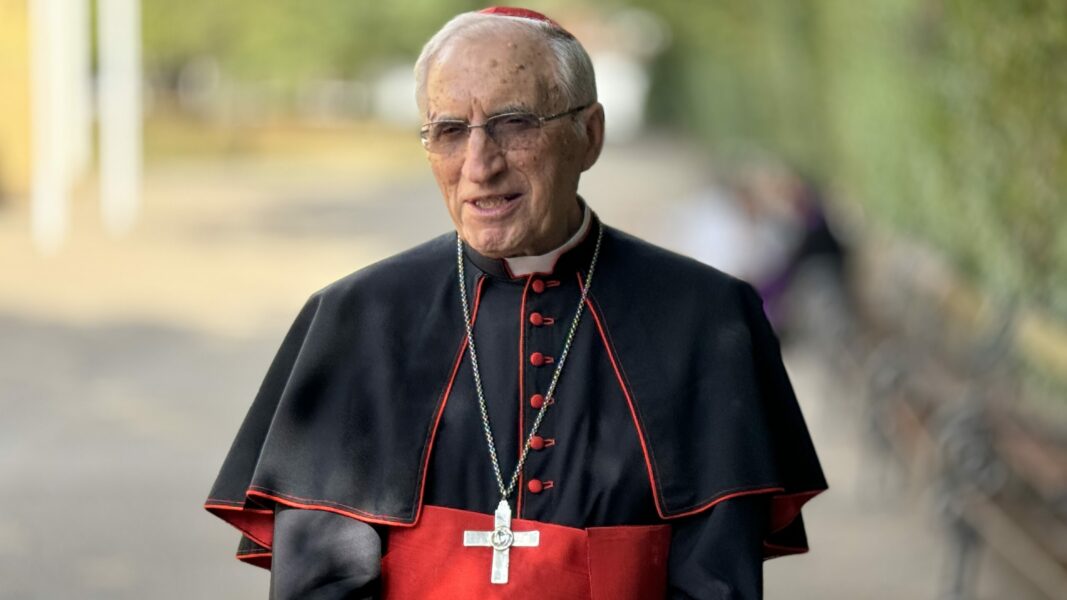
The cardinal and emeritus archbishop of Madrid, one of the decisive figures of the Spanish episcopate in recent decades, turned ninety on August 20. Next October 31 he will also reach 50 years since his episcopal consecration.
Cardinal Antonio María Rouco Varela turned 90 last August 20 and is approaching another exceptional anniversary: next October 31 will mark 50 years since his episcopal ordination. Archbishop of Santiago de Compostela and later of Madrid, president of the Spanish Episcopal Conference for twelve years and cardinal since 1998, his career spans a large part of the recent history of the Church in Spain.
Born in Villalba (Lugo), Galicia, on August 20, 1936, he entered the seminary of Mondoñedo as a child and later studied Theology at the Pontifical University of Salamanca. He was ordained a priest on March 28, 1959, and that same year moved to Munich, Germany, where he studied Law and Theology and obtained his doctorate in Canon Law in 1964. Before fully joining the governance of the Church, he developed an extensive academic career, teaching in Mondoñedo, Munich, and Salamanca, where he became professor of Fundamental Canon Law and vice-rector of the Pontifical University.
From Santiago to Madrid
His half-century of episcopate began under Paul VI. In 1976 he was appointed auxiliary bishop of Santiago de Compostela and received episcopal ordination on October 31 of that year. John Paul II named him archbishop of Santiago in 1984 and, a decade later, on July 28, 1994, transferred him to Madrid. In both sees he succeeded Cardinal Ángel Suquía.
In Galicia he experienced one of the events that would later mark his career: the World Youth Day in Santiago de Compostela in 1989, presided over by John Paul II. Years later, already as archbishop of Madrid, he would again play a central role in a WYD, this time with Benedict XVI in Madrid in 2011. The Holy See’s official biography expressly recalls his role as host of that IV World Youth Day in Compostela.
John Paul II announced his incorporation into the College of Cardinals in January 1998 and created him cardinal in the consistory of February 21, with the title of San Lorenzo in Damaso. Rouco would later participate in two conclaves: that of April 2005, which elected Benedict XVI, and that of March 2013, from which Francis emerged.
Twelve years at the head of the Spanish bishops
His influence extended beyond the Archdiocese of Madrid. Rouco presided over the Spanish Episcopal Conference between 1999 and 2005 and again between 2008 and 2014, twelve years in total. He also served on its Permanent Commission since 1984 and held various positions in the episcopal structure for three decades.
Those years coincided with profound political and cultural transformations in Spain and placed the cardinal at the forefront of the Church’s public response to issues such as marriage and the family, the defense of life, education, religious freedom, and the presence of Catholics in society.
They were also the years of large Catholic gatherings in defense of the family and of a public presence of the Church that made Rouco a regular figure in the national debate. His doctrinal firmness and his interventions regarding legislative changes earned him both support within the Catholic world and strong political and media opposition.
His closeness to the pontificate of John Paul II also had an institutional dimension. The Polish Pope appointed him general relator of the II Special Assembly for Europe of the Synod of Bishops in 1999, and Rouco held positions for years in bodies of the Holy See, including the congregations for the Clergy and Catholic Education, the Supreme Tribunal of the Apostolic Signatura, and various pontifical councils.
Twenty years of governance in Madrid
Rouco remained twenty years at the head of the Archdiocese of Madrid, from 1994 to 2014. During that period there was also a significant expansion of the pastoral and formative structures of a diocese subject to the demographic growth of the capital and its metropolitan area.
One of the projects linked to his governance was the development of San Dámaso. John Paul II appointed him in 1996 Magnum Cancellarium of the then Faculty of Theology San Dámaso, an institution that later became an ecclesiastical university.
Francis accepted his resignation due to age on August 28, 2014. Rouco remained as apostolic administrator until the installation of his successor on October 25 of that year.
His withdrawal from pastoral governance, however, did not mean his disappearance from Spanish intellectual and ecclesial life.
Read also: Rouco Varela praises the magisterium of Leo XIV: “We must return to the Second Vatican Council”
Last July, after the extraordinary consistory held in Rome, the cardinal once again spoke about the situation of the Church, the beginning of the pontificate of Leo XIV, the European crisis of faith, the German Synodal Way, and the interpretation of the Second Vatican Council.
Sanz Montes claims his legacy
The 90th birthday has also provided an occasion to publicly recall his legacy. The archbishop of Oviedo, Msgr. Jesús Sanz Montes, dedicated his weekly letter to the former president of the Episcopal Conference, highlighting especially a facet that accompanied his entire career: his intellectual formation as a canonist and theologian.
Sanz Montes described that academic foundation as fundamental to understanding his later work as a pastor and maintained that “the monumental work of Rouco Varela cannot be understood or valued in its proper measure without first considering his profound intellectual solidity.”
The archbishop of Oviedo also recalled the criticisms Rouco received during the years of greatest public exposure and noted that some presented his “doctrinal firmness as supposed authoritarian rigidity” and his fidelity to Rome as immobility.
The anniversary also has a significant precedent. When Rouco turned 80 and 40 years of episcopate in 2016, he celebrated a Thanksgiving Eucharist in Madrid. At that time he interpreted both anniversaries from a perspective far removed from any merely personal balance sheet: behind those figures, he said, lay “an undeserved torrent of mercy, forgiveness, and grace.”
Ten years later, the figures coincide again. Ninety years of life and, next October 31, half a century of episcopate for a cardinal whose career extends from Paul VI to Leo XIV and who for decades was at the center of the main decisions, debates, and events of the Spanish Church.