


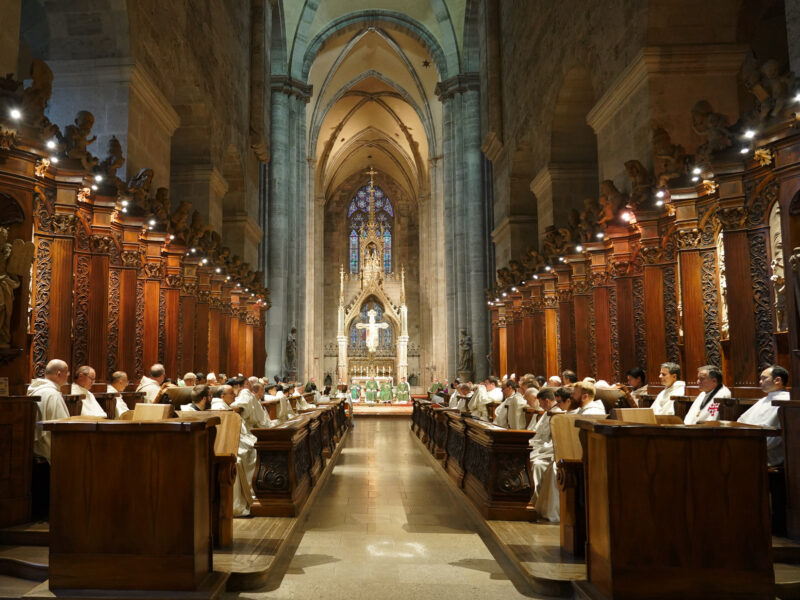
Abbot Maximilian Heim will step down from the governance of the Cistercian Abbey of Heiligenkreuz in Austria on September 14, the feast of the Exaltation of the Holy Cross, after fifteen years leading one of the most numerous monastic communities with the greatest vocational growth in the country. Instead of immediately electing its 69th abbot, the monks will elect, after consulting with the Dicastery for Institutes of Consecrated Life and Societies of Apostolic Life, an administrator who will govern the monastery for the next three years.
Heim’s departure, at age 65, comes five months after the conclusion, on April 8, of the Apostolic Visitation ordered by Rome. The monastery attributes the decision to the heart problems the religious suffered last year and to his desire to hand over responsibility “to younger hands.” Neither Heiligenkreuz’s communiqué nor the information released about the succession establishes a causal link between his resignation and the Apostolic Visitation.
An administrator for three years
Heim will leave office about half a year before the end of his second ordinary term. The religious explained that, after years of service in various governance responsibilities at Heiligenkreuz and in the Austrian Cistercian congregation, he considers the time has come to return to pastoral activity and continue his work as a theologian.
The abbot president of the Austrian Cistercian Congregation, Pius Maurer, highlighted that Heim has led the monks “with trust in God and great commitment” during times he described as challenging.
The succession procedure will have a particularity. After consulting with the competent Roman Dicastery, the community will not elect a new abbot for now, but an administrator whose mandate will last three years.
Maurer explained that this decision responds to the fact that more than a third of the religious with the right to vote have never participated in an abbatial election. The election will take place in mid-September and will correspond to the more than 80 solemnly professed monks eligible to participate.
The formula of maintaining this governance regime for three years was adopted after consultations with the Dicastery for Institutes of Consecrated Life.
The recent Apostolic Visitation to Heiligenkreuz
The succession comes after a particularly delicate period for Heiligenkreuz. In June 2025, the Dicastery for Institutes of Consecrated Life ordered an Apostolic Visitation to the abbey and appointed as visitors the then Benedictine abbot primate Jeremias Schröder and the religious Christine Rod.
The intervention drew particular attention because of Heiligenkreuz’s profile: an abbey known for its conservative doctrinal identity, its intense monastic life, its intellectual connection with Benedict XVI, and a vocational growth unusual in the European religious landscape. The community currently has around one hundred monks.
The decree ordering the Apostolic Visitation established among its objectives to examine the general style of governance of the abbey and the personal conduct of the abbot, as well as compliance with ecclesiastical law and the way spiritual authority was exercised within the community.
The visitors were also to study how criticisms, suggestions, and internal observations were handled, particularly regarding openness, capacity for dialogue, and constructive conflict resolution. The mandate also included the treatment of allegations of abuse or other serious conduct.
At that time, anonymous writings had surfaced with accusations of coercion, abuse, and disputes related to the filling of certain positions in the abbey. At the same time, the Wiener Neustadt Public Prosecutor’s Office opened proceedings related to the identity of the author of the writings, an investigation distinct from the canonical action carried out by Rome.
Rome gave instructions after hearing 90 monks
The Apostolic Visitation formally concluded on April 8, after the visitors held conversations with 90 monks and numerous persons external to the community.
The conclusions made public did not entail Heim’s removal. The Dicastery instead issued a series of instructions aimed at addressing what the monastery itself described as the “great internal structural challenges” arising from its rapid growth.
Among them were improving internal and external communication, establishing strategic priorities for the future of the abbey, reflecting on its theological and spiritual orientation, deepening the preparation of young people for monastic life and the priesthood, and defining more clearly the identity and self-understanding of Heiligenkreuz.
The Dicastery also expressly thanked Heim for his “extraordinary personal commitment” to the abbey and noted that this had contributed to the “remarkable flourishing of the community.”
Christine Rod described the Roman instructions as an important framework for action for the future. For his part, Maurer maintained that, when there are accusations against specific members of the community, Heiligenkreuz proceeds in accordance with ecclesiastical and civil provisions.
Heim’s health problems
A few weeks after the announcement of the Apostolic Visitation in 2025, Heim had to receive medical treatment due to heart problems. In August of that year, he also resigned as abbot president of the Austrian Cistercian Congregation, a responsibility he had held since 2016.
At the time, it was explained that the decision responded to his health situation and the need to focus on Heiligenkreuz during the period the community was going through. He nevertheless retained the position of abbot.
Now, in announcing his definitive departure from the governance of Heiligenkreuz, Heim himself again mentions his heart disease as one of the factors in his decision. After leaving the post, he intends to return to pastoral work and continue his theological activity.
Theologian linked to Joseph Ratzinger
Born in Kronach, Bavaria, in 1961, Heinrich Josef Heim—his civil name—entered the novitiate of Heiligenkreuz in 1983 and adopted the religious name Maximilian. He was ordained a priest in 1988.
He subsequently participated in the consolidation of the Cistercian priory of Bochum-Stiepel, in Germany, where he served, among other functions, as chaplain and cantor. He returned to Heiligenkreuz in 1996 and there served as novice master, cantor, and prior.
In 2011 he was elected 68th abbot of Heiligenkreuz and also became grand chancellor of the Benedict XVI School of Philosophy and Theology of the abbey.
His academic career is especially linked to Joseph Ratzinger. Heim earned his doctorate in Theology with research dedicated to Ratzinger’s ecclesiology, joined the Neuer Schülerkreis—the new circle of disciples of the German theologian—in 2009, and in 2011 received the Ratzinger Prize, awarded by the Vatican Joseph Ratzinger-Benedict XVI Foundation.
A community of around one hundred monks
Founded in 1133 southwest of Vienna, Heiligenkreuz is one of the oldest Cistercian abbeys that maintains uninterrupted monastic life. It currently has around one hundred religious and has the priories of Bochum-Stiepel and Neuzelle in Germany.
Its growth and ability to attract vocations have made the monastery an exception within the context of aging and numerical decline affecting numerous European religious communities. Heiligenkreuz is also known for the place Gregorian chant occupies in its liturgical life and for a theological profile closely associated in recent decades with the thought of Joseph Ratzinger-Benedict XVI.
Heim’s departure will now open a new stage for the abbey. On September 14, the mandate of a new abbot will not begin, but a three-year period under an administrator elected by the monks themselves, while the community continues to implement the indications transmitted by the Dicastery after the Apostolic Visitation.