


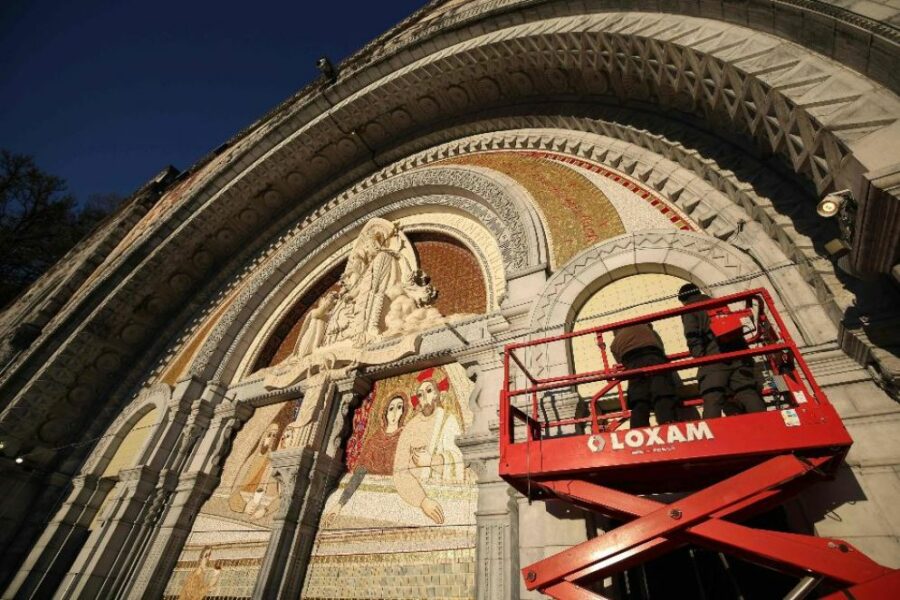
The Lourdes shrine will cover all of Marko Rupnik’s mosaics located on the façade of the Basilica of Our Lady of the Rosary and will keep them hidden after the visit that Leo XIV will make at the end of September. The Bishop of Tarbes and Lourdes, Bishop Jean-Marc Micas, has now confirmed that the measure will be permanent and that a process will subsequently be opened to decide on a new decoration for the façade.
The decision represents a further step beyond what had been announced so far. InfoVaticana reported on 5 August that the mosaics would remain covered during Leo XIV’s visit. Micas has now clarified, according to statements reported by La Dépêche, that they will not be uncovered again once the papal pilgrimage has concluded.
Read also: Lourdes will cover Rupnik’s mosaics during Leo XIV’s visit
The mosaics will remain covered after the Pope’s visit
“The Holy Father’s visit to Lourdes is an opportunity to take a further step on this matter,” Micas explained. According to the bishop, all the works on the façade will be covered and the space will be redecorated on the occasion of Leo XIV’s apostolic journey.
The change will not be provisional. Micas has indicated that the mosaics will remain covered after the Pontiff’s pilgrimage and that a new phase of reflection on the definitive decoration of the basilica will subsequently begin.
The commission that has been studying the future of the works over the past few years will be expanded to include, among others, artists and theologians. The aim will be to examine what new artistic solution will be adopted for the façade.
Rupnik’s mosaics have occupied a particularly visible place in the shrine since 2008, when they were installed to mark the 150th anniversary of the Virgin’s apparitions in Lourdes. The compositions depict the luminous mysteries of the Rosary and frame the entrances to the Basilica of the Rosary.
A process begun in 2023
The decision does not arise solely in view of Leo XIV’s forthcoming visit. Micas began studying the future of the mosaics in 2023, after accusations of sexual, spiritual and psychological abuse against the former Slovenian Jesuit became public.
In March of that year, the bishop announced the creation of a working group to examine possible measures. The commission included victims of abuse, specialists in sacred art, jurists, prevention officers and chaplains of the shrine.
Read also: The Bishop of Lourdes will study the removal of Rupnik’s mosaics from the shrine
In July 2024, Micas made his personal position public: he considered it preferable to remove the works. He did not take that decision immediately because of the division over what to do with them, but he ordered that they no longer be illuminated during the night processions.
The next step came in March 2025, when the mosaics on the basilica doors began to be physically covered. The bishop explained at the time that the measure was intended to facilitate access to the church for people who, because of the abuse they had suffered, found Rupnik’s works an obstacle to entering.
Read also: The Bishop of Tarbes orders the covering of Rupnik’s mosaics at the Lourdes shrine
Micas’s criterion does not depend on the outcome of the proceedings against Rupnik
The Bishop of Tarbes and Lourdes has repeatedly linked his decision to the contact he has maintained with victims of abuse. Micas recently explained that some people had told him that the presence of the works made it especially difficult to come to Lourdes, a shrine associated with the consolation of the sick and those who suffer.
For this reason, he has stated that his pastoral criterion will not depend on the outcome of the canonical process opened against Rupnik. Even a possible ruling in favour of the priest would not, according to the bishop, lead to a reversal of the decision on the mosaics.
Rupnik was expelled from the Society of Jesus in 2023 for disobeying the restrictions imposed on him. He faces numerous accusations from women who denounce sexual, spiritual and psychological abuse committed over the years.
The canonical process remains open
The proceedings against Rupnik are currently continuing in Rome. Last July, the Holy See had to deny reports claiming that the tribunal had decided to acquit the former Jesuit.
The Vatican Press Office stated at the time that those reports were “completely unfounded” and confirmed that the tribunal was still examining the documentation. The judicial body is composed of five judges external to both the Dicastery for the Doctrine of the Faith and the Roman Curia.
Read also: The Holy See comments on the Rupnik case: “There is no decision by the tribunal”
Lawyer Laura Sgrò, representing several complainants, has publicly questioned the lack of information about the progress of the process. According to her, the women she represents had not been called to testify and their attempts to obtain information from the Dicastery for the Doctrine of the Faith had gone unanswered. InfoVaticana already reported in July on the doubts surrounding the conduct of the proceedings.
From a provisional measure to a permanent decision
The main novelty now announced by Micas lies, therefore, in the definitive nature of the concealment. In three years, Lourdes has moved from studying what to do with the mosaics to ceasing to illuminate them, progressively covering some of the works and, finally, deciding that the entire façade should be free of their display.
Leo XIV’s visit will serve to complete that process, but it will not be its cause or its conclusion. After the papal trip, the mosaics will remain hidden and the diocese will begin to study with artists and theologians what works will in future occupy one of the most visible spaces in the Marian shrine.