


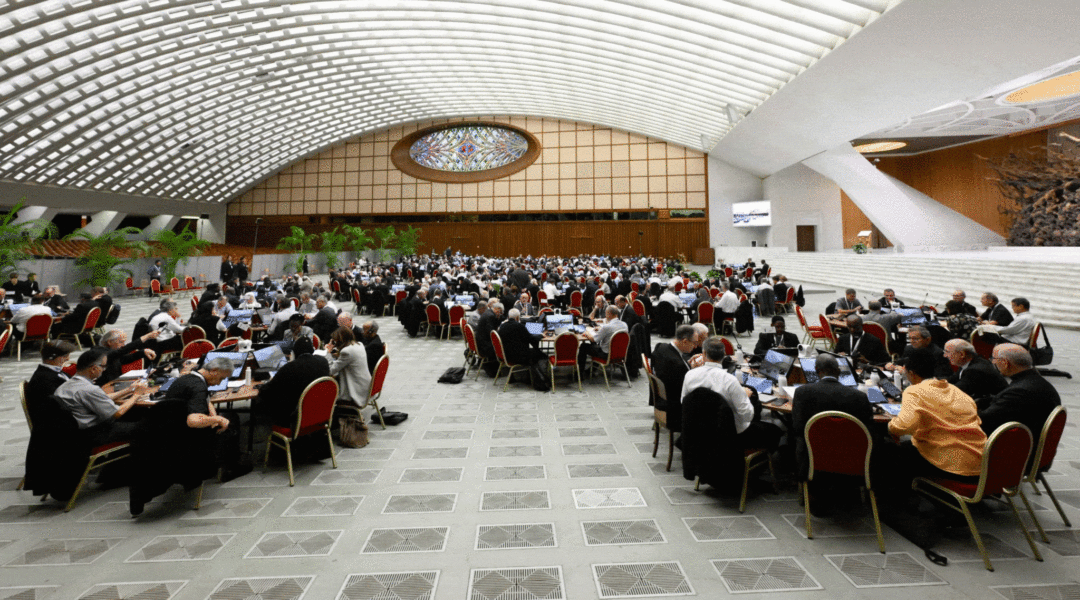
The synodality that is spreading in the universal Church shows how little the Church itself has understood the Second Vatican Council. An opinion article by Martin Grichting
The Second Vatican Council did not create a new Church. But it did intend to bring about a new social form of the Church, one that would once again be in harmony with the demands of the times. For the Council Fathers, the decisive political innovation since the Council of Trent (1545-1563) lay in the fact that the nature of the State had changed. From the absolutist State, through which the king and the nobility also dominated society, there emerged, due to the Enlightenment and democratization, the secular rule of law. This is characterized by the fact that it no longer seeks to dominate the whole of society. It is no longer a “Societas perfecta”.
This has given rise to a broad sphere called “civil society.” The modern State has been scaled back in favor of the latter. It is true that, from a legal point of view, it remains the framework and the social safety net. Moreover, through the judiciary, it acts as an arbiter between political actors and civil society. But by limiting itself to these activities, it creates space for individuals and their associations. They are encouraged to shape the sphere of civil society through their actions. This sphere also includes the economy, the media, the cultural sector, part of the educational field, pressure and interest groups, the entertainment and leisure industry, as well as sports. It is also the world of federations, associations, and foundations, which are of various kinds and pursue diverse objectives.
Once the old State had differentiated itself in this way between formal state power and civil society, the Council Fathers concluded that the Church, with regard to its relationship with the world, should do the same. This does not mean abolishing its hierarchical-sacramental order, which is inalienable. But it does mean finding a new social form that can once again be apostolically effective in a new era. One may consider the current world, marked by civil society, to be advantageous or not. But the Church must find an appropriate relationship with it. This does not mean calling into question the contents of the Christian faith.
Accepting the separation in the state sphere means that, while the hierarchy remains the main interlocutor with state power—although in the modern rule of law the laity also become political actors through elections and voting—they are now, above all, the Christian presence in civil society. Just as the latter is not state-related, the laity do not act there as official representatives of the Church. Rather, they act in their own name, as citizens who are Christians. In this conception lies the Church’s relationship with the “world,” renewed by the last Council.
The Council Fathers expressed this new attitude of the Church toward earthly realities with wisdom and foresight in “Lumen Gentium” (LG), chapter IV (nos. 30-38). They imparted to the laity a spirituality that enables them to be witnesses of Jesus Christ in a world now characterized by its marked civil society nature. However, it is evident that this theological advance has so far placed an excessive burden on both the hierarchy and the laity.
Understanding and implementing the Second Vatican Council would mean that not everything essential for Christian witness and the Church’s action in the secular sphere can any longer be carried out within the Church’s structure and through its official institutions. From now on, this must be done primarily by the laity, individually or in collaboration with like-minded people, in the multiple realities of civil society. Since the modern State has a democratic constitution, the laity are also called to bear witness in that sphere, something they necessarily cannot do there through the ecclesiastical hierarchy either, but only as individuals. However, for both aspects—both for their political witness and for that of civil society—the laity need pastoral attention, Christian formation, and the fearless witness of faith from the hierarchy.
The promotion of synodality is precisely the proof that neither the world in which we live today nor the last Council is understood. This format of debate is the counter-project to both: it calls the laity to integrate into the Church’s official structure in order to seek there, together with the ecclesiastical leadership and under its authority, official answers to the numerous questions posed by a diverse secular reality. The results of these synodal debates must then be transferred to politics and civil society in the form of documents, resolutions, and actions bearing the seal of the ecclesiastical hierarchy.
Synodality suggests to the laity that, when it comes to ecclesiastical and apostolic action in secular reality, only—or primarily—the institutional Church matters. Thus, they wait for the synodal assembly to tell them what they should do. In this way, they fail to realize what their task already is today: to make Jesus Christ—prophet, priest, and king—present in the midst of the fragmented and confusing reality of civil society. And because the current Church leadership is unable to transmit to the laity an appropriate spirituality for this, one that corresponds to their nature, they are drawn into the activity of the hierarchy. From there, they are supposed to collaborate—supposedly—in the Church’s mission. The laity are indiscriminately mixed with the successors of the apostles in the so-called synodal bodies, just as once happened in the Synod of Bishops. This once again ignores the Second Vatican Council. For in LG 10 it had still taught that there is an essential difference between the hierarchical priesthood and the common priesthood. Vatican synodal activists have for years been trying to push for the equalization of clergy and laity also in the particular Churches. The most recent example is the “Notes for the use of Bishops and synodal teams” published at the end of July 2026 by the Apostolic See. This is done with ever more verbiage and greater desperation. And it does not take root, because it does not help the faithful to live their Christianity in today’s world.
With the spread of synodality, the message is once again being transmitted today that Robert Bellarmine (1542-1621) had rightly defended in his time: the Church is as visible as the Republic of Venice. When the Reformers denied the visibility of the Church as an institution, it had to be emphasized from the Catholic side. However, this led to ecclesial life being considered as something that develops primarily within ecclesiastical institutions. From this arose, since the Baroque period, the predominant role of the parish with its associations, confraternities, and other attached bodies. At higher levels, Catholic pressure groups and even political parties were formed. These institutions, directed or at least guided by ecclesiastical authorities, were intended to carry out the Church’s orientation toward the world. Undoubtedly, this bore fruit in the situation of that time. But after the differentiation between state power and civil society, it tended to form a world apart, increasingly less capable of imprinting a Christian mark on these realities.
Today, synodality is a repetition of what has become an anachronism. That is why contemporary synodalists, who often look with contempt on those who follow the Tridentine liturgy, are themselves—in a problematic sense—Tridentine. However, they differ from liturgical Tridentines in one point: they do not realize that they themselves remain Tridentine (ecclesiologically and politically). For the Church is no longer simply opposed, as in the Middle Ages, as a spiritual “Societas perfecta” to the all-dominating state “Societas perfecta.” Rather, although it still confronts state power, it now lives primarily—especially through the laity—in the midst of the reality of civil society. It can no longer confront the latter simply from outside, through the ecclesiastical hierarchy or para-ecclesial bodies. Rather, the secular world must be permeated “from within” (LG 31) by the laity with a Christian spirit.
The Fathers of the Second Vatican Council understood the fundamental change that has taken place in earthly realities since the Modern Age. They understood modernity better than today’s synodalists, who believe themselves to be modern. For the latter remain mentally anchored in the categories of the past. By applying anachronistic recipes, synodalists obscure the hierarchical and sacramental nature of the Church and introduce into it conflicts of competence between clergy and laity. It would be naïve to confuse the noise caused by synodalists with the resonance of the Gospel in political and civil society realities.
Note: Articles published as Tribuna express the opinion of their authors and do not necessarily represent the editorial line of Infovaticana, which offers this space as a forum for reflection and dialogue.