


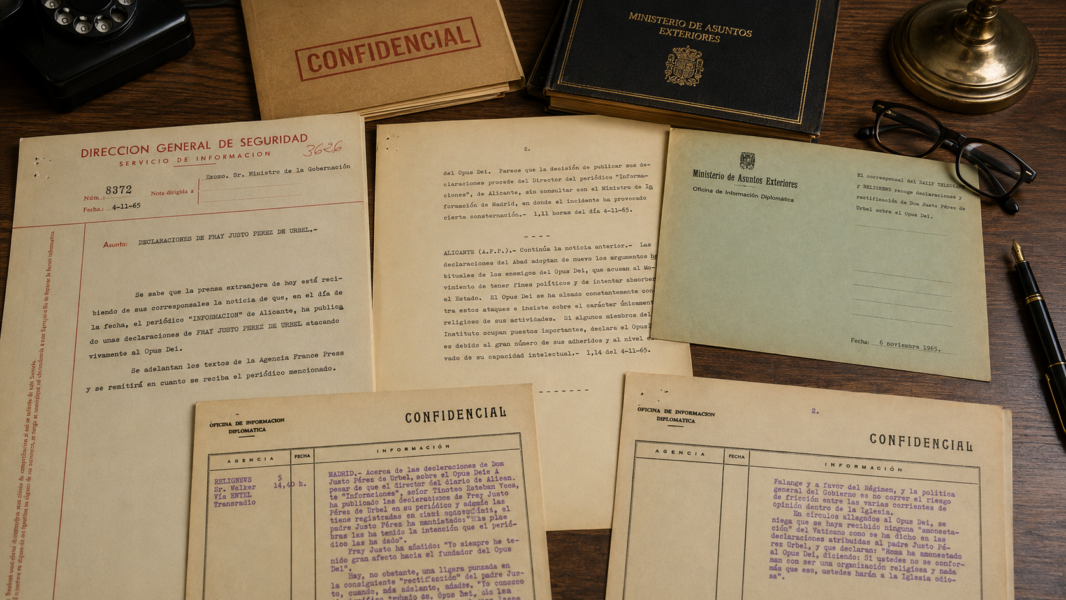
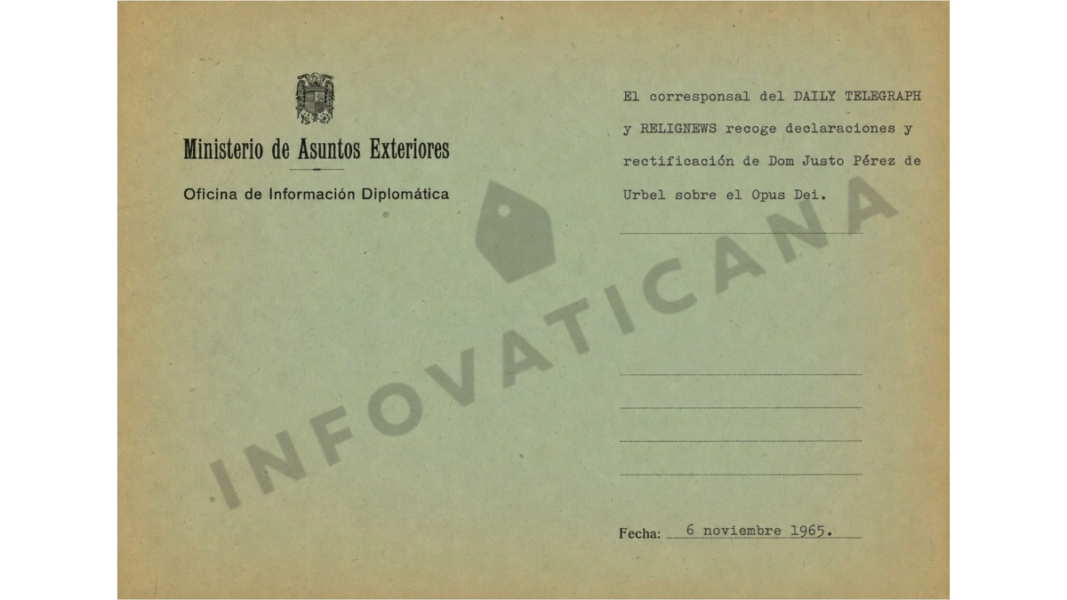
A note from the Dirección General de Seguridad to the Minister of the Interior and a confidential bulletin from Foreign Affairs, which InfoVaticana publishes today for the first time, reconstruct the forty-eight hours of November 1965 in which fray Justo Pérez de Urbel, abbot of the Valley of the Fallen, said out loud what the Falange whispered about Opus Dei, and the State machinery rushed to put out the fire.
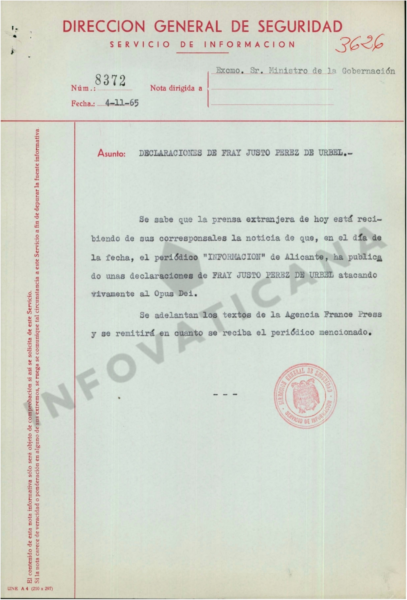
On 4 November 1965, with the Second Vatican Council in its final stretch, the Information Service of the Dirección General de Seguridad registered note number 8372, addressed to the Minister of the Interior, Camilo Alonso Vega. The subject, typed in capital letters: «Statements by Fray Justo Pérez de Urbel». The text is brief and urgent: «it is known that the foreign press today is receiving from its correspondents the news» that the newspaper Información of Alicante has published that same day statements by the abbot of the Valley of the Fallen «sharply attacking Opus Dei». The DGS attaches the France Presse teletype dispatches and promises to forward the newspaper «as soon as it is received». The detail is not minor: the State learned what an Alicante newspaper was publishing through Paris.
Neither of the two documents has been cited until today in the bibliography on the Valley of the Fallen nor in the histories of Opus Dei: InfoVaticana publishes them for the first time.
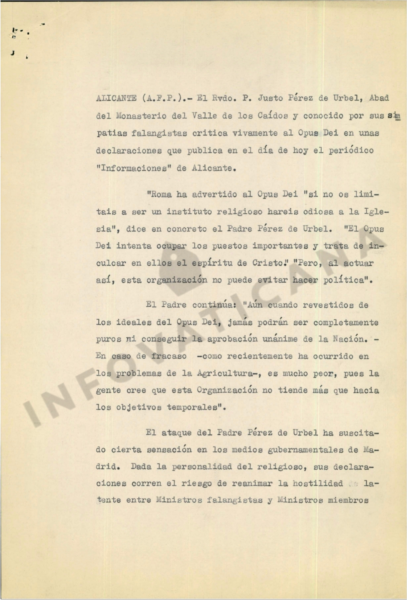
The attached cables capture the substance of the attack. «Rome has warned Opus Dei: if you do not limit yourselves to being a religious institute you will make the Church odious», the abbot states according to France Presse. And he continues: «Opus Dei seeks to occupy important posts and tries to instil in them the spirit of Christ. But, in acting this way, this organisation cannot avoid engaging in politics». The abbot concludes: «Even when clothed in the ideals of Opus Dei, they will never be able to be completely pure nor obtain the unanimous approval of the Nation. In case of failure—as has recently occurred in the problems of Agriculture—it is much worse, for people believe that this Organisation tends only toward temporal objectives».
The speaker was no ordinary clergyman. Fray Justo Pérez de Urbel, a Benedictine from Silos, medievalist, national councillor of the Movement and procurator in the Cortes, had been since 1958 the first mitred abbot of the Holy Cross of the Valley of the Fallen. He was, moreover, an old acquaintance of the Work: the official accounts of Opus Dei themselves recall that in 1942 he visited Escrivá at the Diego de León centre and that he was the one entrusted with teaching Liturgy to the first three faithful of the Work ordained priests, among them Álvaro del Portillo. The attack came from within the family.
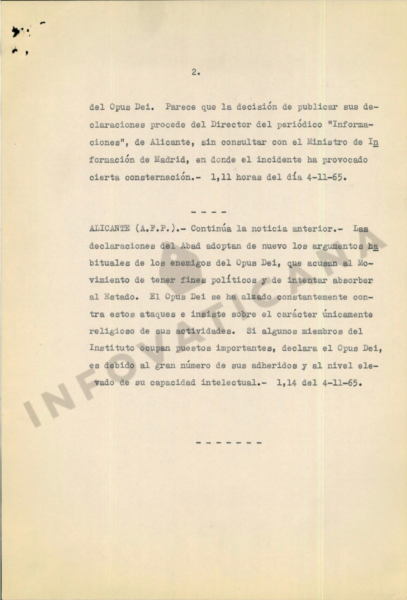
France Presse immediately gauged the political reach: the statements had caused «a certain sensation in governmental circles in Madrid» and ran «the risk of rekindling the latent hostility between Falangist Ministers and Ministers who are members of Opus Dei». It also recorded the detail that hurt most in the Council: the decision to publish had come from the newspaper’s director, «without consulting the Minister of Information in Madrid», where the incident had provoked «a certain consternation». The structural reading is inevitable. Información was not just any newspaper, but the flagship of the Press Chain of the Movement, then directed by Timoteo Esteban Vega, a career journalist in the house: a Falange newspaper fired at Opus Dei, bypassing Fraga’s ministry.
The second document is dated 6 November and stamped «Confidential». It is a bulletin from the Diplomatic Information Office of the Ministry of Foreign Affairs that reproduces the dispatch of the agency Relignews signed by the Daily Telegraph correspondent in Madrid. By then fray Justo had already retracted: «My words did not have the intention the newspaper gave them», and «I have always had great affection for the founder of Opus Dei». The bulletin, however, records beforehand a damning detail for the retraction: the newspaper’s director had not only published the statements, but «moreover has them recorded on magnetic tape».
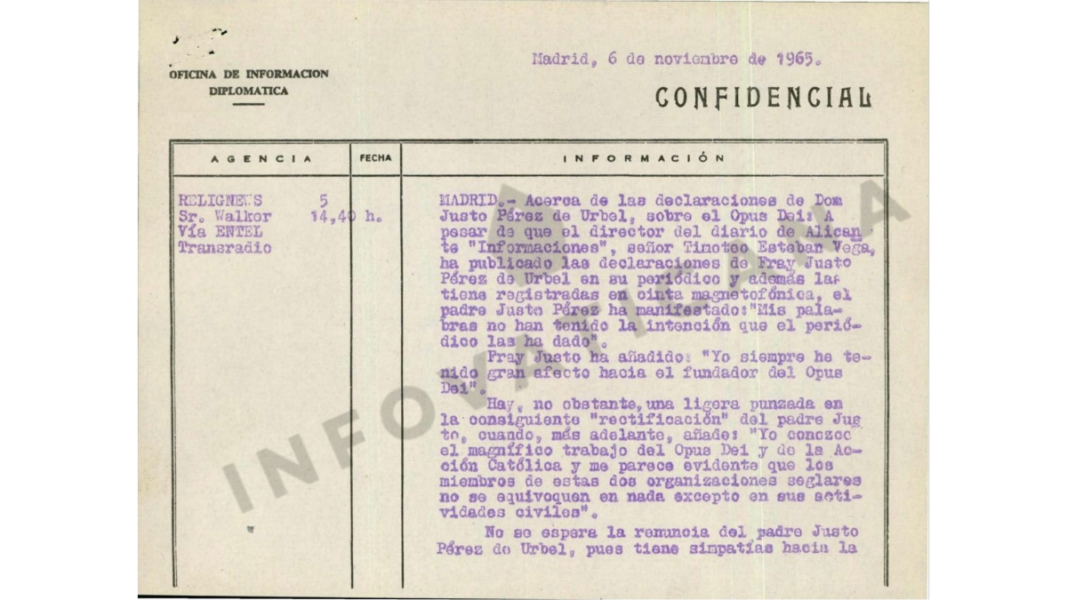
The jewel of the file follows. The anonymous analyst from Foreign Affairs, himself placing the word in quotation marks, notes: «There is, nevertheless, a slight sting in the subsequent «retraction» of Father Justo», when the abbot adds that members of Opus Dei and of Catholic Action «are not mistaken in anything except in their civil activities». In other words: he retracted everything except the thesis.
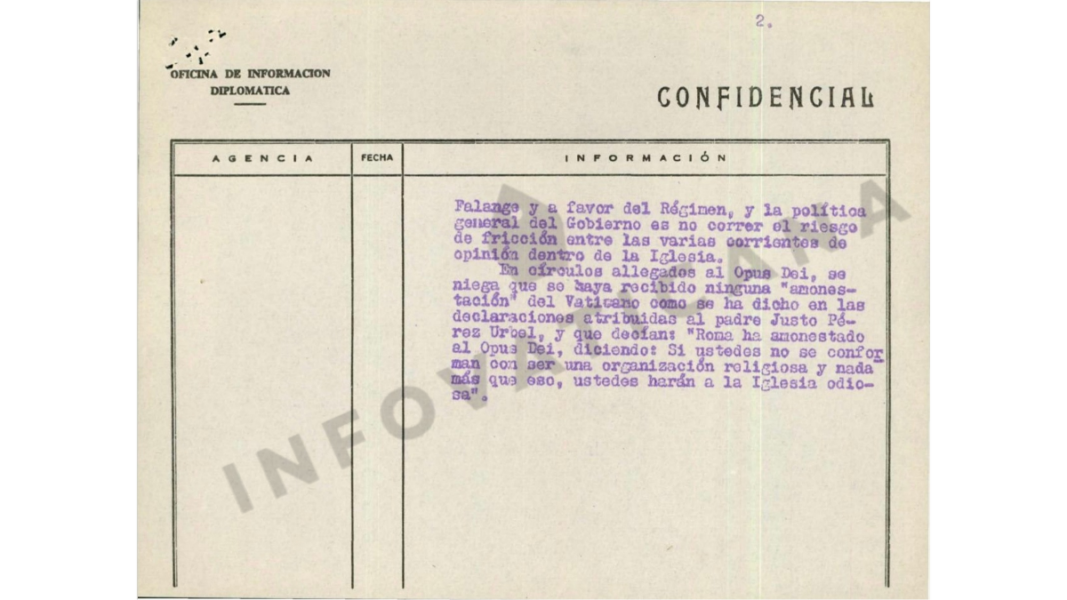
The bulletin concludes with two State observations. First: the abbot’s resignation is not expected, «since he has sympathies toward the Falange and in favour of the Regime, and the general policy of the Government is not to run the risk of friction among the various currents of opinion within the Church». Second: «in circles close to Opus Dei it is denied that any «admonition» from the Vatican has been received», against the version attributed to the abbot: «Rome has admonished Opus Dei, saying: if you do not conform to being a religious organisation and nothing more than that, you will make the Church odious».
The documents do not settle whether the Roman warning existed; they record the attribution and the denial. What was indeed a live issue in Rome at that time was the Work’s discomfort with its secular institute status: the 1962 efforts to change its canonical standing had been rejected, and the question would not be closed until the personal prelature of 1982.
The second wave of France Presse carried the usual institutional defence: the abbot’s arguments are «the habitual ones of the enemies of Opus Dei»; the Work insists «on the solely religious character of its activities»; and if some of its members occupy important posts, «it is due to the great number of its adherents and the high level of their intellectual capacity».
Fray Justo resigned the abbacy in September 1966, officially for health reasons. Alonso Vega, the minister who received the note, had attended his abbatial blessing seven years earlier. The file was archived. The magnetic tape, as far as is known, never appeared.