


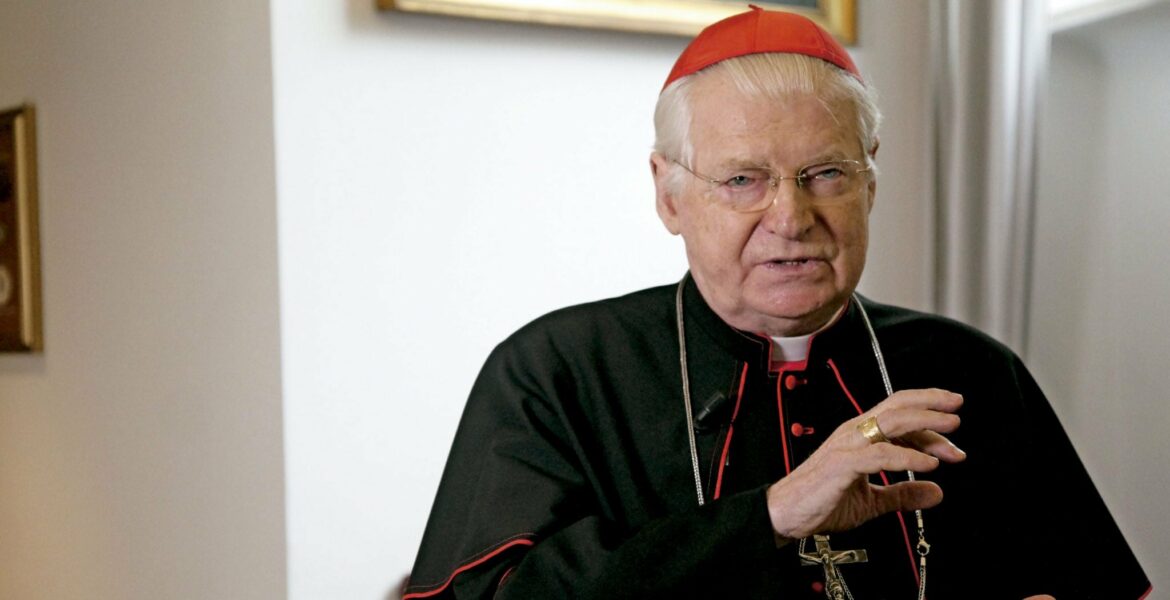
Cardinal Angelo Scola, Archbishop Emeritus of Milan and former Patriarch of Venice, has warned of the risk that synodality could end up becoming a parliamentary dynamic if it is separated from the ecclesial communion that must sustain it. The Italian cardinal defended the usefulness of the synodal method, but stressed that it does not in itself constitute the foundation of the Church’s life: “The source of synodality is communion.”
Scola made these remarks in an interview granted to Monsignor Willy Volonté, rector of the Diocesan College of Breganzona, published on the occasion of the launch of an edition of Communio for Italian-speaking Switzerland. The international theological journal was founded in 1972 by Hans Urs von Balthasar, Henri de Lubac and Joseph Ratzinger, and the new edition will be presented on August 23 at the Meeting of Rimini.
The risk of a parliamentary synodality
Asked specifically about the danger that synodality might turn into a parliamentary process rather than an expression of the Church’s communion, Scola acknowledged that the risk exists.
“That is correct,” the cardinal replied. However, he ruled out that the solution lies in abandoning the synodal method. “Synodality is a method that encompasses all the possibilities it can express. This aspect should not be eliminated, but presented in such a way that it finds a compelling and substantial proposal,” he explained.
The former Archbishop of Milan thus placed the issue not so much in the mechanisms of participation as in the principle from which they must proceed.
“Today in the Church there is much talk—and rightly so—of synodality, understood as a method, as a path,” he stated. But he immediately introduced the distinction that structures his reflection: “The source of synodality is communion: lived communion is the spring water that the synodal method must channel so that it bears fruit in building a Church of communion.”
Scola’s warning comes as the process begun with the Synod on Synodality has entered its implementation phase in the dioceses and will continue over the coming years.
The method cannot replace communion
Scola insisted that the synodal element must find an increasing place in the life of the Church, but always subordinate to the ecclesial reality it seeks to express.
“It is important that the synodal element be increasingly highlighted in the Church, so that the attempt to give shape to communal action becomes a truly effective way of living out the Christian life,” he noted.
The distinction is central to his statements: synodality appears as a method or path, while communion constitutes the prior reality that gives it meaning. In this way, the multiplication of consultations, meetings or participatory mechanisms would not by itself guarantee greater ecclesial communion.
The issue has gained particular relevance as dioceses begin to put into practice the conclusions of the synodal process. Just a few days ago, the Bishop of Oslo, Fredrik Hansen, drew a similar distinction when announcing the first diocesan synod of his particular Church: “A diocesan synod is not a democratic assembly,” he stated, while excluding from any vote matters relating to doctrine, faith and morals.
Scola calls for a more creative Christian life
The cardinal also addressed the obstacles that, in his view, currently hinder a fuller living out of the faith. Among them he pointed to a conception of the Christian life that, despite maintaining generous proposals, can end up being “passive” and “not very creative.”
Scola considers it necessary to recover the capacity to develop the creativity that springs from the Christian experience itself and to overcome certain attempts that he described as ineffective in sustaining the Christian project.
In this context he also places the mission of the new edition of Communio. Asked about the contribution the journal can make to an authentic experience of communion, he replied bluntly: “As far as possible, it must do so. Because if it does not, it has no future.”
The experience of Communio alongside Ratzinger, Balthasar and de Lubac
The interview also allowed Scola to recall his early years around Communio and his relationship with the great theologians who promoted the publication.
“We were nothing compared to de Lubac, Balthasar and Ratzinger,” the cardinal acknowledged when recalling the “great respect” that the young Italian collaborators felt for the three founders.
According to Scola, that experience did not arise simply from an editorial or academic project, but from personal relationships and a strong desire to communicate a certain reflection on the Church. The young Italians, he explained, had “a capacity for adherence” and the will to bring to light ideas that might otherwise not reach the public.
From its first German and Italian editions, Communio later spread to other countries. The new edition for Italian-speaking Switzerland, published by Edizioni Cantagalli, will have an editorial board made up of theologians and academics from the Italian-speaking Catholic world.
Recalling that experience, Scola returned to the same question that runs through his reflections on synodality. When asked whether communion is achieved through unity or through diversity, he refused to remain solely with differences and called for attention to be directed toward that “more” that communio can offer.
For the cardinal, the experience of the journal is precisely an example of that search: a diversity of voices that does not turn the Church into a parliament of opposing positions, but finds its starting point and its purpose in communion.