


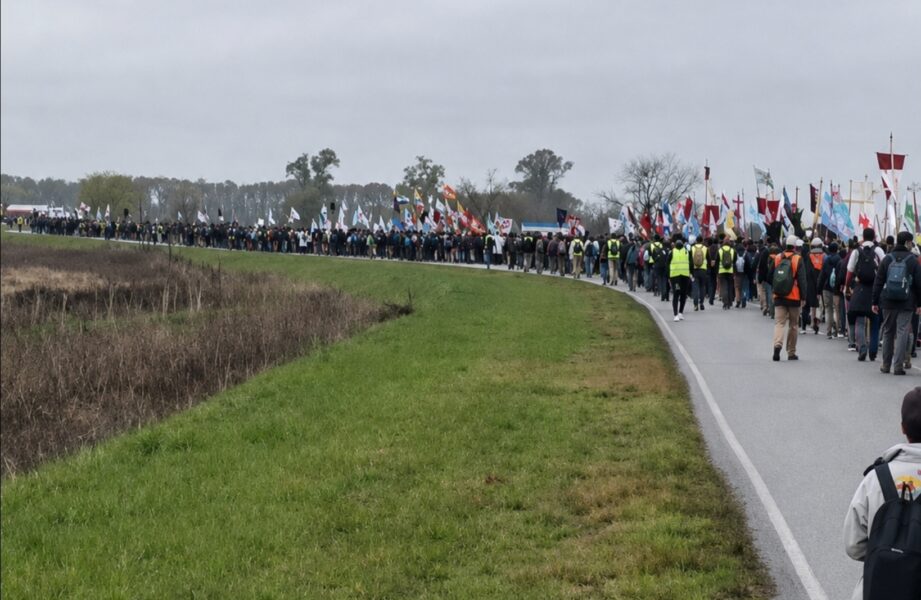
More than 2,300 pilgrims have walked the hundred kilometers separating Rawson from the Basilica of Our Lady of Luján this weekend in the XVII Pilgrimage of Our Lady of Christendom, the great penitential march of traditional Argentine Catholicism inspired by Chartres. Three days of traditional Mass, rosary, confessions and adoration under the motto “Behold your mother” (Jn 19, 27), and a new record of participation that confirms the unstoppable growth of traditional pilgrimages around the world.
The column set out on the morning of Friday, August 15, the solemnity of the Assumption of the Virgin, from the Church of the Immaculate Conception in Rawson, in the heart of the Buenos Aires pampas. Pilgrims had begun arriving in the town the day before and during the early hours, and at 8:30 the march set off toward the shrine of the patroness of Argentina, organized in chapters, with the Holy Mass celebrated each day in the traditional form of the Roman rite at field altars, the recitation of the rosary, nocturnal adoration of the Blessed Sacrament, and priests hearing confessions along the entire route. The organizers strive to ensure one priest for every hundred pilgrims, “because confession cannot be lacking: it is fundamental for there to be a real conversion,” as Nicolás Stier, one of the founders of the march, explained to InfoCatólica.
“Behold your mother”
The motto of this seventeenth edition refers to Christ’s words on the Cross entrusting His Mother to the beloved disciple. The organizers wanted the three days of walking to deepen the spiritual motherhood of Mary, presented as guide and consolation of the pilgrims from the Incarnation to Calvary. As every year, hundreds of pilgrims took advantage of the march to make or renew their consecration to the Immaculate Heart of Mary according to St. Louis Marie Grignion de Montfort and to receive the imposition of the scapular.
The profile of the walkers once again refutes those who present the traditional liturgy as something for nostalgics: the majority of pilgrims are between 18 and 30 years old, and family chapters—which walk half the stages with small children and strollers—have become the seedbed of the pilgrimage. On the final day, as usual, the column was swelled by family members and friends who came for the last stretch to the basilica.
From four pilgrims to more than 2,300
The figures for this edition confirm a sustained progression that is already part of the history of Hispanic-American Catholicism. The adventure began in 2010, when four friends—contagious from the Chartres experience—set out and arrived in Luján numbering only eighteen. From there the numbers grew to 50, to 100, to 200; in 2023 there were 1,600 registered; in 2024 they approached 2,000, already with chapters arriving from Mexico; in 2025 more than 2,200 pilgrims set out from Rawson, and this year the departure exceeded 2,300, a hundred more than the previous edition. “We always grow. Slowly and steadily, but we grow. At least five or ten percent a year,” summarizes Stier, who attributes the phenomenon to a single cause: “This growth is explained by the fruits it generates in souls. Otherwise, it has no explanation. ‘By their fruits you will know them.’”
Without Mass in the basilica, another year
The pilgrimage culminated this Sunday, August 17, before the national shrine of Luján with adoration of the Blessed Sacrament and the recitation of the rosary. Once again, however, the closing Mass could not be celebrated inside the basilica: the prohibition decreed by the bishop of Mercedes-Luján after Traditionis custodes remains in force, and the final Mass had to be prayed outside the church before the last stretch on foot to the shrine.
“It seems there is room for ‘everyone, everyone, everyone,’ but not for the traditional Mass,” lamented Stier on the eve of departure in an interview by Javier Navascués published in InfoCatólica. The founder of the pilgrimage affirmed that the struggle for the liberation of the traditional liturgy “is, above all, spiritual”: “We pray that God may enlighten the hearts of those who are today at the head of the Church. We ask that they realize, or at least accept, that we want to live the traditional liturgy in all its splendor, as it has always been lived.”
Far from discouraging participation, the restrictions seem to have strengthened it. “Young people are looking for this. They discovered it and it is something that will not stop,” Stier said in the same interview, paraphrasing Archbishop Cordileone. “Despite all the efforts of modernism to bury the traditional liturgy, it is more alive than ever and returns with greater fervor and fruits of holiness in souls.”
From Chartres to Covadonga: a Christendom that walks
Luján does not walk alone. The Argentine march is the eldest American daughter of the Pentecost pilgrimage from Paris to Chartres, organized by Notre-Dame de Chrétienté since 1983, which in its latest edition once again approached 20,000 registered participants and hung the “sold out” sign. And the model continues to multiply: just three weeks ago, the VI Pilgrimage of Our Lady of Christendom-Spain took 1,700 pilgrims from Oviedo to Covadonga—two hundred more than last year, a new record—with 52 priests, 21 seminarians and forty chapters, eleven of them foreign, under the motto “By faith they conquered kingdoms.”
Between the two shores, collaboration is already close and fraternal: Argentine and Spanish organizers share experience and management; this summer Argentine pilgrims walked in Covadonga; an Argentine chapter carried its national banner along the paths of the Italian pilgrimage; and Argentine volunteers are even collaborating with the English march. Initiatives in the United Kingdom, Portugal and Italy are joining the network, while projects are germinating in Mexico, Ecuador and Paraguay. “It is very hopeful to see how we are becoming more and more traditional pilgrimages,” celebrates Stier, for whom this simultaneous flowering of marches under different Marian titles—Chartres, Covadonga, Luján—expresses one and the same reality: “Our Lady is the same person who appeared in each country under a different title. It is the same Church incarnate in the society and reality of each place.”
This year, among others, the Argentine pilgrims were accompanied by Father Augustin-Marie Aubry, prior of the Fraternity of Saint Vincent Ferrer (Chémeré, France), and Father Antonius Mamsery, superior of the Missionaries of the Holy Cross of Tanzania, a sign of the now universal reach of the event.
The pilgrims of Luján already have a concrete intention for next year: to celebrate the closing Mass once again inside the basilica, and for Leo XIV to restore to the Traditional Mass the freedom that Traditionis custodes took away.