


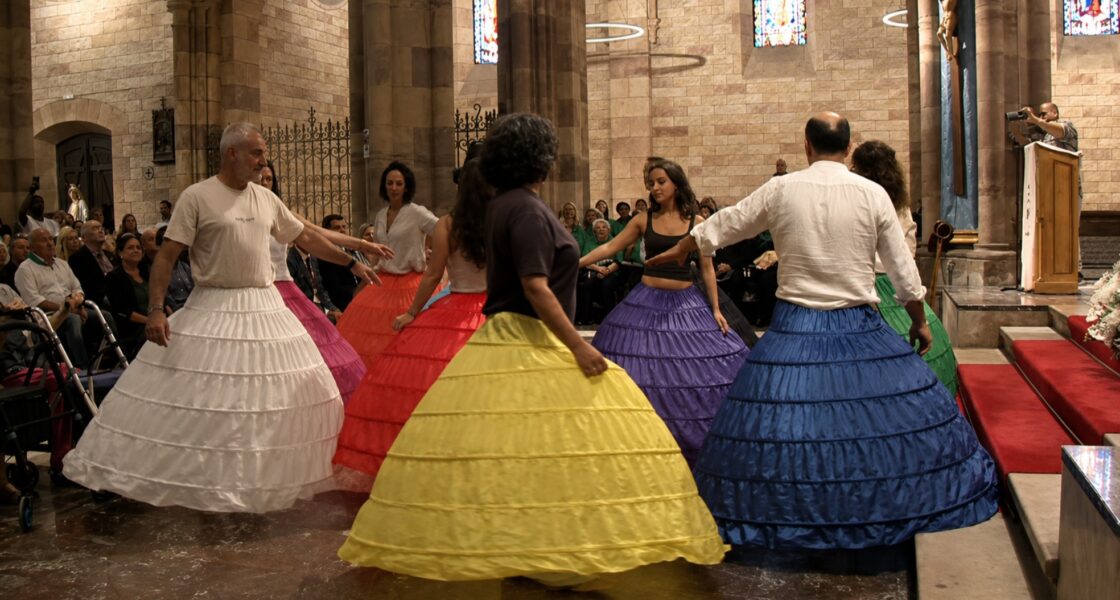
At the Solemn Mass of the Virgen Grande, broadcast live by Cantabria Televisión, the parish priest of the Assumption in Torrelavega downplayed the dogma defined by Pius XII, attributed Marian titles to “mythology,” and introduced a “contemplative dance” circling the altar in colorful skirts—including men—between the Gospel and the homily, as well as jotas and pericotes during the offertory.
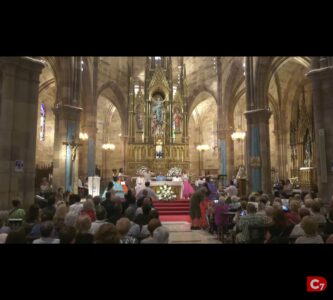
The parish of Our Lady of the Assumption in Torrelavega—the church its faithful call “our cathedral” and for which the Diocese of Santander is seeking the title of Parochial Basilica from Rome—celebrated a round anniversary this year: the 125th anniversary of its inauguration on August 15, 1901. The Solemn Mass of the Virgen Grande festivities, presided over by parish priest Juan Carlos Rodríguez del Pozo and concelebrated by the Amigonian religious Félix Martínez and Juan Manuel González, was broadcast live by Cantabria Televisión. Thanks to that broadcast, everything said and done there has been recorded.
“We don’t have to take it literally”
The most serious moment came during the homily. Speaking about the solemnity of the day, the parish priest stated, as recorded in the broadcast:
“Mary, today we celebrate that she ascends to heaven body and soul. Obviously, we don’t have to take it literally. No human being is going to ascend to heaven body and soul. Heaven is not a physical place. Heaven is a state of the soul, of fullness, of happiness.”
It is worth recalling exactly what the priest was inviting the congregation not to take “literally.” On November 1, 1950, Pius XII, in the apostolic constitution Munificentissimus Deus, exercising the supreme pontifical magisterium, “declared and defined it to be a dogma of faith divinely revealed that the Immaculate Mother of God, the ever Virgin Mary, having completed the course of her earthly life, was assumed body and soul into heavenly glory.” And the same document warns: “if anyone, which God forbid, should dare willfully to deny or to call into doubt that which we have defined, let him know that he has fallen away from the divine and Catholic faith.”
This is not, therefore, a pious image open to symbolic interpretations, but the very object of the feast being celebrated: a truth of divine and Catholic faith whose persistent denial has a name in the Code of Canon Law (cans. 750 and 751). The Catechism records it in number 966. And the priest relativized it from the ambo, at the Solemn Mass of the patroness, before the civil authorities of Cantabria and with television cameras present.
The titles of the Virgin, “mythology”
It was not an isolated slip. Moments earlier, the parish priest had explained the origin of Marian honors in these terms:
“God chooses Mary, a humble woman, a woman of the people. Mythology has made her and exalted her so much, and has put many necklaces on her, many crowns, many privileges, many titles, because sometimes we have to turn to mythology to speak of realities that are earthly […] they are worldly realities that we find hard to express in words and so we have to resort to mythology.”
The “privileges” and “titles” of the Virgin—Immaculate, Assumed, Mother of God, Queen—are not the product of any mythology: they are defined dogmas and the constant doctrine of the Church. Presenting them as a mythological device to express “worldly realities” empties Catholic Mariology of all content. All this, by the way, minutes after the assembly had sung the psalm “at your right hand stands the queen, adorned with gold of Ophir.”
Continuing in the same vein, the celebrant concluded: “titles, possessions, are the fireworks of the feasts.”
“Contemplative” dance with hoop skirts between the Gospel and the homily
The other chapter is liturgical. Right after the Gospel was proclaimed—and before the homily, that is, at the heart of the Liturgy of the Word—the parish priest announced:
“Now we are going to contemplate the contemplative dance group of the parish […] which is going to give us a nod on this 125th anniversary. We are going to see many colors that symbolize the rose window […] the colors, the diversity, the joy […] They are going to dance in a circle. The circle is perfection […] Around the table of the Eucharist no one is left out […] So, with these keys, let’s enjoy this for a moment.”
Immediately afterward, a group of men and women dressed in enormous hoop skirts in garish colors—orange, fuchsia, red, purple, sky blue, white, yellow—performed a choreography in a circle, holding hands, on the red carpet of the sanctuary, at the foot of the altar. When they finished, there was applause in the church and a commentary from the celebrant: the dance “has been enveloping us in that circle of love and solidarity.”
The Holy See settled this question half a century ago. The Congregation for Divine Worship, in its pronouncement on dance in the liturgy (Notitiae, 1975), established that in the Western tradition dance cannot be introduced into liturgical celebrations: doing so “would mean introducing an atmosphere of profanity into the liturgy,” and if one wishes to offer a dance as a cultural expression, it must be done outside the celebration. The instruction Redemptionis Sacramentum (2004) reproves elements of spectacle in the Mass (n. 57) and recalls that the liturgy is not available for anyone’s creativity: “no one, not even a priest, may add, remove, or change anything in the liturgy on his own authority” (Sacrosanctum Concilium 22 §3; can. 846 §1).
Jota, pericote, and picayos during the offertory; speeches and gift-giving after Communion
The second dance intervention was carried out by the Nuestra Señora de las Nieves Dance Group of Tanos, which is celebrating its centenary. The broadcast itself describes it: during “the first part of the offertory” the group “danced a jota and a pericote and said goodbye with the picayos dance.” That is, while the gifts were being prepared for the Holy Sacrifice, the sanctuary hosted a regional folklore performance. No one disputes the picayos before the image of the patroness in the procession—legitimate popular piety, with centuries of history and its proper place, in the street—; what has no place is moving the performance inside the liturgical action, exactly the distinction made by the Holy See.
After Communion, and before the final blessing, the Mass was interrupted again for a “protocolary act”: the presentation of a painting of the parish to the group, the reciprocal presentation of the group’s coat of arms, and speeches by their representatives from the sanctuary, including a “challenge” for the following year. All this within the celebration, with the Blessed Sacrament just distributed.
A model Mass… of what should not be done
The whole—liturgical formulas altered to the celebrant’s taste from the initial greeting, scenic dance after the Gospel, folklore during the offertory, speeches and gifts after Communion, and above all the public relativization of a dogma of faith on the day of its solemnity—paints the portrait of a liturgy understood as a community festival and of a preaching that has replaced the content of the faith with vague notions about welcome and diversity.
The paradox is painful: it happens in a church aspiring to the title of Basilica, on its 125th anniversary, before the President of Cantabria and the municipal corporation, and with a television broadcast. Precisely because of that visibility, what happened has exemplary value for the entire diocese.
It is up to the Bishop of Santander, Don Arturo Ros—mentioned in the canon of this very Mass—as the first person responsible for the liturgical life of his diocese (can. 838; Redemptionis Sacramentum 19-25), to clarify whether he knew about and authorized what happened and, above all, whether he considers it compatible with the Catholic faith that one of his parish priests should preach, on the day of the Assumption, that “no human being is going to ascend to heaven body and soul.” The faithful have the right—a right, not an aesthetic preference—to have the liturgy celebrated in accordance with the norms of the Church and to be preached the faith of the Church, not the celebrant’s opinions (Redemptionis Sacramentum 11-12).