


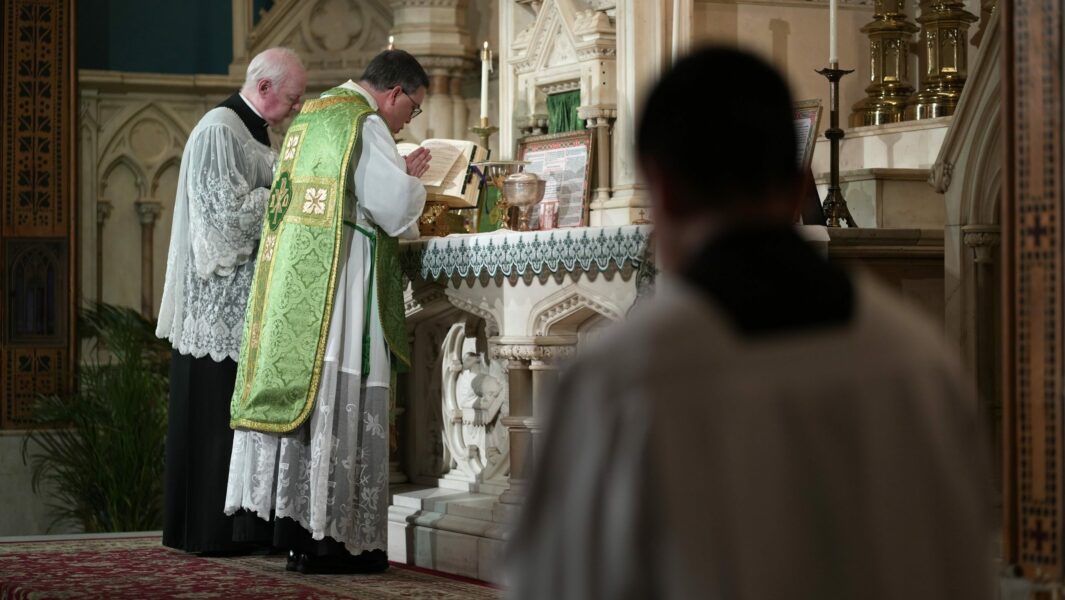
There is a falsehood we have accepted for too long without confronting it: the supposed opposition between fidelity to doctrine and liturgy, on the one hand, and mercy, humility, and closeness, on the other. The pattern repeats itself with exasperating self-assurance. You ask that the rubrics be observed? Then you are rigid. You recall what the Church teaches on an uncomfortable moral issue? You lack pastoral sensitivity. You receive Communion on your knees? You are probably vain or scrupulous. You maintain that a priest cannot celebrate according to his whims, nor a Catholic reshape doctrine according to his preferences? There must be something of the Pharisee in you. For decades we have endured this caricature as though it contained some serious argument. It does not.
For in all that reasoning the fundamental link is precisely missing: what does one thing have to do with the other? Since when does fidelity prevent charity? Since when does obedience to the Church incapacitate one for attending to the poor, accompanying the sick, listening to the suffering, or welcoming the sinner? The opposition is absurd, yet it has been repeated so often that it has come to function as a conditioned reflex: merely recall a liturgical norm or a doctrinal truth and someone immediately triggers the spring of “rigidity,” “Pharisaism,” or “lack of mercy.” There is no longer even any need to discuss the substance. The one who raises the objection is morally discredited and the matter is settled.
The mechanism is exactly the same in liturgy and in doctrine. In the liturgy, someone decides that a rubric is too cold, too ancient, or insufficiently pastoral and replaces it with what he considers more fitting. In doctrine, someone concludes that a teaching of the Church is too demanding, uncomfortable for the contemporary world, or difficult to explain, and begins to erode it through exceptions, silences, and reinterpretations. In both cases the same moral alibi appears afterward: it is not a matter of disobeying, but of being merciful; it is not a matter of placing one’s own criterion above what has been received, but of attending to “what truly matters.” And whoever points out that it is not for each individual to decide which part of the faith or the liturgy deserves to remain in force is quickly placed in the dock of the rigid.
Reality, however, refutes that imposture every day. There are priests who spend their lives for their faithful, who live with an austerity that would shame their critics, who spend hours in the confessional, who travel kilometers to visit the sick, and who sustain entire parishes with a silent poverty of dedication, and who moreover celebrate Holy Mass with fidelity and preach without mutilating what the Church teaches. There are missionaries who have left homeland, family, and comforts to disappear in places where no one will see them and who do not need to water down a single truth of faith in order to love the persons before them. There are religious sisters who spend their lives caring for the elderly, the sick, orphans, and the poor, and whose existence is sustained by a spiritual, doctrinal, and liturgical discipline that some despise as “rigidity.” Do they also lack mercy? The accusation is not only intellectually weak; it is offensive.
Perhaps the question needs to be inverted once and for all. Is it not precisely an act of humility to assume that you, a poor nobody, are not the one to invent how Holy Mass is celebrated or to correct what the Church has received and taught? The priest does not approach the altar to express himself, nor does the theologian receive Revelation as raw material to be updated at his pleasure. Neither stands before a blank page. The liturgy does not belong to the celebrant, and doctrine does not belong to the interpreter. Both are realities received, prior to us, and destined to outlive us. Words we have not written, a faith we have not founded, sacraments we have not invented, and a tradition that infinitely surpasses us.
Here lies one of the most elementary forms of humility: knowing one’s own place. Accepting that not everything depends on oneself. Understanding that one’s own sensibility is not the measure of the Church, that our pastoral intuitions do not constitute a new source of revelation, and that our whims do not necessarily improve what we have received. A well-placed ego also knows how to obey when it does not fully understand, when the norm does not coincide with its tastes, or when the doctrine is unpopular.
The one who respects a rubric is suspected of rigidity, and the one who alters it to his liking presents himself as pastoral. The one who recalls an uncomfortable teaching must first explain that he hates no one, while the one who empties it of content automatically receives the presumption of compassion. As though mercy belonged by definition to the one who lowers the demand and never to the one who has the difficult task of telling the truth. As though it were impossible to embrace the sinner without blessing the sin, or to accompany fragility without turning it into a doctrinal criterion.
It is especially irritating that those who permit themselves such irregularities later point the finger at the faithful who receive Communion on their knees, at the priest who respects the rubrics, at the father who wishes to transmit to his children what the Church has always taught, or at the Catholic who dares to recall that certain questions are not open to permanent renegotiation. “Rigid,” “Pharisees,” “scrupulous,” “integrists,” “obsessed with norms”: the labels are distributed with prodigality precisely by those who claim to deplore judgments about others. They attribute to themselves the power to decide who is humble, who is merciful, which doctrine remains pastorally acceptable, and which rubric may be sent to the attic. And then they call proud the one who asks by what authority they do so.
It is therefore fitting to ask where the Pharisaism truly lies. For there is far more pride in believing oneself authorized to remake the liturgy according to one’s own criterion than in kneeling before God, and far more arrogance in effectively correcting the doctrine of the Church than in accepting that one is not its master. Fidelity can, of course, be turned into a motive for pride, because no human sensibility is vaccinated against pride. But it is grotesque that those who have made their own sensibility the ultimate criterion systematically accuse of ego those who, precisely, accept submitting it to something above themselves.
For too long we have been told that “what matters” is not norms, nor formulas, nor definitions, but persons. The phrase carries that unmistakable ring of a certain Catholicism of the eighties that still survives by inertia: less doctrine and more Gospel, less rubrics and more life, less norms and more mercy. As though the Gospel did not contain doctrine, as though the liturgy were not the life of the Church, as though mercy could exist separated from truth. That mantra worked for decades (while churches and seminaries emptied) because it presented some as men of heart and others as somber guardians of regulations. But the caricature is expiring. It is becoming increasingly difficult to conceal that behind many appeals to spontaneity and mercy there was, quite simply, a claim of ego.
The underlying question was never mercy versus rigor. It was another: who commands. Whether we receive the liturgy or fabricate it. Whether doctrine obliges us or we judge which parts of doctrine remain acceptable. Whether the Church possesses something to transmit or each generation is authorized to recompose it according to the cultural climate of the moment. Once formulated in this way, much of the artifice collapses, because the supposed humble person who continually invokes mercy ends up appearing as what he often is: someone convinced that his personal criterion is more human, more Christian, and wiser than what he received.
One can be rigorously faithful and profoundly merciful. One can love the rubrics and spend oneself for the poor or the sick. One can uphold doctrine in its entirety and treat with infinite delicacy the one who does not manage to live according to it. One can defend tradition and give one’s life for others. And one can also speak continually of humility while placing one’s own criterion above the liturgy and the faith of the Church. That may be called creativity, discernment, pastoral care, aggiornamento, or mercy. The vocabulary changes; the mechanism is the same. Often it is nothing more than ego—perhaps even a well-intentioned ego, but ego nonetheless.