


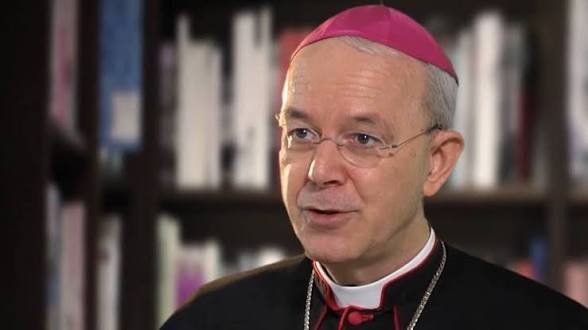
Auxiliary Bishop of Astana, Monsignor Athanasius Schneider, has issued his first public statement since Rome declared that the six bishops of the Priestly Fraternity of Saint Pius X (FSSPX) had incurred automatic excommunication for the episcopal consecrations celebrated in Écône on 1 July without papal mandate and against the will of Pope Leo XIV. In an extensive text published exclusively by journalist Diane Montagna and which InfoVaticana offers in full in Spanish with Monsignor Schneider’s authorization, the prelate addresses the conflict from a historical, doctrinal, and canonical perspective.
The bishop had repeatedly asked Leo XIV to grant the FSSPX the apostolic mandate necessary to ordain new bishops and thereby avoid a new rupture. In his appeal of 24 February, he expressly asked the Pontiff to act as a “bridge-builder” and warned of the danger of provoking “a truly unnecessary and painful new division within the Church.”
Now, Schneider maintains that the Fraternity faced a “tragic” and exceptional choice between obeying Rome’s directives and preserving what it considers the unequivocal integrity of Catholic doctrine and liturgy. The prelate does not issue a definitive juridical judgment on the Vatican’s actions in the document, but seeks to explain the reasons that led the FSSPX to proceed with the consecrations. His intention is to offer “elements for a deeper reflection on the current situation of the Church,” together with historical precedents that allow a better understanding of “the dilemma in which the Priestly Fraternity of Saint Pius X considers itself to be.”
The dilemma between preserving the unequivocal integrity of the Catholic faith and canonical recognition by the Pope
By Monsignor Athanasius Schneider
It is useful to recall a case in history in which a great saint faced the following dilemma: choosing between preserving the unequivocal integrity of the Catholic faith and being canonically recognized by the Pope. That saint was the fourth-century Father of the Church, Saint Athanasius of Alexandria. In 357, Pope Liberius, after signing an ambiguous formula of faith—which omitted the crucial doctrinal term “consubstantial”—ordered Saint Athanasius to enter into communion with Arian and semi-Arian bishops, bishops with whom the Pope himself, under imperial pressure, had unfortunately entered into communion. Saint Athanasius refused to obey the Pope, after which the latter, according to the testimony of Saint Hilary of Poitiers and other historical sources, excommunicated him, accusing him of disturbing the peace of the Church. Despite having been excommunicated by the Pope, Saint Athanasius continued to govern his diocese of Alexandria and even showed understanding for the lamentable conduct of Pope Liberius. However, Pope Saint Damasus, the successor of Pope Liberius, thanked Saint Athanasius and consulted him on the affairs of the Eastern bishops. Pope Liberius was the first Pope not to be canonized, while Athanasius was not only canonized but declared a Doctor of the Church.
Today, Saint Athanasius would be considered a schismatic according to the definition of “schism” in the current Code of Canon Law, since he refused to be in communion with members of the Church—heretical and semi-heretical bishops—who were canonically recognized and therefore subject to the Pope.
The episcopal consecrations carried out in Écône by the Priestly Fraternity of Saint Pius X (FSSPX) on 1 July 2026 also constitute an example of this rare dilemma: having to choose between preserving the unequivocal integrity of the Catholic faith as taught by the Magisterium throughout the centuries, or being canonically recognized by the Pope. This dilemma is evident in the conditions linked to the canonical recognition of the FSSPX by the Pope: it must accept certain doctrinal ambiguities recently introduced—reflected in some non-definitive teachings of the pastoral Second Vatican Council and in certain statements and acts of the post-conciliar Magisterium—and accept not only the validity, but also the correctness—legitimacy—of the rite of the new Mass, despite its doctrinal and ritual vagueness, which marks a clear break with the traditional Roman rite.
In addressing this complex question, it is essential to maintain a sober perspective, clarify terminology, and keep in mind the true and ultimate end of the Church and her great Tradition, for this extends far beyond the last centuries or decades. In doing so, analogous situations from the great crises in the history of the Church must also be considered.
Over the past centuries, two unhealthy developments have occurred within the Church that have led to a narrow view of reality: the tendency to treat the juridical aspect as quasi-absolute, that is, legalism; and the tendency to absolutize the person of the Pope and obedience to him, that is, papalism. Legalism—the rigid adherence to the letter of the law—and papalism—undifferentiated and almost absolute obedience to the Pope—have come to take priority over the need for unequivocal clarity in faith and liturgy. However, during all the great doctrinal crises in the history of the Church, the iron rule was to avoid any kind of doctrinal ambiguity, as occurred with Pope Honorius I, whose doctrinally ambiguous letters, issued as part of his ordinary Magisterium, were firmly condemned by subsequent Popes and by three ecumenical councils, despite the attempts of his second successor, Pope John IV, to carry out a kind of hermeneutic of continuity.
In our days it is widely asserted within the Church that no conflict of conscience can arise between obeying the Pope and preserving the unequivocal purity of the faith. This means, ultimately, that obedience to the Pope is granted such a high value that it is considered preferable to accept ambiguities in matters of faith and in liturgical rites rather than to act against an order of the Pope, even if that order is merely human and may be defective. Likewise, a narrow understanding of communion, both with the Pope and with the Church, has emerged. Obedience to the Pope is considered indistinguishable from communion with the Church. This risks elevating obedience to the Pope to the same level as obedience to God’s divine revelation.
A distinction must also be made between positive law—that is, disciplinary laws promulgated by the human authority of the Church—and Divine Law, that is, the truths of faith revealed by God. No one can contradict Divine Law and remain Catholic. However, in truly extraordinary and exceptional circumstances, a Catholic may be obliged in conscience to act against positive law precisely in order to remain faithful, without compromise, to Divine Law.
The very concepts of “schism” and “submission” have still not been fully clarified in their concrete and practical application. The Code of Canon Law (canon 751) defines schism as “the refusal of submission to the Supreme Pontiff or of communion with the members of the Church subject to him.” In fact, in the recent history of the Church, a very narrow understanding of “schism” and “submission” has emerged, in which material disobedience to the Pope—regardless of intention—is practically equated with formal schism.
The state of formal schism must also be kept in mind, which means the principled rejection of papal authority through the establishment of a separate hierarchy, as occurred with the Greek Orthodox Church in 1054 and, subsequently, with the numerous and diverse sedevacantist groups up to the present day. However, a state of formal schism cannot be spoken of as long as supernatural faith in the dogma of papal primacy and infallibility persists, together with the desire to live in concrete submission to pontifical authority, even if, due to an extraordinary crisis in the Church, this cannot be fully realized at the moment. An extraordinary crisis of the Church may involve an obscuring or temporary suspension of the principal duty of the papal ministry, namely, to defend and proclaim unequivocally the integrity of the Catholic faith and liturgy.
The same applies to the concept of being “in communion” with the Pope. For a very long period, episcopal ordinations were carried out without the direct intervention of the Pope, and particular Churches and individual bishops expressed their communion with him in various ways. Only later in the history of the Church did the Popes require that every episcopal ordination take place with a papal mandate. However, even after that development, canon law did not consider illicit episcopal ordinations—that is, those carried out against the will of the Pope—as crimes against the unity of the Church, as inherently schismatic acts, or as intrinsically evil acts. Even today, the current Code of Canon Law includes illicit episcopal ordinations among crimes relating to the celebration of the sacraments or classifies them as acts of usurpation of office.
Indeed, the norm requiring a papal mandate for episcopal consecrations is a matter of positive law, not of Divine Law. Otherwise, this norm would have been observed throughout the entire history of the Church, always, everywhere, and by all, without exception. Of course, a papal mandate for episcopal consecrations is ordinarily necessary and was wisely established to better ensure the hierarchical submission of the episcopate to the Pope.
The extraordinary character of the current crisis of the Church is manifested, in the present case, in the fact that a community whose essential characteristic is the desire to be faithful to the Pope—and the Priestly Fraternity of Saint Pius X considers itself as such—faces a tragic choice: to obey the Pope and thereby be forced to accept uncertain and unclear aspects of doctrine and liturgy, or to disobey the Pope in a matter of grave importance, such as the consecration of bishops, with the sole intention of preserving the means to transmit the faith and the liturgy in all their integrity, as a service to souls and, therefore, to the entire Church, including the papacy itself.
Nor should the full magnitude of the current crisis of the Church be ignored, but rather contemplated with honesty, tracing it back to its roots. These roots are found in certain vague and ambiguous doctrinal statements of the Second Vatican Council which, over the past sixty years, have sown confusion, such as doctrinal relativism derived from the teaching and practice of ecumenism and interreligious dialogue, which have contributed to undermining the uniqueness of Jesus Christ and of His Church as the only way of salvation. Likewise, certain doctrinal and ritual defects of the liturgical reform, with its Protestantizing tendencies, have obscured the central sacrificial character of the Mass and its Christocentric orientation.
Saint John Henry Newman made the following remarkable and timely observation: “The bishops, when not teaching formally [ex cathedra], may err, as we know they erred in the fourth century. Pope Liberius could sign a Eusebian [Arian] formula at Sirmium, and the mass of bishops at Ariminum [Rimini] or elsewhere, and yet, despite this error, they could be infallible in their ex cathedra decisions” (Arians of the Fourth Century, London, 1876, p. 464).
What the Bishop of Regensburg, Monsignor Rudolf Graber, stated more than fifty years ago further characterizes the current situation of the Church: “What happened more than 1,600 years ago is being repeated today, but with two or three differences: Alexandria is today the entire universal Church, whose stability is being shaken, and what was then carried out by physical force and cruelty has now moved to another level. Exile is replaced by banishment to the silence of being ignored, and murder by the murder of reputation” (Athanasius and the Church of Our Time, Edinburgh, 1974, p. 23; original: Athanasius und die Kirche unserer Zeit, Abensberg, 1973).
The FSSPX is practically the only community in the Church today that openly draws attention to the evident doctrinal ambiguities of certain conciliar statements and of the rite of the new Mass, demanding their unequivocal clarification and, if necessary, even their modification, in accordance with the constant Magisterium of the Church. The “hermeneutic of continuity” or of “reform in continuity”—a valid and useful approach in itself—can also become a kind of “straitjacket” that merely cosmetically covers the wounds caused by doctrinal and liturgical ambiguities and confusions. In practice, the Holy See demands a form of circular reasoning: that everything is in order as long as sufficiently arduous intellectual efforts are made.
In reality, through its tireless insistence on doctrinal and liturgical clarity, the FSSPX renders a great service to the entire Church, a service of historical value. If the Holy See were to take this position of the FSSPX seriously and, moreover, recognize the objective ambiguities existing in certain statements of the Second Vatican Council and in the rite of the new Mass, this would mark the beginning of the end of the modernist project within the Church, which in fact began more than a hundred years ago.
The current crisis between the Holy See and the FSSPX can also be illustrated by the following parable: a fire is declared in a large house. The fire chief allows only the new extinguishing methods to be used, although these have proven less effective than the old, tried-and-tested methods and tools. A group of firefighters disobeys this order, continues to use the proven methods, and even recruits new firefighters, all despite the chief’s prohibition, and, in fact, the fire is contained in many places. However, these firefighters are labeled disobedient and schismatic and are punished for it.
Taking the parable further: the fire chief now admits only those firefighters who recognize the new methods and obey the new rules of the fire station. But, given the enormous magnitude of the fire, the desperate struggle to contain it, and the inadequacy of the official methods, other helpers intervene selflessly—despite the fire chief’s prohibition—bringing skill, knowledge, and good intentions and, in the end, help to save the very house that the fire chief was trying to protect.
Over time, historical circumstances change and a new fire chief appears who recognizes the unfortunate effects of the new extinguishing methods. He not only allows the use of the old, proven methods again, but himself becomes their fervent defender. He also recognizes the contribution of those firefighters who were once misunderstood, harshly punished, treated as outcasts, and expelled as rebels, and welcomes them back into the ranks. Finally, once that great upheaval has been overcome, what was once condemned as disobedience and rebellion is revealed as an act of selfless dedication.
History will one day reveal whether the following words of Saint Augustine are applicable to the current situation of the FSSPX:
“Often divine Providence permits even good men to be expelled from the congregation of Christ by the turbulent seditions of carnal men. When, for the sake of the peace of the Church, they patiently endure that outrage or injury and do not attempt any novelty in the form of heresy or schism, they will teach men how God must be served with a true disposition and with a great and sincere charity. The intention of such men is to return when the tumult has ceased. But if this is not permitted because the storm continues or because their return might arouse another even fiercer one, they maintain their firm purpose of seeking the good even of those responsible for the tumults and commotions that expelled them. They do not form separate conventicles of their own, but defend to the death and uphold with their testimony the faith that they know is preached in the Catholic Church. These, the Father who sees in secret crowns secretly. This seems to be a rare type of Christian, but examples are not lacking. Thus, divine Providence uses all kinds of men as examples for the care of souls and for the edification of His spiritual people” (De vera religione, 6, 11).
What Saint Athanasius wrote to his brother bishops throughout the world in the midst of an extraordinary crisis of faith is also applicable to our time:
“The canons and decrees of the Church were not given in the present, but were transmitted to us rightly and firmly by our ancestors. Nor did the faith have its beginning in this time, but came to us from the Lord through His disciples. Therefore, so that the dispositions that have been preserved in the churches from ancient times until now may not be lost in our days, and so that the deposit entrusted to us may not be demanded of us, awake, brothers, as stewards of the mysteries of God, seeing that they are now being snatched away by strangers” (Ep. encyclica, 1).
God, in His Providence, writes straight even with lines that, from a merely juridical perspective, appear crooked. May He grant that that day come soon. Let us rejoice in the midst of tribulation and say: I believe in the invincibility of the Church and of the Papacy, and I believe that the Holy See will one day return to shine before the whole world as the Chair of truth.