


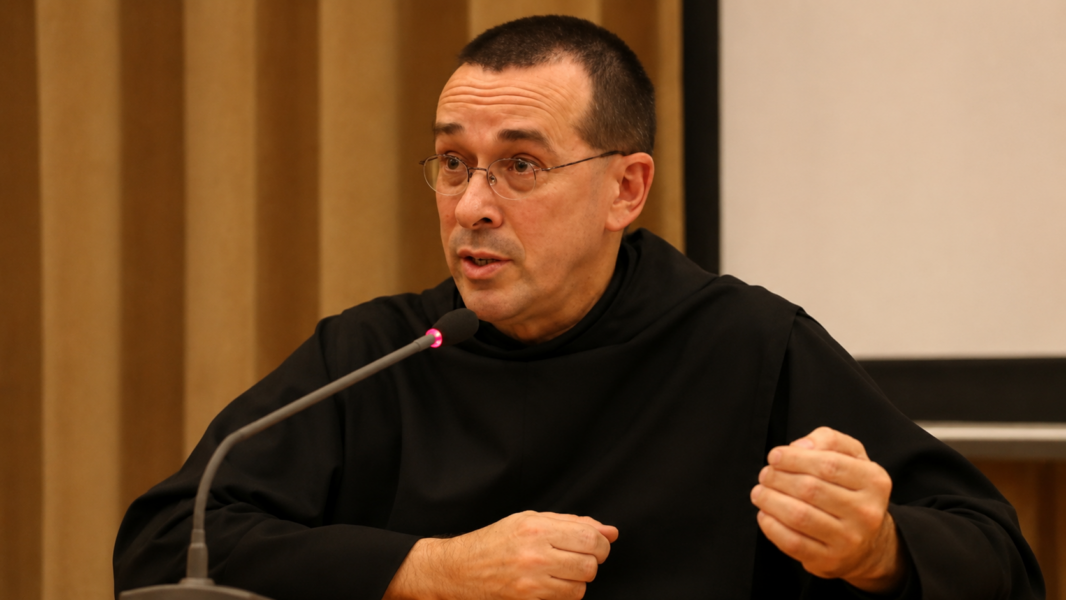
Dom Alcuin Reid, founder and prior of the Monastère Saint-Benoît in Provence, has stated that the liturgical reform implemented after the Second Vatican Council went beyond what was established by Sacrosanctum Concilium and has defended that the liturgy must develop in continuity with the received tradition, without being subjected to “preferences” or “theological fashions.” The Benedictine has also addressed the canonical situation of his community and assures that it is currently in the process of regularization with the competent ecclesiastical authorities.
In an extensive interview granted to AdVaticanum, Reid analyzes the application of the conciliar constitution on the liturgy, the influence of Benedict XVI, the consequences of Traditionis Custodes and the life of his monastery, located in the French diocese of Fréjus-Toulon. The liturgist maintains that the question cannot be reduced to a preference between ritual forms, because the liturgy constitutes a central element in the transmission and living out of the faith.
The Liturgical Reform and Sacrosanctum Concilium
Reid considers that the distance between the provisions of Sacrosanctum Concilium and the reform subsequently carried out constitutes a historically documented issue.
“That the liturgical reform after the Second Vatican Council exceeded the mandate of the Council itself may now be considered an established fact,” he affirms. According to Reid, decades of academic studies have shown the differences between what the conciliar fathers requested and the transformations introduced afterward.
This position does not imply, he clarifies, a rejection of Sacrosanctum Concilium. On the contrary, he highlights among its principles the full, conscious, and effective participation of the faithful in the liturgy as the fundamental source of Christian life.
The problem, in his judgment, lay in the implementation. Reid maintains that active participation was rapidly promoted without first providing the liturgical formation that the conciliar document itself considered necessary.
“In the rush to worship the spirit of change, the necessary foundations were not established,” he states. For the Benedictine, the formation of priests and faithful should have preceded the practical modifications and not been subordinated to them.
The Liturgical Influence of Benedict XVI
Reid devotes a significant part of the interview to the thought of Benedict XVI, with whom he maintained an intellectual relationship. When he was a cardinal, Joseph Ratzinger wrote the preface to his work The Organic Development of the Liturgy.
To explain Benedict XVI’s liturgical conception, Reid recalls one of his statements: “The Church stands or falls with the liturgy.”
From this principle, he maintains that the liturgy is not limited to externally expressing the faith, but constitutes one of the places in which it is received, celebrated, and transmitted. Therefore, any reform should develop in continuity with the preceding liturgical tradition.
“The liturgy is a locus fidei; it is an encounter with the living faith of the Church, with the person of Christ at the center, and not simply an expression of it,” he explains.
Reid considers that one of the main contemporary errors consists in understanding the liturgy as a secondary or merely ceremonial matter. He recalls in this regard the teaching of the Catechism of the Catholic Church, which defines the liturgy as a “constitutive element of the holy and living Tradition.”
The Vetus Ordo and the Participation of the Faithful
The liturgist also raises a question about the concrete results of the reform. According to Reid, some of the central objectives of Sacrosanctum Concilium, especially conscious and fruitful participation, can currently be observed among communities linked to the liturgical books prior to the reform.
In his judgment, this phenomenon forces one to ask whether the magnitude of the structural modifications introduced after the Council was necessary to achieve the objectives established by the conciliar fathers.
Reid admits that celebrations according to the modern liturgical books can incorporate elements of greater continuity with tradition, but considers that those measures do not by themselves resolve the underlying historical question about the relationship between the conciliar mandate and the reform that was subsequently carried out.
The statements coincide with a moment in which Leo XIV has dedicated several catecheses to Sacrosanctum Concilium. The Pontiff has insisted that the reform of the rites did not constitute the sole purpose of the conciliar constitution and has highlighted the centrality of the liturgy in the life of the Church.
Traditionis Custodes and the Pontificate of Leo XIV
Asked about the possibility that Leo XIV might modify the restrictions established by Traditionis Custodes, Reid avoids making a prediction.
“I have no way of predicting how, when, or if the Holy Father will address the open wound in the liturgical life of the Church that he inherited from his predecessor, which is Traditionis Custodes,” he affirms.
The Benedictine considers positive the message addressed this year by Leo XIV to the French bishops, in which the Pope asked for concrete solutions for the inclusion of the faithful linked to the Vetus Ordo.
Reid acknowledges the impatience existing among some of these faithful in the absence of normative changes, but asks to maintain an attitude of prayer for the Pontiff and to avoid hasty conclusions about his actions.
Read also: Dom Alcuin Reid: “Everything possible must be done to preserve the unity of the Church”
The Monastery Seeks to Regularize Its Canonical Situation
The interview also provides an update on the situation of the Monastère Saint-Benoît after the priestly ordinations received in 2022 without the corresponding dimissorial letters from the diocesan bishop.
Reid maintains that Traditionis Custodes, together with the difficulties the diocese of Fréjus-Toulon was then experiencing, prevented the ordinations planned for members of the community. Faced with that situation, the monastery decided to turn to another Catholic bishop to confer them according to the traditional liturgical books.
The decision had canonical consequences. In June 2022, the diocese communicated that the ordinations had been received illicitly and declared the suspension of Reid and Ildephonse Swithinbank. The then bishop of Fréjus-Toulon, Dominique Rey, subsequently decreed the suppression of the public association of the faithful Monastère Saint-Benoît and withdrew permission to establish its oratory.
Reid maintains that the community made that decision to guarantee the continuity of its sacramental life. In the new interview he assures that there are currently contacts with the competent authorities to resolve the situation.
“We are in the process of regularizing the situation with the relevant authorities and we pray that this will be completed soon,” he affirms.
The prior indicates that he does not wish his community to find itself again in similar circumstances and assures that the monastery currently carries out its daily life “with great peace.”
Read also: Bishop Rey (Toulon) suspends the monastery that ordained priests behind the bishop’s back
The Liturgy as the Center of Monastic Life
The Monastère Saint-Benoît daily celebrates the eight traditional hours of the Divine Office and the conventual Mass according to the usus antiquior. The community also maintains the Ember Days, the Rogation processions, and the ceremonies of Holy Week according to the books prior to the reforms of 1955, for whose use it received authorization from the Holy See.
Reid explains that the monks have also begun to sing the entire Matins with Gregorian melodies. This work has led to the publication of the first volume of a Nocturnale Monasticum, a project intended to provide the texts and melodies necessary for the singing of the monastic night office.
The community is likewise working on the restoration of its current property, acquired in 2020 near Brignoles. The complex includes a tenth-century Romanesque church that was given to the Benedictines in 1025 and was later linked, among others, to the Templars and the Order of Malta.
For Reid, this material recovery is linked to the fundamental purpose of the community: to maintain a Benedictine life in which, following the Rule of Saint Benedict, “nothing is to be preferred to the Work of God.”