


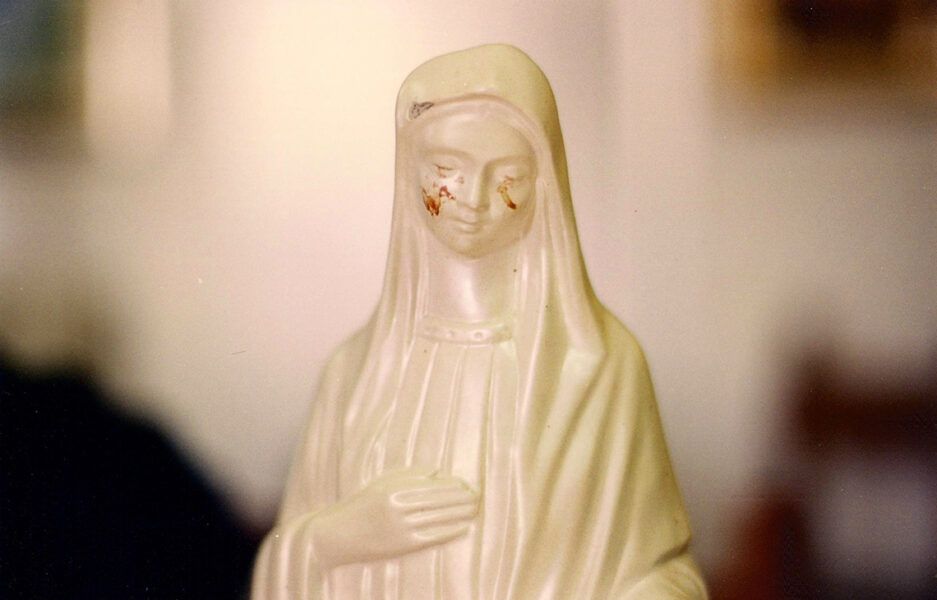
The Assumption is not the Virgin’s retirement nor her withdrawal from history: it is the very foundation of her maternal queenship. We confess a woman taken up into the glory of God and proclaimed Queen of Heaven; Civitavecchia recalls what that Queen does with her glory: she bends over a poor plaster face and weeps blood for her children. It is not a new paradox. Pius XII, the pope who in 1950 defined the dogma of the Assumption, asked before the tears of Syracuse whether men would know how to understand “the secret language of tears”—the same expression Grillo would make his own. The crowned Queen and the weeping Mother are one and the same.
This is the story of Civitavecchia: that of a Queen who, according to what was lived there, wished to show her sorrowful face in the humble grotto of a working-class family.
It all began in a place without prestige. In Pantano, a suburb of Civitavecchia overlooking the Tyrrhenian Sea, an electrician from the national electric company, Fabio Gregori, had built with his own hands a small grotto in front of his house for a plaster image of the Virgin—the Queen of Peace of Medjugorje—that his parish priest, Don Pablo Martín, had given him. An ordinary family, “not very observant” according to the neighbors, with nothing to distinguish them. Until the little Virgin wept.
It was February 2, 1995, at 4:21 p.m. The first witness was Jessica, Fabio’s five-year-old daughter. She saw blood flowing from the statue’s eye and called her father: “Daddy, Daddy, the little Virgin is crying.” Fabio did not believe her—“How can a plaster statue cry?”—and even scolded her, convinced it was a childish prank. Then he saw it himself: the blood ran “down to the heart” of the figure. He touched it, and weeping, took the girl in his arms and ran to the church. In forty-two days the scene would repeat fourteen times: thirteen in the Gregori garden and one, the decisive one, in the bishop’s hands.
What followed was not naïve piety, but scrutiny. The blood proved to be human; the forensic medicine institutes of La Sapienza, Gemelli, and Criminalpol identified it as male—XY chromosomes—though with strong female components. A CT scan of forty-three slices ruled out cavities and internal mechanisms; the statue, cemented to the grotto and protected by a sheet, was watched by the police, who also saw the tears form. The judiciary even seized the image: “Should I risk thirty thousand fanatics following a piece of plaster?” the prosecutor justified. More than fourteen hundred signatures returned it to devotion. In 2000 the case was closed with a total acquittal: the judges recognized “a phenomenon inexplicable by science, on which only the Church can pronounce.” The family never received a cent.
The most uncomfortable witness was the bishop himself. Girolamo Grillo had been the first to distrust; he even asked that the statuette be removed. His skepticism dissolved on March 15, 1995: while praying the Salve Regina asking for discernment, the little Virgin wept in his hands, before witnesses. “I cannot doubt its reality at all,” he would later declare under oath. From then on he bore the difficult condition of being both “witness” and “judge” of the event; he signed the messages with his own hand and authorized their publication.
Because there were messages. That summer apparitions began to Fabio and Jessica—ninety-three between 1995 and 1996. The Virgin appeared in silence, in adoration, from the consecration until communion, as if to emphasize that her Son was alive in the Eucharist. Fabio describes her without rhetoric: “She is most beautiful. And she is a mother, with a mother’s heart.” A mother so delicate that she even apologizes: “I ask your forgiveness for the time I take from your family.” And a mother who gives her names: Virgin of the Roses, Mother of the Church, Queen of Families, Bearer of Peace, and above all, Queen of Heaven.
And what does that language say? The messages of Civitavecchia explicitly place themselves in the wake of Fatima. They warn of an evil that seeks to destroy humanity and that, to achieve it, first attacks the smallest of churches, the domestic one: the family. They ask for consecration to the Immaculate Heart, the Rosary—“divine weapon”—the Eucharist and confession; they assure that every good deed snatches a soul from Satan. Two phrases run through the years. One is a commission: “Dear children, I need you; bear witness with strength, even from the rooftops; help me to fulfill the divine plan.” The other is a reproach that seems written for our age of screens: “You see my tears as a motive of curiosity, but your heart remains hard.” The prodigy is consumed as spectacle and the heart shrugs.
An exceptional witness took it seriously: John Paul II. Cardinal Sodano telephoned Grillo, in the pope’s name, to ask him not to be skeptical. On the night of June 11, 1995, Wojtyła had the statuette brought to his rooms, prayed at length before it, and placed on its head a small golden crown and, in its hands, a rosary that the image still preserves. In October 2000 he offered the entire Church to the Virgin and signed a testimony written by the bishop. From a second identical image, which the pope himself sent him through Cardinal Deskur, a perfumed oil has flowed ever since: blood of the Passion in one, outpouring of the Spirit in the other.
Accuracy is fitting, for it is never superfluous in these matters. The diocese erected the sanctuary of St. Augustine in 2005 and crowned the image in 2014; the messages were disseminated with the bishop’s signature. But the definitive judgment on the supernatural belongs to the universal Church, which here has kept its customary prudence. It was said, unintentionally, by a civil court: only the Church can pronounce. That point of measure does not weaken the story; it makes it credible.
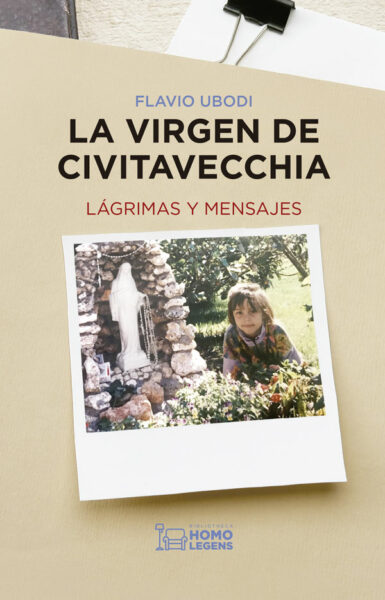
The Assumption tells us where Mary is: in glory, Queen. Civitavecchia—for those who believe what was lived there—tells us what she does with that glory: she does not keep it for herself, she pours it out; she does not reign far away, she weeps near. And it returns to the reader the old Gospel question before the signs: “What must we do?” The book by Flavio Ubodi published by Homo Legens, which gathers and compares the tears and the messages, does not seek to feed the curiosity the Virgin herself reproaches, but to help answer that question. It is, in the end, the only thing a weeping Queen can ask of her children.

The Virgin of Civitavecchia. Tears and Messages, by Flavio Ubodi, with a foreword by Riccardo Caniato and an interview with Fabio Gregori, is published by Homo Legens.