


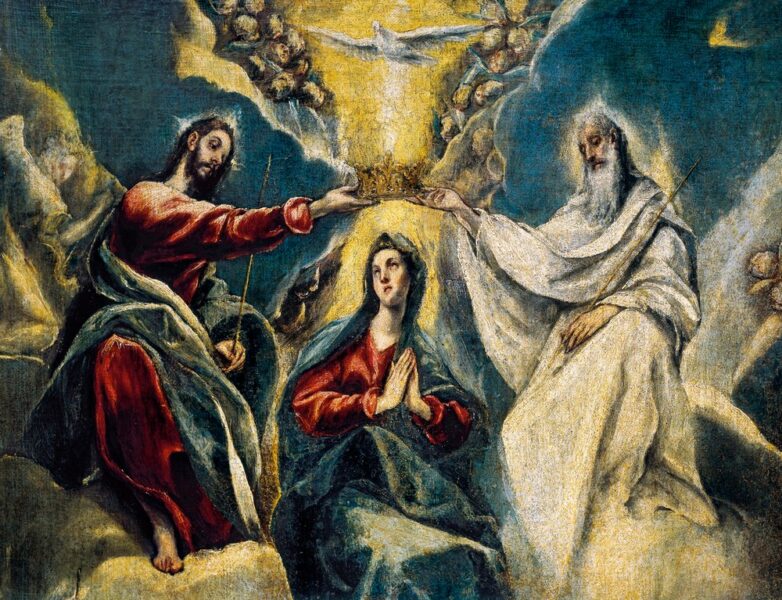
Today, August 15, the Church celebrates the Assumption of Mary, body and soul, into Heaven. On this solemnity, we read in the 1962 bilingual missal of the faithful that “Mary was taken up by a miraculous power and carried into heaven. It is a marvelous triumph: the heavenly court rejoices, the angels sing the glory of their Queen, and the Most Holy Virgin is crowned Queen of creation. The fact of Mary’s Assumption was declared a dogma of faith by Pope Pius XII in 1950.” It was instituted as a first-class feast, with white as the liturgical color.
Seven days later, on Saturday, August 22, the Church celebrates, according to the current calendar, the memorial of “Santa María, Queen of Heaven and Earth,” a celebration that, it is stated, was instituted by the same Pope Pius XII in 1954 (four years after the proclamation of the dogma of the Assumption) to honor Mary as Queen of all creation, and which was included in the Encyclical Ad coeli Reginam (October 11, 1954). August 22 was originally chosen by Pope Pius XII as the eighth day after the Assumption, thus completing a Marian octave. This connection symbolizes the coronation of Mary as Queen of Heaven, immediately after her Assumption, body and soul, into heavenly glory. This is also reflected in the Glorious Mysteries of the Holy Rosary, corresponding to the fourth and fifth Glorious Mysteries, respectively: the Assumption and the Coronation of Mary as Queen and Empress of Heaven and Earth.
However, in the 1962 Missal of the Faithful, August 22 celebrates, in contrast to what was said above and to the reformed calendar, the Immaculate Heart of Mary, whose liturgical cult, the Missal indicates, “had already been suggested by the Fathers of the Church in their commentaries on the Song of Songs. However, it was not until the nineteenth century that Pius VII began to grant some places a feast in her honor. Pius IX endowed this feast with its own Mass and Office, and Pope Pius XII consecrated the world to the most sweet and maternal Heart of the Virgin Mary in 1942, amid the horrors of the Second World War, hoping to find in such a benign heart a remedy for so many calamities. In 1944, he gladly granted the petitions of many bishops, religious congregations, and the faithful, extending the feast of the Immaculate Heart of Mary to the entire Universal Church and designating the Octave of the Assumption for its celebration.”
The change of the feast celebrated on August 22 occurred, it seems, with the calendar reform by Paul VI. It is a somewhat complicated matter to explain. Apparently, the feast of the Immaculate (or Most Pure) Heart of Mary, fixed on that date by Pius XII in 1944, was moved in Paul VI’s calendar to the Saturday following the Sacred Heart of Jesus in June. August 22 was then assigned to the feast of Santa María Reina, previously instituted in May by the same Pius XII. It is one of the few calendar changes that makes sense, since, as we said, the fourth and fifth Glorious Mysteries are prayed, and the revelation of the Holy Rosary by the Virgin to Saint Dominic of Guzmán occurred in the thirteenth century.
As we know, the institution of a dogma is the formal and solemn act by which the Pope declares that a belief is an absolute, infallible, and obligatory truth, revealed by God. And in this specific case, we can verify the statement about dogmas that “they do not create a new truth, but officially establish a belief that already existed in the faith”; because, prior to the proclamation of the dogma, August 15 was already celebrated as the Assumption of Our Lady, which was of first class, with a common octave, and had its own vigil, to which the liturgical color purple corresponded. This is indicated by a bilingual missalette from 1947. According to that same missalette, the day that closed the octave celebrated the Most Pure Heart of Mary, a second-class feast, with white as the liturgical color. This only confirms that the proclamation of the dogma, as has always happened in the history of the Church, came only to give the force of the law of faith to an ancient veneration of the Church.
As we see, August 22 did not celebrate the feast of Mary the Queen, but the Most Pure Heart of Mary, as read in the 1962 missal.
For his part, Pius XII had instituted the feast of Mary the Queen on May 31; a feast that Paul VI moved as a memorial to August 22, relocating the celebration of the Immaculate Heart of Mary to June. Prior to the institution of the feast of Mary the Queen on the calendar on May 31, that day celebrated Mary, Mediatrix of All Graces. On the one hand, we note that in the calendar reformed by Paul VI, May 31 celebrates the Visitation of the Virgin Mary to her cousin, Saint Elizabeth; and on the other, that now, Tucho Fernández, prefect of the CDF, in his infinite wisdom, has come to deny what the Church has celebrated and prayed for centuries: that Mary is the mediatrix of all graces. It is evident: in EVERYTHING, the modernists who have kidnapped the Church want to make a clean slate of its bimillennial tradition and begin a new entity, immanentist, modernist, anthropocentric, and liberal.
After this somewhat confusing explanation of the shifting dates, I would like to explain that last year I was able to attend a Traditional Mass on one of these three dates—I do not remember which now—and I had the joy of hearing a wonderful sermon on the queenship of Mary and the fact that Mary is Queen because she is the Mother of the King.
Coinciding with the wonderful feast we celebrate today, and its natural continuation, which is the coronation of Mary, with its dates of August 15 and 22, even without an octave, I thought it might be very interesting to share a chapter from the book “The Crucified Rabbi” by Taylor Marshall, regarding the queenship of Mary.
Taylor Marshall has fallen somewhat out of favor lately in traditional circles due to his strange “change of opinion” regarding various issues since the episcopal consecrations of the SSPX. This, however, does not detract from the value of his trilogy on the origins of Catholicism, of which “The Crucified Rabbi” is the first volume.
In this work, Marshall places side by side issues that show how Jesus came to fulfill the promises of the Old Testament, being truly the Messiah. The second chapter deals with the Jewish Kingdom and the Catholic Church.
The basic question, Marshall states, is actually the relationship between the Kingdom of God and Christ. Our understanding of the Church will depend on this. The concept of Messiah derives from the Jewish hope that God will be faithful to His covenant with David, the archetype of the Messiah. Marshall then describes the nature of the kingdom of Israel and the Jewish paradigm of messianic kingship in the person of King David.
And he quotes Benedict XVI, when he stated that “the promise of the Davidic kingdom to the messianic kings ‘anointed’ derives from the covenant that God made with David in 2 Samuel 7, 9-16. This covenant involved three promises to David:
1. The son of David will build a house for the name of God, that is, a temple (7, 13).
2. God will establish the throne of his kingdom forever (7, 13, 16).
3. God will be his father, and he will be his son (7, 14).”
The Davidic covenant involved an exchange between David and God. The genealogical House of David would build a literal House for God. This turns out to be the Temple that Solomon, the son of David, built for God. In return, God promises to establish the “house” or dynasty of David as an eternal monarchy. This promise is based on God’s relationship with David as his Father: “I will be his father, and he will be my son” (7, 14). This divine covenant with David anticipates that the definitive Davidic Messiah will truly be the Son of God eternally begotten: Jesus can call God “Father” because Jesus of Nazareth is not only fully human and fully Davidic, but also fully divine.
From these preliminary questions, we can understand Mary as Queen Mother of Jerusalem. When most non-Catholic Christians look at the Catholic Church, they often question what seems to them like “worship of Mary.” Many Protestants (former heretics, now “separated brethren”) misunderstand the importance of the Blessed Virgin Mary precisely because they are not familiar with the way the Davidic Covenant structured the messianic kingdom. In other words, non-Catholics are unaware of the profound Jewish meaning of the Virgin Mary. And also of the Papacy, by the way.
The royal and messianic Kingdom of David had its capital in Jerusalem, beginning with King David around 1004 B.C. and was eclipsed in 586 B.C. with the capture of King Zedekiah and the forced exile of the Jews who were still alive. Before the tragic Babylonian exile, the true king of Judah and heir of David sat on the throne in Jerusalem. Furthermore, there were two other important political figures alongside the Davidic king in the messianic court of Jerusalem. After the king, the second most important person in the Kingdom of Judah was the Gebirah. This Hebrew title is literally translated as “Mighty Woman” and refers to the mother of the Jewish king. Most translators translate Gebirah as “Queen Mother”.
The Jewish queen mother possessed a powerful influence over the kingdom. This power and authority came from her status as the mother of the Davidic king, not from her own personal importance. Properly understood, the queen mother held a political office and represented the legitimate genealogy of the king. King Solomon the Wise instituted the formal place of the queen mother when he ascended the throne of his father, King David. One of the first things King Solomon did after his enthronement was to place a throne at his right hand and enthrone his mother as the Gebirah: “So Solomon sat on the throne of his father David; and his kingdom was firmly established… then (his mother) Bathsheba went to King Solomon to speak to him on behalf of Adonijah. And the king rose to meet her, and bowed down to her; then he sat on his throne, and had a seat brought for the king’s mother; and she sat at his right hand (1 Kings 2, 12-19).”
King Solomon rose to greet his mother and bowed down to her, not because he worshiped her as a goddess, but because, as king, he understood the honor due to the queen mother. Her presence at court signified that Solomon was the legitimate heir of King David because she literally served as the link of flesh and blood between father and son. Given the importance of genealogical dynasties, the office and role of the queen mother also existed in many other cultures. A similar office of Gebirah was also honored in the northern kingdom of Israel. “Let us go visit the princes and the family of the queen mother” (2 Kings 10, 13).
Jeremiah highlighted the place of preeminence that the queen mother occupied at the end of the Davidic kingdom when he wrote: “Say to the king and the queen mother: Come down from your throne” (Jer 13, 18). The end of the Davidic reign of Jerusalem is marked by the deposition of the Davidic king and his mother. The queen mother was so important that the end of the kingdom meant that she too had to be deposed.
We see here that it is natural for Catholic Christians to honor the Blessed Virgin Mary. Her Son is the true Davidic King and she is rightly enthroned at His right hand as the Gebirah and Queen Mother of the Kingdom of God. The position of Solomon’s mother at his right hand is the reason why Mary is almost always depicted in religious works of art seated in heaven at the right hand of Christ. The exalted place of the Virgin Mary in Catholicism did not arise from medieval superstition, but from a Jewish understanding of royalty. Just as Bathsheba served as the link of flesh and blood between her son Solomon and King David, so too the Blessed Virgin Mary is the link of flesh and blood that unites Jesus with the messianic privileges of the Davidic Kingdom. Christians honor and venerate the Blessed Virgin Mary because her lineage confirms that Jesus is the legitimate heir of God’s promises. Mary is the final link in a millennial chain of messianic prophecy.
The truth, beauty, and strength of Catholicism, the only true religion, and of the Church, founded by Jesus Christ for the salvation of souls and outside of which there is no salvation, stand above human changes, made with greater or lesser success. Let us venerate Mary Most Holy today with the love and devotion she deserves.
Note: Articles published as Tribuna express the opinion of their authors and do not necessarily represent the editorial line of Infovaticana, which offers this space as a forum for reflection and dialogue.