


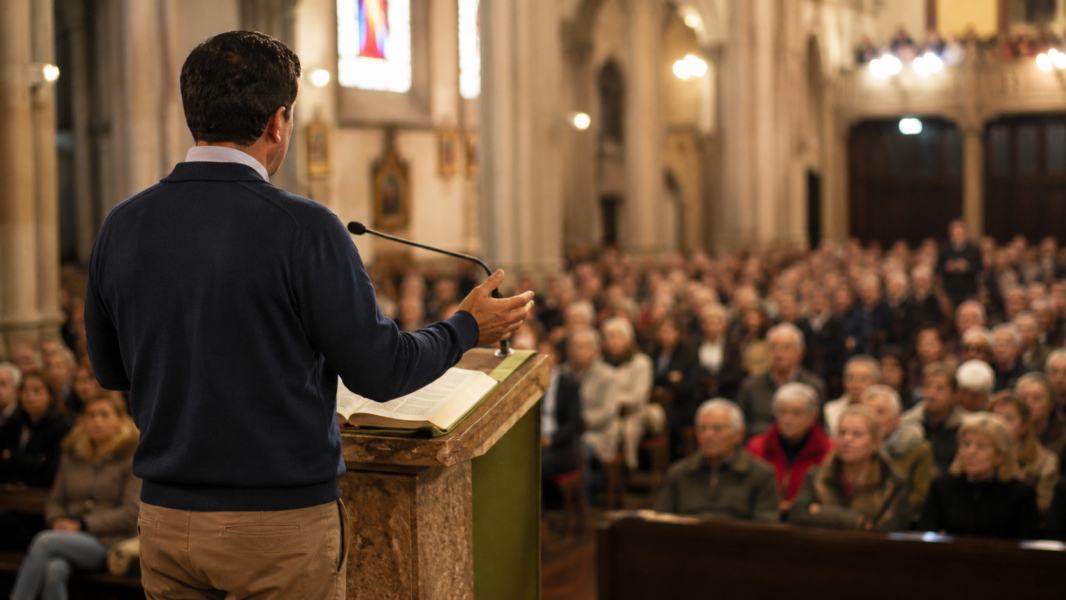
The Bishop of Mainz, Peter Kohlgraf, has assured that he will not adopt disciplinary measures against the parishes in his diocese where laypeople continue to preach during the celebration of Mass, despite expressly acknowledging that Canon Law does not permit this practice and that he lacks the authority to authorize it. «If I find out, I will not intervene disciplinarily nor sanction it according to ecclesiastical law», he stated in an interview published on August 11 by the German Church portal Katholisch.de.
The statements come less than two months after the Dicastery for Divine Worship and the Discipline of the Sacraments rejected the request of the German Episcopal Conference to obtain an indult that would allow duly authorized laypeople to deliver the homily during the Eucharistic celebration under certain circumstances. Rome then recalled that reserving the homily to the priest or deacon «is not a mere disciplinary norm», but derives from the very nature of the liturgy.
Read also: Rome says no to Germany: the homily will remain reserved for priests and deacons
«I cannot allow it», but neither will he sanction it
Kohlgraf, who also chairs the Pastoral Commission of the German Episcopal Conference, acknowledges in the interview that the response received from Rome does not introduce a new norm and that it affects all dioceses, not only the German ones.
When directly asked whether a pastoral agent with preaching training could do so during a Eucharistic celebration in his diocese, his response was negative: «No, according to the Roman provisions they cannot do so. Nor can I grant that permission. Canon Law does not allow it and that remains our basis».
However, immediately afterward he explained that in some communities in Mainz the preaching of laypeople during Mass has already become a habitual practice and made it clear that he has no intention of intervening to prevent it.
«If I find out, I will not intervene disciplinarily nor sanction it according to ecclesiastical law. I do not promote it either and I cannot authorize it. I simply take note that in some parishes this established practice exists», he pointed out.
The bishop’s position thus establishes a distinction between the norm he recognizes as in force and the action he intends to maintain in the face of its non-compliance. According to Kohlgraf, the recent Vatican response will not entail «any change» in the concrete pastoral practice of the Diocese of Mainz.
Kohlgraf questions part of Rome’s argumentation
The bishop also expressed reservations about the arguments used by the Dicastery for Divine Worship. «The Vatican’s argumentation regarding the prohibition of lay preaching, in some points, does not seem entirely coherent to me», he stated.
Kohlgraf refers specifically to the relationship between the one who presides over the Eucharist and the one who delivers the homily. In his opinion, if the argument were based exclusively on the fact that the priest celebrating Mass must preach, «consequently» neither should a concelebrating priest or a deacon do so.
Rome’s response, however, had based the reservation of the homily on the ordained ministry. The Dicastery pointed out that this constitutes an exercise of the munus docendi sacramentally entrusted to ordained ministers and emphasized the unity between the proclamation of the Word and the Sacrament within the Eucharistic celebration.
Kohlgraf also recalled that Germany had an indult in the 1970s that allowed, under certain circumstances, the preaching of laypeople with theological training, for example in school Masses, and showed himself favorable to studying a similar exception again.
«If there were an indult, it would seem fine to me and I would be grateful», he stated, although he again acknowledged that it does not correspond to a diocesan bishop to make that decision on his own.
He is concerned that Rome’s decision will encourage «denunciations»
More than the continuity of a practice contrary to the liturgical norm, Kohlgraf assured that he is concerned about another consequence of the Roman intervention: that complaints from the faithful about liturgical abuses will increase.
«I am more concerned that Rome’s prohibition on lay preaching will now encourage denunciation», he declared.
The bishop explained that he receives communications from people who inform him of liturgical infractions and demand that he intervene. Some, he added, even turn to the apostolic nuncio or directly to Rome.
Kohlgraf assures that he responds to these complaints «with kindness and serenity». He takes note of them and usually refers them to the parish priest or the pastoral leader of the corresponding community.
The discussion on lay preaching has continued in Germany since the Vatican refusal in June. Organizations linked to the Synodal Way immediately demanded that the bishops renegotiate the issue with Rome, while other voices have defended that the dioceses maintain the practices already in place.
«The faithful have a right to good homilies»
The interview also addresses the quality of preaching, an issue that Kohlgraf considers related to the debate. The bishop maintains that limiting oneself to retelling the Gospel during the homily «is too little» and that it is also not appropriate to use the Gospel text solely as a starting point for moral teaching disconnected from its content.
«Those attending Mass have a right to good homilies», he states.
For Kohlgraf, good preaching must serve «the praise of God», strengthen the faithful, offer guidance for life and lead them to personally reflect on the Gospel.
Regarding laypeople with theological training, the bishop considers them «a richness for the Church» and acknowledges understanding the disappointment of those who would like to preach during the Eucharist. At the same time, he states that he will continue to formally adhere to the possibilities provided by Canon Law.