


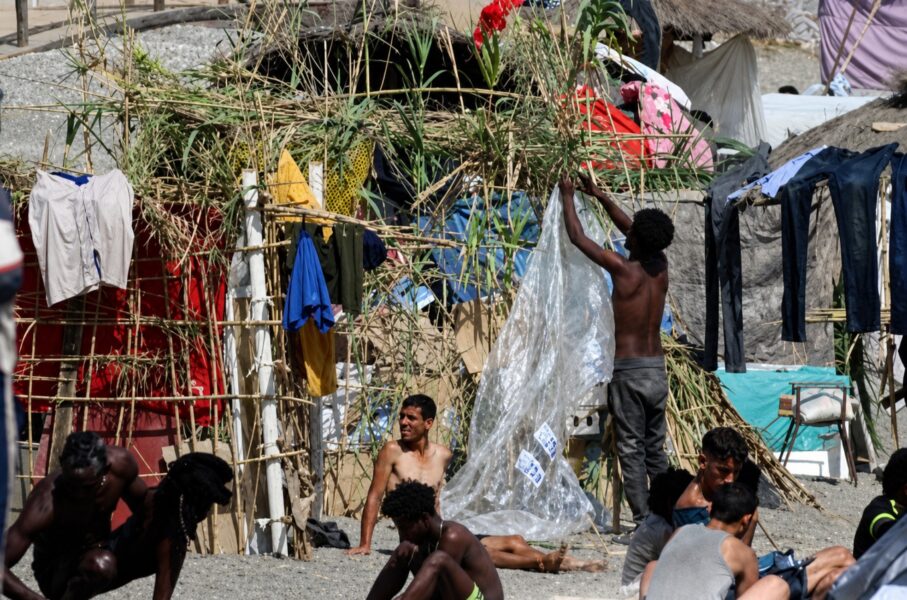
Two weeks after the largest mass entry in Spain’s history, the courts are already processing sexual assaults against minors, the police admit that Ceuta is not a safe city, and elderly residents confess to the media that they sleep with a knife. Meanwhile, a large part of the ecclesial discourse remains focused on the logistics of reception, fueling a moral confusion that threatens to open an infinite distance between the Church and the people.
Two weeks have passed since, between July 30 and 31, more than 72,000 people—80,000 according to local authorities’ estimates—illegally crossed the border into Ceuta from Morocco, in an operation that the president of the Spanish Episcopal Conference himself, Bishop Luis Argüello, did not hesitate to describe as an “invasion”: “The invasion of Ceuta is a test. Demography is a weapon,” he wrote on August 2. The Minister of Defense, Margarita Robles, has spoken bluntly of an “aggression” against the city.
The data no one can continue to ignore
The human toll is harrowing: 82 bodies recovered on the Spanish side—most due to “mechanical asphyxiation by drowning,” according to the Institute of Legal Medicine of Ceuta—at least 14 on the Moroccan side, and nearly 200 deaths at sea according to the CEE’s own Department of Migration. The Moroccan Association for Human Rights raises the total confirmed death toll, between Ceuta and Melilla, to 141 victims.
Regarding how many people remain in the city, the fluctuating figures are themselves a scandal: the Interior Minister spoke this Thursday of about 5,000; the president of Ceuta, Juan Jesús Vivas, places the estimate between 8,000 and 11,000, and has demanded “transparency in communication” from a government that once spoke of 2,500. Vivas has described the situation as one of “maximum risk” for coexistence and security, “absolutely unsustainable,” with thousands of people “wandering our streets, our neighborhoods, the hills, the beaches.”
On the judicial front, the Superior Court of Justice has confirmed the processing of at least three sexual assaults attributed to immigrants who arrived in the surge—two of them against minors, one involving penetration and with the aggravating factor of forcing the victim to sell drugs, and mostly committed against women and girls who also arrived in the mass entry and were left to fend for themselves—with two remands in provisional custody and one deportation. The National Police recorded on August 11 six complaints of sexual assaults filed by minors, and health sources at the University Hospital warn that the number of people who have come forward reporting rapes or other assaults “is higher.” This is compounded by nine provisional detentions in total (assault on officers, aggravated injuries, drug trafficking), seven judicial deportations of foreigners with criminal records, and incidents such as the Moroccan who broke into a home in the city center and lay down in the bed of the couple who lived there.
The majority union of the National Police, JUPOL, said it without anesthesia: “Today Ceuta is not a safe city, not at all.” Officers respond to an average of 200 emergency calls daily, with fights, stabbings, attempted break-ins at businesses, and sexual assaults on minors “thwarted by plainclothes colleagues or by the neighbors themselves.” At the hospital, the government insists that “there is no collapse,” but the Secretary of State for Health himself admits “significant strain,” and the center is operating under Level 1 of its External Disaster Plan, with 275 medical attentions recorded in the last 24 hours. And over the city looms, this very Saturday, August 15, the call on social media for a new mass entry that has forced the deployment of 1,600 police and civil guards and 2,000 soldiers.
The parable of Pepi
Amid this scene, an episode has occurred that summarizes, better than any editorial, the moral distortion in which we live. On Wednesday, a 66-year-old resident, Pepi, broke down in tears before Minister Robles: “I’m afraid. I live alone. I’ve never seen myself like this, closing the windows, the door, checking everything. Tonight I barely rested; I grabbed a knife.” The next day, on television, the same Pepi recounted with complete naturalness that she and her neighbors bring the immigrants “a bag of fresh, cold water, a bottle” and some food every day.
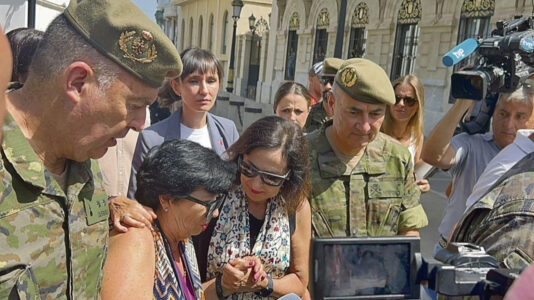
Let no one be mistaken: Pepi’s charity honors Pepi. The poor woman is not guilty of her moral confusion. What honors no one is the moral system that has led a widow to sleep with a knife under her pillow and, the next morning, to take on as her own the logistics of those who have caused her that terror. That lady is not incoherent: she is an obedient Christian abandoned by those who had the duty to protect her and disoriented by those who had the duty to guide her. The incoherence is at the top.
A Church focused on logistics
Because what has the faithful people heard from their pastors these two weeks? Father Ángel, from the overwhelmed CETI, declaring before the cameras of laSexta that those who arrived in the surge “are saints” because “we would do any barbarity in their place”; not a word about the mafias, about Moroccan instrumentalization, about the duty of public authorities to protect the border, nor about the ordeal of the people of Ceuta. The CEE’s Department of Migration, focusing its statement on the reception of minors and asylum seekers and appealing to the “humanity” of the authorities. The Sunday collections. Emergency aid. Water, clothing, food.
What is at stake in Ceuta is not mercy; it is that the logistical management of an invasion—the word is Argüello’s, not ours—should be presented as the entirety of the moral response, when Church doctrine says otherwise. The Catechism (n. 2241) recalls the duty to welcome “to the extent possible,” but also the right of authorities to regulate migratory flows in accordance with the common good and the duty of the migrant to respect the laws and heritage of the receiving country. Pope Leo XIV himself, who asked in the Angelus for “mercy and justice” for Ceuta, has insisted in his recent magisterium on “the right not to have to migrate” and on combating traffickers who trade in “sirens’ songs” and “industries of death.” Curiously, that half of the papal message systematically disappears from homilies, press conferences, and talk shows.
There have been nuances; they are not enough
It would be unfair to deny the nuances. Argüello has named the hybrid war and the biopolitics that uses people “for profit and power.” The bishop of Sant Feliu and the archbishop of Tangier have recognized that this is not an ordinary migratory phenomenon but an eminently geopolitical operation. Even the religious communities of Ceuta have spoken out to demand solutions. But a lucid tweet from the president of the CEE does not compensate for decades of a dominant discourse that has reduced the Church’s social teaching on migration to a single mandate—welcome, welcome, welcome—amputated from its other two pillars: justice and the common good. In the collective imagination, the message that has taken hold is that opposing a massive and illegal entry is a sin, and that the Christian response to 72,000 people launched against a city of 84,000 inhabitants is to bring fresh water.
The people of Ceuta do not need help organizing the logistics of their own demographic submersion. They need security, borders, law, and truth. And they need a Church that is a moral beacon and not a loudspeaker of confusion; that weeps with the 200 victims of the sea and also with Pepi; but that denounces the mafias and the regime that shelters them with the same vigor with which it passes the collection plate. If the shepherds do not soon undertake an examination of conscience and self-criticism—beginning with those who canonize on live television the protagonists of an aggression and ending with those who remain silent for political calculation—the distance between the Church and its people, already great, will become infinite. And that wound will not be healed by any bottle of cold water.