


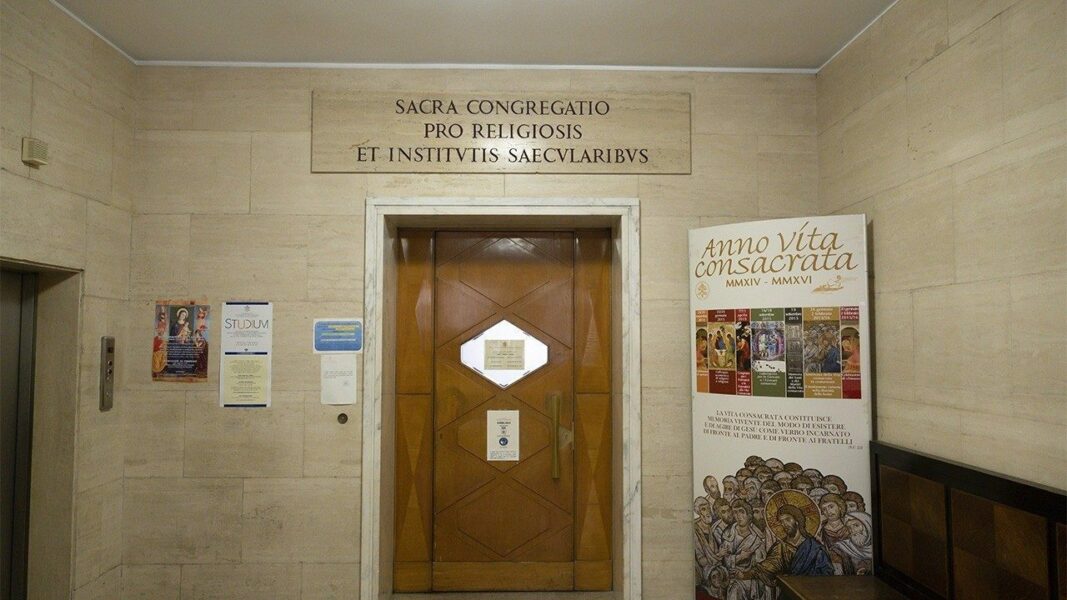
The Holy Father has this week appointed a group of new consultants to the Dicastery for Institutes of Consecrated Life and Societies of Apostolic Life. Fifteen religious and specialists with very different profiles: canon lawyers, major superiors, psychologists, academics and formation directors. The list, as often happens in Rome, says quite a bit more when one looks at who has been chosen than when one limits oneself to reproducing their positions.
Among those appointed are His Excellency Bishop Alfonso Vincenzo Amarante, C.SS.R., rector of the Pontifical Lateran University in Rome; the Salesian Kevin Otieno Mwandha, vice-rector of the Pontifical Salesian University; the Benedictine Ignasi M. Fossas i Colet, abbot president of the Sublacense-Casinense Congregation; the Jesuits Damián Guillermo Astigueta and Flavien Zolabi Mambueni; the Claretian Maurizio Bevilacqua; the Dominican Benjamin James Earl; the Marist Brothers Antoine Kazindu and Emili Turú Rofes; the superior generals Chiara Lorenzato and Maria Nirmalini; and the religious sisters María Rosaura González Casas, Mary Lembo, Patricia Murray and Maria do Disterro Rocha Santos.
It does not appear to be an improvised list. There are quite recognizable lines.
Canon lawyers and men of governance
One of the most solid profiles is that of the Dominican Benjamin James Earl, former procurator general of the Order of Preachers before the Holy See and currently coordinator of the revision of the Constitutions of the Dominican nuns.
His incorporation makes considerable sense. Earl knows the proper law of religious orders, Roman procedures and the type of problems that end up on the dicastery’s table when a community enters into crisis. Moreover, he does not appear as a figure particularly given to the ideological battles of recent years. His profile is more that of a canon lawyer than an ecclesial activist.
Also legal is that of the Argentine Jesuit Damián Guillermo Astigueta, dean of Canon Law at the Gregorian University and specialist in penal law, abuse and the exercise of authority.
And in the field of effective governance appears Ignasi M. Fossas, monk of Montserrat and abbot president of the Sublacense-Casinense Congregation.
InfoVaticana already reported in July 2025 on his intervention in several Benedictine monasteries in Flanders, including the temporary suspension of community life at Keizersberg Abbey and the opening of a canonical visitation. Fossas therefore does not arrive only with academic titles, but with experience in uncomfortable decisions.
There is also a detail that is not minor. When speaking of synodality in the Benedictine sphere, Fossas has recalled that a monastery is not a parliamentary democracy and that communal listening does not eliminate the authority of the abbot. In times when the term “synodality” serves almost everything, precision is appreciated.
Psychology, abuse and new categories of authority
Another of the clearest lines in the list is the presence of specialists in abuse, vulnerability and power relations.
The Mexican religious sister María Rosaura González Casas, deputy director of the Institute of Psychology at the Gregorian, has for years been working on spiritual abuse, sexual abuse, vulnerability and the exercise of authority in women’s religious life.
In November 2025 she participated in a seminar of the International Union of Superiors General and the Union of Superiors General on the abuse of adult women and the so-called “false mysticism,” one of those concepts that have gained ground in recent years to describe situations in which spiritual language is used as an instrument of manipulation.
Also entering the dicastery is Mary Lembo, a Togolese religious sister who has specifically researched sexual abuse committed by priests against African religious sisters.
And alongside them appears Astigueta, a canon lawyer specialized in crimes and abuse.
The signal is quite clear: Rome wants to continue paying close attention to abuse within consecrated life, not only to sexual crimes against minors, but also to relations of dependence, conscience and authority among adults.
The problem will lie in the balance. Religious life needs effective mechanisms to pursue real abuse, but it also needs to preserve words that for centuries were perfectly understandable: authority, obedience, discipline, superior, rule. If every internal conflict ends up reinterpreted with therapeutic categories, the remedy may end up affecting the very nature of consecrated life.
Patricia Murray, the most clearly synodal quota
If there is a name that stands out for its closeness to the synodal universe of Pope Francis’s pontificate, it is Patricia Murray.
The Irish religious sister was for years secretary of the International Union of Superiors General and one of the most visible figures of women’s religious life in the synodal processes.
The UISG itself has collected her interventions in which she speaks of “radical inclusion,” synodal leadership and greater presence of women in ecclesial structures. She also celebrated the opening to women of the instituted ministries of lector, acolyte and catechist and expressed her desire that women could preach more frequently.
There is no basis for claiming that Murray has expressly defended women’s priesthood. But neither is it necessary to force the interpretation: her trajectory clearly places her in the sector that in recent years has promoted synodality, female leadership and greater participation of women in decision-making bodies.
Her appointment is probably the most evident sign of continuity with one of the priorities of the previous pontificate.
Emili Turú and the reform of structures
The Spaniard Emili Turú Rofes, former superior general of the Marist Brothers, brings another type of profile.
He currently directs Faith and Praxis for Global Leadership, an organization dedicated to accompanying religious congregations in processes of leadership and institutional transformation.
The matter is not minor. A good part of Western religious life is aging, with few vocations and with structures designed for much more numerous congregations. There are too many buildings, too few religious, and it is not always clear who will govern in ten or fifteen years communities that half a century ago had hundreds of members.
In that context, discourses have proliferated about new models of leadership, redistribution of power, governance and transformation of structures. Turú has been working precisely on that for years.
The question is what is meant by “transform.” It can mean prudently adapting a structure to guarantee the continuity of a charism. Or it can mean importing into religious governance the language of consultancies, horizontal leadership and organizational theory until it becomes difficult to recognize the old figure of the religious superior. Time will tell which approach weighs more.
Brazil and religious life with a social accent
Also appointed has been Maria do Disterro Rocha Santos, president since 2025 of the Conference of Religious of Brazil.
Her appointment deserves attention because of the institution she leads. The CRB forms part of a Brazilian ecclesial ecosystem where synodality, social commitment, defense of human rights and public intervention by religious men and women carry great weight.
In July 2026, already under her presidency, the organization published a letter regarding the Brazilian electoral process in which it called for promoting “ethical and democratic discernment.”
That does not allow attributing to Rocha Santos concrete positions on abortion, sexual morality or women’s priesthood. It is advisable not to confuse the general orientation of an institution with the personal positions of the one who presides over it. But it does allow locating the ecclesial environment from which she comes.
The academic profiles
Other names seem to respond more clearly to academic needs.
Alfonso Vincenzo Amarante, rector of the Lateranense, is a moral theologian and a man fully integrated into the university structures of the Holy See. He was promoted by Francis and Leo XIV continues to count on him.
Maurizio Bevilacqua, director of the Claretianum, is specifically dedicated to the theology of consecrated life and has worked on issues such as the evolution of this form of life after Vatican II, synodality or the so-called “ecological conversion.”
Kevin Otieno Mwandha, a Kenyan Salesian and vice-rector of the Pontifical Salesian University, brings academic and formative experience.
The Jesuit Flavien Zolabi Mambueni, rector of the theological institute of the Society of Jesus in Abidjan, combines spiritual formation and psychology.
The superior generals Chiara Lorenzato and Maria Nirmalini bring direct experience of female governance of active congregations, while the Rwandan Marist Antoine Kazindu comes fundamentally from the field of formation and accompaniment.
For now, none of the latter stand out for having protagonized major doctrinal or moral controversies.
A quite revealing list
Viewed as a whole, the list has more interest than might appear at first glance.
There are canon lawyers and men of governance with real experience, such as Earl or Fossas. There is a notable presence of specialists in abuse and psychology. There are figures clearly identified with the synodality of Pope Francis’s pontificate, such as Patricia Murray. And there are experts in the transformation of religious structures, an issue that will become increasingly important as vocations continue to decline in Europe and North America.
It is not a uniformly progressive list nor a correction of the previous course. Rather it seems a combination of continuity and pragmatism.
Leo XIV will have to confront a problem that is not solved with organizational charts. Many congregations do not need only to reorganize their structures; they need vocations. They do not need only new theories of leadership; they need religious willing to obey, pray, live in community and persevere.
The appointments allow us to see some of the tools with which Rome wants to confront that crisis. What remains to be seen is what it will use them for.
And all this in a dicastery that continues to offer one of those peculiar Roman formulas of the previous pontificate: a religious sister at the head as prefect and a cardinal as pro-prefect, just in case.