


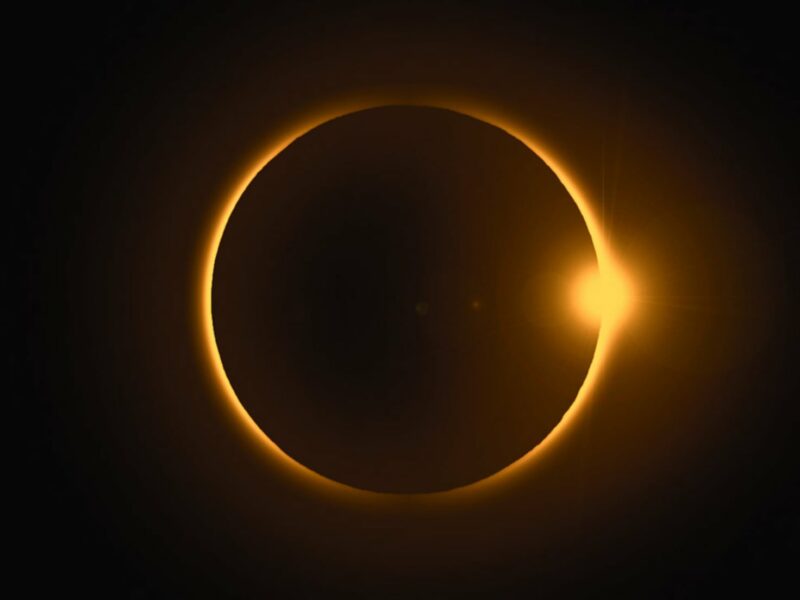
This afternoon, while the sun in Spain still occupies a mid-afternoon position, the moon will cover its disk exactly, without a single thread of light left over or missing, and for a few seconds the day will turn into an ephemeral twilight. That perfect coincidence of two circles in the sky reminds us of the mathematical structure of Creation, full of overwhelming coincidences that bear the signature of God.
The sun is about four hundred times larger than the moon, and is about four hundred times farther from us. No physical law requires that double proportion, but from it results that both celestial bodies, seen from Earth, present identical apparent size. That is why the moon fits over the sun like the key in its lock, hiding the luminous disk and leaving visible only the corona.
In no other planet of the solar system does a similar adjustment occur between the central star and its moons. Not even on Earth has it always occurred nor will it occur eternally: the moon moves away from us about four centimeters each year, so that there was a remote time when it covered it in excess and there will come, if God so deems, another when it will no longer reach to cover it. We live, cosmically speaking, in the brief window in which the measure is perfect, and in that window dwells precisely the only creature capable of raising its head, understanding what it sees and marveling.
But mathematics reveals another disconcerting property of creation to those who look at it slowly: the universe is immense and tiny at the same time, depending on the side from which it is contemplated.
Look at your fingernail, that minimal fragment of matter. In it there are on the order of ten thousand trillion atoms, a figure similar to the number of stars that astronomers estimate in the entire observable universe, with its galaxies, its suns and its worlds that we will never see. The entire firmament, numerically speaking, fits on the tip of a finger.
And the small, in turn, overflows the immense. The possible combinations of a chess game—sixty-four squares, thirty-two wooden pieces—exceed by many orders of magnitude the total number of atoms in the universe. A board that fits under the arm holds more possible worlds than particles of matter exist in the entire cosmos. The infinitely large and the infinitely small shake hands in the work of God, as if creation were folded upon itself and each corner contained, in cipher, the totality.
Something similar happens with time. Imagine that you propose to recite aloud, at a rate of one per minute, all the possible alignments of two rival football teams, with each player in every conceivable position. It seems like an after-dinner pastime. Well: you would need a time millions of times greater than that elapsed since the creation of the universe until this morning. The thirteen thousand eight hundred million years that science attributes to the cosmos would not suffice even to pronounce a tiny fraction of the list.
Cosmic time, which seems to us unfathomable, turns out to be ridiculously brief compared to the possibilities contained in the enumeration of a miserable sports lineup. The eternity of God cannot be «much time,» nor even a great deal of time: it is something entirely different, a fullness that not even the most unrestrained combinatorics can touch.
«You have arranged all things by measure and number and weight»
None of this is a mathematical demonstration of the existence of God, and it would be naive to present it as such. But the believer does not need demonstrations to recognize a style, just as one does not need to be an expert to recognize the hand of a painter in his painting. The book of Wisdom left it written: «You have arranged all things by measure and number and weight» (Wis 11:20). And the psalmist sang it even before: «The heavens proclaim the glory of God, the firmament declares the work of his hands» (Ps 19:2).
It was precisely a total solar eclipse, that of 1919, that allowed Einstein’s theory of relativity to be confirmed, by making visible for the first time how the sun’s gravity curved the light of distant stars. The same «unnecessary» coincidence that makes eclipses possible has turned out to be one of the tools with which man has deciphered the deepest laws of the cosmos. As if the Creator had not only written the book of nature, but had left the bookmark placed on the exact page from which we were to begin reading.
The ancients saw in eclipses omens of misfortune and received them with trembling. We, who know how to calculate them to the second with centuries of advance notice, can receive them with gratitude before the elegance of an intelligence that wanted human reason to be able to understand the universe, and that from time to time, as it will do this afternoon over the sky of Spain, draws back the veil for a few minutes to remind us that none of this was obligatory. The measure, the number and the weight of all things are not necessity, but a gift.