


The Government of Andorra will bring a reform of the Criminal Code to the Consell General in September to decriminalize abortion. And it will do so, according to all indications, with the knowledge—and without public opposition—of the Vatican Secretariat of State. After years of discreet negotiations led by Cardinal Pietro Parolin, Rome is preparing to silently witness the fall of one of the last legal systems in Europe that criminally protected the life of the unborn.
The project, according to the reconstruction published by La Veu Lliure, is the result of conversations that began in 2019 between the Andorran Executive and the Holy See. The institutional particularity of the Principality—one of its two heads of State is the Bishop of Urgell, currently Monsignor Josep-Lluís Serrano Pentinat—turned any reform into a directly Vatican matter. Precisely for this reason, what happens in September cannot be presented as an event unrelated to the Church: if the reform goes ahead without the episcopal co-prince or Rome blocking it, the reading will be inevitable.
“Decriminalize is not legalize”: the same old semantic trap
The head of Government, Xavier Espot, insists on distinguishing between decriminalize and legalize: abortion will still not be allowed on Andorran territory and the CASS—the Principality’s Social Security—will not fund abortions abroad. The reform would be limited, they say, to removing criminal consequences for the woman who aborts.
It is exactly the same argumentative scheme with which the liberalization of abortion began in practically all the countries around us. First, it is decriminalized “only for the woman”; then “certain cases” are decriminalized; then it becomes a healthcare service; and finally a protected “right.” Anyone familiar with the legislative history of Spain, France, or Italy knows that the boundary the Andorran Government presents today as impassable is, in reality, the first square on a board whose end is known. The fact that criminal law ceases to protect the unborn is not a technical nuance: it is the State’s renunciation of recognizing that there is a victim.
In fact, during 2025 the Executive itself considered a much more ambitious approach: referral of women to abortion clinics in France or Spain, medical accompaniment from Andorra, and public funding for those found “in situations of vulnerability.” The fact that this design is now shelved does not mean it has disappeared. It means it has been decided to process it in phases.
Parolin, the negotiator
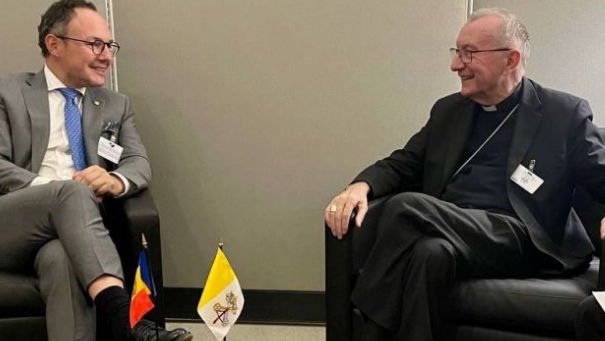
The Andorran interlocutor throughout this process has been Cardinal Pietro Parolin. The Secretary of State received Espot and Minister Ladislau Baró on July 29 at the Vatican, in the latest of a series of meetings dating back years. After that meeting, the Andorran Government confirmed that the reform will reach Parliament in September and thanked the Holy See for “the climate of trust and discretion” maintained.
It is worth pausing on that phrase. A Government preparing to decriminalize abortion publicly thanks the discretion of the Secretariat of State. Parolin’s diplomacy, true to its style, has once again opted for silent compromise rather than testimony: in 2023, during a visit to the Principality, the cardinal recalled that the defense of life is “an inalienable principle” for the Church. Three years later, that inalienable principle appears to have become negotiable, provided the operation is managed without noise.
La Veu Lliure concludes that the Vatican would have accepted, or at least decided not to block, a limited decriminalization. Rome has not denied that interpretation. And in these matters, the silence of the Secretariat of State is rarely accidental.
The silence of the co-prince
Nor has Monsignor Serrano Pentinat, who succeeded Monsignor Joan-Enric Vives at the head of the Diocese of Urgell in May 2025, commented on the terms of the reform. The episcopal co-prince has spoken of “dialogue” and of “accompanying women in difficult situations,” formulas that are as pastorally agreeable as they are legally innocuous. But the Bishop of Urgell is not an observer: he is a head of State. His signature, his silence, or his abstention will have direct consequences on the law. And on his conscience.
The question that no one in Rome seems willing to answer is elementary: can a Catholic bishop, co-prince of a State, allow the promulgation of a law that removes criminal protection for the life of the unborn? The Catechism and the constant magisterium of the Church—from Evangelium vitae onward—leave little room for diplomatic creativity.
Macron presses, Rome yields
While the Holy See negotiated discreetly, the other co-prince pushed without disguise. Emmanuel Macron—the same one who inscribed abortion in the French Constitution—raised the issue again during his visit to Andorra last April, addressing it both with Espot and with Serrano Pentinat. The result is clear: the French president’s pressure advances and Roman resistance retreats.
It is true that, according to La Veu Lliure, the arrival of Leo XIV complicated the conversations and helped reduce the scope of the project compared to the 2025 plans. The Pope has reiterated the defense of human life since the beginning of his pontificate. But consistency will be measured in September: if the project reaches the Consell General and prospers without the Holy See saying a word, the defense of life will once again have remained in the realm of generic statements while diplomacy did the opposite work behind closed doors.
What is at stake
Andorra was, along with Malta and very few other territories, one of the last European strongholds where the legal system fully protected the life of the conceived. That exception was not an anachronism: it was a testimony. If it falls in September, it will not have fallen by defeat, but by a negotiation in which the Church sat at the table to agree on the terms of its own withdrawal.
The final text that reaches the Consell General remains to be seen. But the precedent is already set: when the life of the unborn enters the Vatican diplomatic agenda, the inalienable ends up having a price. And discretion, it seems, is part of the payment.