


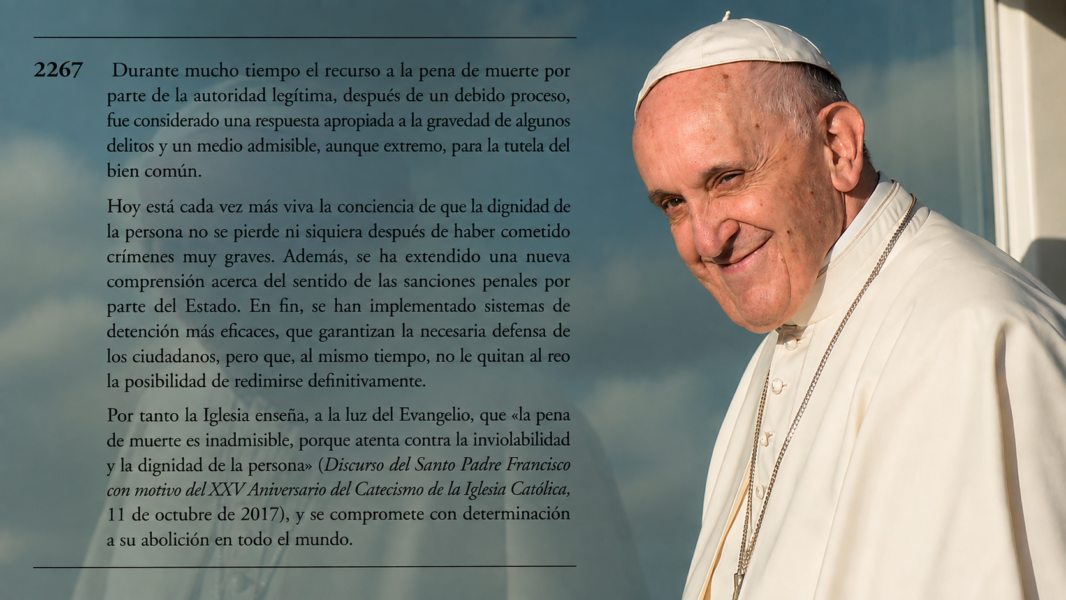
Eight years have passed since the Holy See rewrote number 2267 of the Catechism, and eight years later the problem created by that rescript remains intact, with an aggravating factor: it is no longer only Francis’s problem. Leo XIV has made the formula his own this very spring—in a return flight from Africa, before DePaul University, before the OSCE—and precisely for that reason this article is addressed to him. Not to ask him to rehabilitate any gallows, which no one longs for, but to ask him for what his predecessor never granted: to say what the word means on which the doctrinal credibility of the Church has been mortgaged. As long as “inadmissible” remains undefined, the entire Church is left at the mercy of the horses: those of others and, worse still, its own.
The facts are known and it is worth restating them with precision. On 2 August 2018 a rescript was published, approved by Francis in an audience of 11 May and signed on 1 August by Cardinal Ladaria, which replaced the 1997 text—John Paul II’s, which admitted capital punishment only as a last defensive resort against an unjust aggressor, in cases he judged already extremely rare, perhaps nonexistent—with a new teaching: the death penalty “is inadmissible, because it attacks the inviolability and dignity of the person,” with an express commitment to universal abolition. The only source cited was a speech by Francis himself, from October 2017, in which he had stated that capital punishment is “in itself contrary to the Gospel.” An accompanying letter from the Congregation for the Doctrine of the Faith certified that the new formula “is not in contradiction with previous teachings of the Magisterium.” The certification was necessary because appearances suggested otherwise: from the profession of faith imposed on the Waldensians in 1208 to Pius XII in 1952, passing through the Roman Catechism of Trent, the lawfulness in principle had been the constant teaching of popes, councils, and doctors.
The reaction did not come from the hostile press but from academia. On 15 August 2018, forty-five theologians, philosophers, and clerics published in First Things an appeal to the cardinals asking them to advise the Pope to withdraw the revision, because its appearance of contradiction with Scripture and traditional teaching was causing scandal; within days more than thirty additional signatures were added. On the other side, Monsignor Paglia, president of the Academy for Life, offered the press the maximalist reading: with the new text “it has become clear that there are no exceptions.” Between these two poles ambiguity flourished: some read a revisable prudential judgment, others a declaration of intrinsic malice, and moralists pointed out that “inadmissible” is not a defined term in moral theology, so each understood what they wished. Eight years later, the dispersion persists. A catechism exists to settle disputes; this number founds them.
The cost is not academic. In 2004, Cardinal Ratzinger had drawn a clear boundary for the American bishops: among Catholics there is legitimate diversity of opinion on war and capital punishment; on abortion and euthanasia, none. That boundary protected what is essential by distinguishing it from what is debatable. The 2267 of 2018 erased it, and with it erased something more: it established the precedent that a centuries-old teaching can be reversed by a speech, a rescript, and a certificate of non-contradiction. Whoever wishes to apply the same template tomorrow to any other dossier already knows the way. One need not long for the executioner—nobody here does—to see that the teaching credibility of the Church is not lost by parcels: if the constant magisterium could have erred in this, the question of why it would not have erred in that is served, free of charge, to all its adversaries, internal and external.
Why Leo XIV? First, because he has assumed the formula. On 23 April, returning from Equatorial Guinea, he equated them by juxtaposition: “I condemn murder. I condemn the death penalty.” The next day, in his video message to DePaul for the fifteenth anniversary of abolition in Illinois, he cited the current 2267 and reproduced even its architecture: the dignity that is not lost even after the gravest crimes, and also the effective prisons that make the penalty unnecessary; the same mixture of essence and circumstance that constitutes the problem. In May, before the OSCE, he excluded capital punishment alongside torture and degrading treatment, while the federal government of his country announces that it is strengthening the federal death penalty. Second, because he himself has formulated the distinction that the current text blurs: in 2023, as bishop of Chiclayo, he made his own Bernardin’s “consistent ethic of life,” but precisely collecting the warning of the cardinal of Chicago: each life issue has its own moral character, and fusing them without attending to their relative moral importance departs from Catholic teaching. Exactly. We ask him to apply his own warning to number 2267. And third, because few popes have arrived better equipped for the task: doctor in canon law, and bearer by election of a name that refers to the author of Aeterni Patris, the encyclical that made Saint Thomas the common teacher of the Church; the same Thomas who taught the lawfulness of capital punishment in the Summa. The tools are on his table.
To remedy does not require, in its minimum degree, restoring the 1997 text; it requires answering a single question, and the Church has ordinary instruments for this: a responsum ad dubium from the Dicastery for the Doctrine of the Faith. The dubium is simple: does “inadmissible” enunciate an intrinsic malice or a prudential judgment on present circumstances? If the former, let it be explained how it is reconciled with the Waldensian profession, with Trent, and with Pius XII, or let the rupture be admitted and its consequences borne. If the latter, let 2267 be reformulated to say what it means: the Church can commit itself to abolition, with all the prudential force in the world, without mortgaging its past or grounding the petition in a dignity that, if it were the foundation, it was also in 1208. None of this is unprecedented: 2267 itself was revised in 1997 after Evangelium vitae—catechetical texts are revisable by definition—and if the obstacle is that Fratelli tutti incorporated the formula in 2020, that is precisely the reason why only a Pope can do it.
Eight years, two pontificates, one word undefined. We do not ask Leo XIV to defend the gallows. We ask him to define a term. For that, exactly, a Pope exists.