


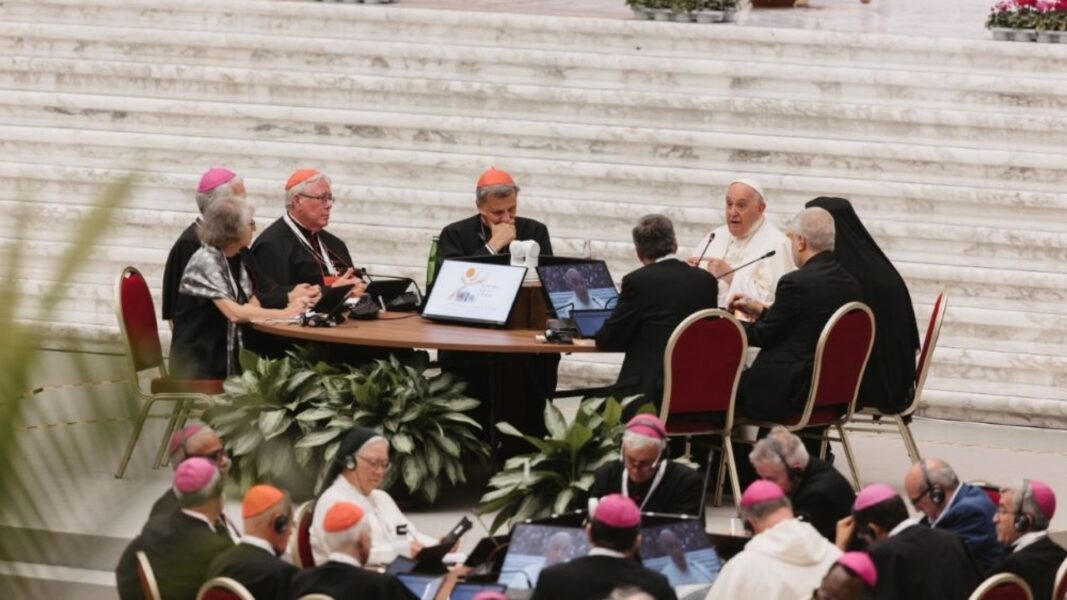
One has followed the synodal process of recent years with that mixture of fascination and drowsiness produced by certain lengthy spectacles, and has reached a conclusion that, though obvious, remains melancholy: the Church has invented a new genre, the meeting whose subject is the meeting. The Synod on Synodality is to theology what a congress of congressmen on congressuality would be: a tautology with a budget. Ionesco would have written it; Escher would have drawn it. Three years, two Roman sessions, continental assemblies, an Instrumentum laboris delivered in installments, a final document that consecrates the “conversation in the Spirit,” and now an implementation phase that will culminate in 2028 with an assembly meant to evaluate how we have walked while walking. Mise en abyme, as the French say when a painting contains the painting that contains it.
Meanwhile, in the parishes where the Church truly exists, real questions are being asked. They are asked by mothers in sacristies, by adolescents in catechesis, by catechists who do not know what to answer because no one wearing a mitre has ever developed an answer. One, a layman without office or charism, therefore allows himself to propose an alternative synodal program: synods on genuinely disputed questions. Quaestiones disputatae was the name of the genre when theology still had a pulse. Here are five, with their etcetera.
- First Synod: on children who die without baptism. The question has a doctrinal dossier that takes one’s breath away. Florence taught that those who die with only original sin descend into hell, though with unequal punishments, poenis disparibus; Trent reiterated the necessity of baptism; and Saint Thomas, with a delicacy our pastoral documents might envy, articulated the Limbo of the Infants: neither beatific vision nor sensible punishment, but a natural happiness. The Synod of Pistoia dismissed it as a “Pelagian fable,” and Pius VI condemned the mockery in the Auctorem fidei of 1794—nota bene: he did not define Limbo; he forbade laughing at it, which in theology is already a form of protection. The twentieth century then let it die of second-hand embarrassment; the Catechism replaced it with a trust in mercy (§1261), and the International Theological Commission concluded in 2007, with the venia of Benedict XVI, by speaking of “serious reasons for hope.” Hope, it must be said, is not a doctrine: it is what remains when doctrine has gone on holiday.
And here the genre no longer admits irony, because the question has changed in scale. Tens of millions of abortions are committed each year. Behind some of them stands a woman who one day enters a church and asks a priest where her child is. The honest answer available today is “we hope,” and hope without content consoles little. The dilemma has two exits, and neither has been willing to be taken: if those souls see God without further ado, then abortion turns out to be the most efficient path to heaven ever devised—an intolerable conclusion that no one dares to formulate and that therefore no one bothers to refute; if they do not see Him, let it be said clearly and let the corresponding consolation be developed, for tradition possesses it: commendation, suffrage, mercy implored and not presumed. Three years of synod would suffice for this. They would, in fact, suffice to begin.
- Second Synod: on the manner of receiving Communion. Here there is no need to invent the debate, because the Holy See itself opened it and left it wide open. Memoriale Domini, 1969: Paul VI consults the worldwide episcopate on Communion in the hand; the result yields 1,233 non placet against 567 placet; and immediately an indult is granted wherever the practice had already been introduced. Within a decade the exception devoured the rule, a textbook case of post-conciliar juridical mechanics. Half a century later, two practices coexist with two implicit theologies and no explicit catechesis. Is it fitting to receive God in the hand? Its defenders brandish, with convert’s fervor, Cyril of Jerusalem and his “make of your left hand a throne for the right” (a text, it should be noted, of disputed authorship, which is what usually happens with texts that are too convenient). Its opponents reply with Trent: totus Christus in every fragment, and fragments, in a lay palm, have the ugly habit of falling. Are both forms “equally commendable,” as praxis suggests, or does one remain the universal law and the other a permission that has forgotten it is one? A synod could study the matter seriously: particles, reverence, a sensus fidelium measured and not presumed. One suspects the results would discomfort everyone, which is the unmistakable sign that a question is real.
- Third Synod: on the age of Confirmation. “The sacrament in search of a theology,” repeated for half a century; half a century repeating the diagnosis without writing the prescription. There are two coherent logics, and we have chosen to follow neither. If the sacrament is grace and not a medal, administer it as soon as possible: the East chrismates infants and no one accuses the East of sacramental frivolity; Saint Pius X lowered First Communion to the age of seven in 1910, Quam singulari, precisely because he understood that grace should not wait on bureaucracy. If, on the other hand, Confirmation is the personal ratification of an adult who decides, then why at fourteen and not at twenty-five, the age at which the average Westerner begins to choose even the sofa? What we have is the worst of both logics: Confirmation as a graduation ceremony, the sacrament of farewell, statistically the last time we see the confirmand. Canon 891 delegates to episcopal conferences, the conferences to dioceses, each diocese to its custom, and the seal of the Holy Spirit ends up depending on the postal code. A synod could fix the order of Christian initiation, which is no small matter: it is deciding what a Christian is while making one.
- Fourth Synod: on the demography of hell. Balthasar dared to hope that all men are saved; Ralph Martin answered him with Scripture and the entire tradition; Barron intervened; and the dispute, as alive and serious as few others, remains confined to books the clergy do not read while praxis resolves it by fait accompli: the practical universalism of the funeral, where every deceased person “is already in heaven” and each exequy is an express canonization without process, without miracles, and without a devil’s advocate. The consequences are not decorative: if everyone is saved, mission becomes a hobby and martyrdom a misunderstanding. Ratzinger, in Spe salvi, at least permitted himself an arithmetic: few the entirely corrupt, few the entirely pure, the great majority destined for purification. Speculation, yes, but from someone who had read everything. And purgatory opens the adjacent door: indulgences remain in force, the Enchiridion was reissued in 1999, and the Church administers a treasury it is ashamed to spend. November, suffrages, the communion of saints: pastoral gold unextracted, in plain sight, on the surface.
- Fifth Synod: extra Ecclesiam nulla salus. Florence again, with its hard text; Lumen gentium 16, with its opening; Dominus Iesus, trying to make both things true at once without fully explaining how. And in the middle, the Feeney case, an authentic koan of ecclesiastical history: the Jesuit excommunicated—for disobedience, technically; the “technically” are the poetry of canon law—for defending with excessive rigor that outside the Church there is no salvation. Reconciled in 1972 without retracting, by the way. The question every adolescent formulates in catechesis—“why be Catholic if my Buddhist friend is saved just the same?”—has for sixty years received in reply a comme il faut shrug of the shoulders, and from that shrug has come the missionary collapse, which is not correlation but cause. A synod on this would fill stadiums. It would fill, at the very least, the seminaries with arguments.
And the etcetera, which would suffice for an entire pontificate. The eucharistic fast, lowered from midnight to three hours by Pius XII and from three hours to one by Paul VI, one hour in which parking fits: homeopathic asceticism. The asymmetry between the Communion line and the desert of the confessional, with Saint Paul and his “whoever eats unworthily” read hastily once a year. The devil, of whom Francis spoke constantly and in whom less clergy believe than confess to believing, with the few available exorcists overwhelmed with work. The ashes of the deceased, scattered on the mountain against a 2016 instruction that no faithful has heard cited from a pulpit. Guardian angels, degraded from celestial militia to decorative motif of a child’s room. Each of these matters truly divides, truly interests, and lacks developed pastoral care; each would provide material for three years of assemblies with profit.
The predictable objection is that these are “divisive” questions. Answer: exactly. That is what councils and synods were invented for—for disputed questions. Nicaea—of whose seventeenth centenary we have just emerged so commemorative—did not meet to converse in the Spirit about the experience of being Church: it met because Arius was saying things and it had to be decided whether they were true. Trent existed because Luther existed. Division is not cured by ignoring it in assemblies about the assembly; it is cured by studying it to the bone. The other thing, the method about the method, the path about the path, has a name in the history of art—mannerism—and in the history of television another, crueler one: the show about nothing. With the difference that the latter, at least, had wit.
One is not asking for much. One is asking for an agenda. Between now and 2028 there is time enough for five synods of the old kind, with their theses, their antitheses, and their anathemas if necessary. The Spirit blows where He wills, agreed. But it would not hurt, for once, to offer Him an order of the day.