


By Fr. Paul D. Scalia
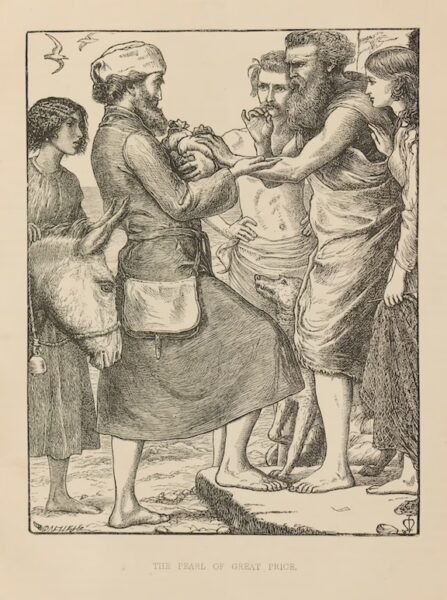
Traditionally, two of the parables presented to us today are understood as lessons on the cost of discipleship. The treasure hidden in the field and the pearl of great price signify the Kingdom of God. (See Matthew 13:44-46). It is worth giving up everything we have to obtain them. Although this interpretation is profoundly true, the great modern scholar and translator of Scripture, Monsignor Ronald Knox, suggests another.
According to Knox, we can understand Christ himself as the man who finds a treasure in the field and the merchant who finds the pearl of great price. Fallen man is the treasure. We are the pearl of great price. Christ has found us and sells all that he has to buy us.
Now, this interpretation is not contrary to the traditional one. But neither is it merely an alternative. Rather, it is prior. It precedes and enables our own discipleship, our own finding and buying. We cannot assume the cost of discipleship, we cannot sell all that we have, until and unless we ourselves are bought. We must be found before we find, bought before we can buy.
This is the structure of salvation. God takes the initiative; we respond. “This is love: not that we have loved God, but that he loved us and sent his Son as an atoning sacrifice for our sins.” (1 John 4:10). The Kingdom of God is not only—or even primarily—about us finding and treasuring Jesus Christ. It is, first of all, about God finding us, loving us, and buying us.
Thus, Jesus found us buried under the dirt and grime of sin. Our sins cover us in such a way that our glory and nobility cannot be seen. But He found us, pulled us out of the earth, and saw in us a treasure. To buy us, He set aside His heavenly glory, left peaceful Nazareth, suffered torture and humiliation, and died on the Cross. “You were bought at a great price.” (1 Corinthians 6:20).
It is interesting that the man in the Gospel does not buy only the treasure, but the entire field. In the same way, through His death, Jesus has not only bought us, but also our surroundings, everything that surrounds us. There is nothing in our lives that He has not died to redeem and sanctify. Our families, friendships, finances, work, rest, entertainment, past, present, and future: all of this is the field that surrounds us and that He has redeemed, buying it for Himself.
Jesus is likewise the merchant in search of fine pearls. We are that pearl of great price. He looks at us and sees beauty, goodness, and infinite value. He seeks us not because He needs us (no one needs a pearl), but simply because He desires to have us for Himself.
Notice that He is searching. This is an element that distinguishes Christianity from every other religion. All others are man’s search for God; Christianity is God’s search for man. Just as the Lord God once asked us in the Garden: “Where are you?” (Genesis 3:9), so Jesus now comes into this world in search of us, the fine pearl. “For the Son of Man came to seek and to save the lost.” (Luke 19:10).
When we understand these parables as centered first on Christ, only then can we apply them more precisely to ourselves. We can seek Him because He has already found us. We can buy the field and acquire the pearl because He has given everything for us.
The treasure and the pearl cannot be hidden. Unfortunately, we can. We can avoid the One who seeks us. We can try not to be found. In fact, the habit is deeply rooted in us: “I heard your footsteps in the garden and was afraid, because I was naked; so I hid.” (Genesis 3:10).
We are experts at hiding. We hide in our work or in family obligations (I am too busy to pray). We even hide in prayer: when we recite prayers instead of praying, when we remain on the surface of our faith, when we use our structured prayer as a way to keep Him at a distance. (Leave me alone, Lord, I am praying the Rosary).
Our salvation is intimately tied to being found—known—by God. St. Paul reminds the Galatians how they have “come to know God,” and immediately corrects himself: “or rather, to be known by God” (Galatians 4:9). The most important part is not knowing, but being known. Likewise, when describing eternal life to the Corinthians, he observes: “Now we see imperfectly, as in a mirror; but then we shall see face to face. Now I know in part; but then I shall know fully, even as I am fully known.” (1 Corinthians 13:12). Heaven includes being fully known. Found.
The first step of discipleship is not to find or to buy, but to allow ourselves to be found and bought. It means allowing Him to know us. Yes, He already knows us because He knows everything. But He wants to know us not only as the Creator knows His creatures, but as the Father must know His children and Christ His friends. He wants to know us because we have made ourselves known, because we have invited Him into our lives, minds, and hearts. That is what it means to be found.
Being known by Him means learning our true worth. Only with the confidence of that worth can we become those who constantly seek Him, the treasure and the pearl, and give all that they have to gain Him.
About the author
Fr. Paul Scalia is a priest of the Diocese of Arlington, VA, where he serves as Episcopal Vicar for the Clergy and Pastor of Saint James in Falls Church. He is the author of That Nothing May Be Lost: Reflections on Catholic Doctrine and Devotion and editor of Sermons in Times of Crisiss: Twelve Homilies to Stir Your Soul.