


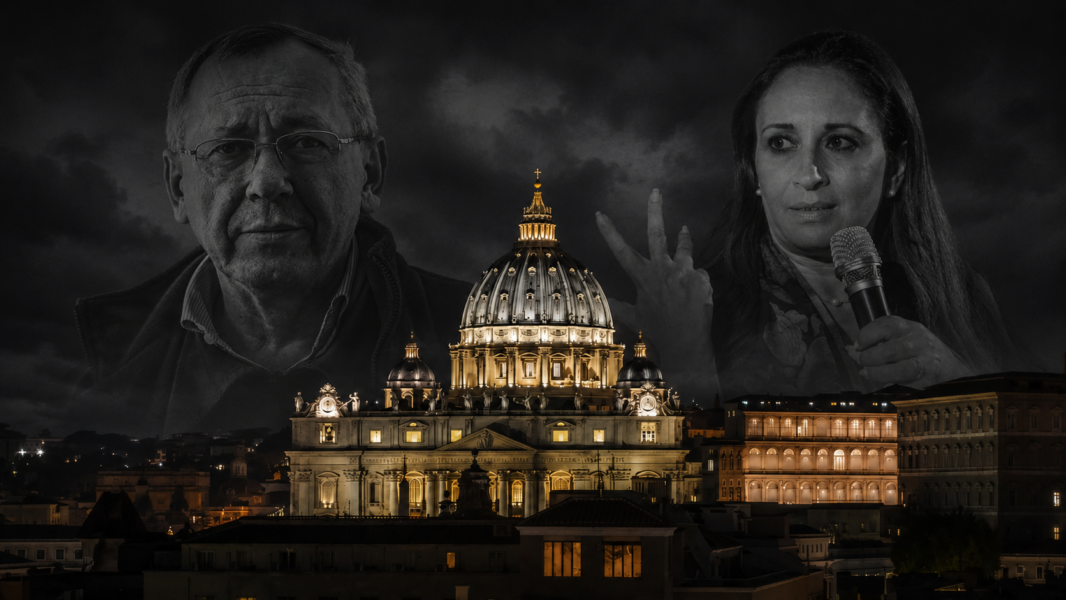
After the Holy See officially denied reports of an alleged acquittal of Marko Ivan Rupnik and confirmed that the canonical process is still ongoing, lawyer Laura Sgrò made public her criticisms of the procedure’s development, denouncing the lack of information provided to the women she represents and demanding clarification on whether they will be allowed to participate as injured parties in the trial.
In statements to La Nuova Bussola Quotidiana and Crux, as well as in a letter addressed to the Prefect of the Dicastery for the Doctrine of the Faith, Cardinal Víctor Manuel Fernández, the Italian lawyer insists that she does not seek a public trial or to question the canonical order, but rather to obtain “the minimum information that guarantees the right of defense and the right of contradiction.”
“Without it, there can be no justice,” she states.
Five questions that remain unanswered
According to OSV News, Sgrò sent a letter to Cardinal Fernández on July 21 raising five specific issues: whether the trial had actually begun, its current status, the composition of the tribunal, what had happened to the request submitted by her clients to be admitted as injured parties, and why the complainants had still not been called to testify.
The following day, the Holy See Press Office officially confirmed that the judicial process is underway and denied reports of an alleged acquittal of Rupnik. The Director of the Press Office, Matteo Bruni, explained that, “during the trial, as in any judicial proceeding, information about ongoing activities cannot be shared out of respect for the trial itself” and also to avoid harming those involved. He added that, if the tribunal deems it necessary to gather more information, “it will be its responsibility to proceed independently to obtain it.”
However, the statement did not address one of the central questions raised by the lawyer: what has happened to the request for the complainants to be admitted as injured parties in the proceedings.
The issue of victims in the process
It is precisely here that Sgrò places the core of her criticism.
The lawyer denounces that her clients “have not only not been summoned,” but that the request submitted to intervene as representatives of the injured party “has not even received a response.” She also claims to have repeatedly attempted to contact Cardinal Fernández and the Secretary of the Disciplinary Section of the Dicastery for the Doctrine of the Faith, Archbishop John Joseph Kennedy, without receiving a reply.
“I have always been given the runaround; no one wants to talk to me,” she states.
The issue is not minor from a legal standpoint. Canon 1729 of the Code of Canon Law provides that the injured party may bring, within the criminal proceedings themselves, an action to claim compensation for damages suffered as a result of the offense. It is precisely this possibility that Sgrò requested for her clients and on which, so far, the Dicastery for the Doctrine of the Faith has not given a public response.
The lawyer also maintains that her clients do not know the identity of the judges handling the case and have not even been heard as witnesses.
“How can a trial be credible when the victims do not even know the names of the judges? It is another form of violence committed against these women,” she asserts.
A debate that goes beyond the Rupnik case
Sgrò’s criticisms are not limited to the case of the former Slovenian Jesuit, but reopen a broader debate on the participation of victims in certain canonical criminal proceedings.
The lawyer denounces that the alleged victims remain on the sidelines of the process, without sufficient information about its progress and without a response to the requests made by their legal representation. A similar criticism was raised by the victims of the Peruvian priest Eleuterio “Lute” Vásquez, whose canonical investigation was also surrounded by complaints about the limited communication maintained with the complainants during the processing of the case.
In the letter sent to Cardinal Fernández, Sgrò asserts that her clients “feel abandoned and betrayed, victims once again of a system that never welcomed, protected, or comforted them.” In her view, the lack of communication constitutes “additional violence” against women whose wounds “remain open.”
Transparency and credibility
The lawyer concludes her letter by appealing to the credibility of the Church itself.
“The Church, like the victims, needs transparency, justice, and truth,” she writes, while requesting to be kept informed “to the extent possible” about the progress of the proceedings and reminding that her clients “must be considered a resource and not an obstacle on the path to truth.”
The canonical trial against Rupnik continues as the tribunal examines the extensive documentation gathered during the investigation. For the time being, the Holy See maintains confidentiality regarding the development of the proceedings, citing the need to preserve the integrity of the process, while the complainants demand to know what their role will be in a procedure whose outcome could become a reference for future cases of abuse tried by canonical justice.