


Between February 2024 and September 2025, InfoVaticana did me the immense favor of publishing in installments the research I was conducting on the life and monastic work of the Hieronymite monk fray Lope de Olmedo (1370 – 1433).
This research was enrolled for three academic years (2020 – 2023) in a doctoral project in Medieval History at the Faculty of History of the Universitat de Barcelona, where I had obtained my degree and research proficiency back in 2002.
It was a time when I could see how the ideologized drift in the study of history had only worsened in 20 years, with highly tendentious studies funded by public money, devoid of content, marked by a total ignorance of the Church’s own logic and a scandalous, entirely unscientific presentism. The project did not culminate in a doctoral thesis, but the time, effort, and material resources devoted to rescuing fray Lope de Olmedo from oblivion and interested distortion were worthwhile, and the results of the research will soon see the light, God willing, articulated from the aforementioned publications on this portal.
But what I would like to address in this text today is an episode that took place during one of the three doctoral courses at UB; reading Pío Moa’s book “Galería de charlatanes” has encouraged me to put it in writing.
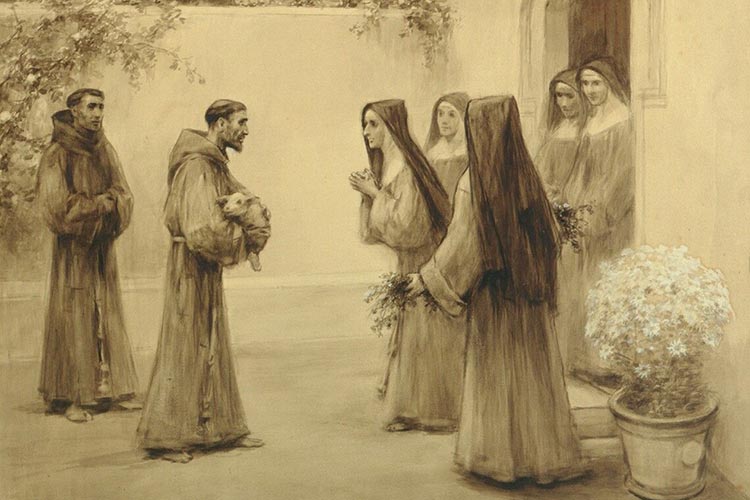
Some of the professors involved in the doctorate were immersed in an international research project on Franciscan observance, building a European atlas that could locate the Franciscan convents of strict observance—the reformist movement returning to the origins that took place in the late Middle Ages—and creating specific records for each of them, with their chronology and basic particularities. As a doctoral student, I was called to a meeting in which I was asked to prepare the individual records of some of these convents. Some time later, I was summoned again to set aside the first idea and investigate, based solely on bibliography—not primary sources—about the figure of the conventets in Poor Clare convents in the Crown of Aragon. The conventets were small friaries (that is their meaning in Catalan) located within Poor Clare convents, intended to serve the nuns sacramentally.
I was asked to study four specific conventets: those located at the Monastery of Pedralbes in Barcelona, and those of Manresa, Balaguer, and Girona. The premise from which the directors started was to try to prove that the one holding power in those convents was the abbess, above the friars, and that, after the Observant reform, the friars had abandoned that cura monialis (spiritual and sacramental care of the nuns).
After the initial surprise of being assigned to work on a question that had nothing to do with my research topic, which implied hours I would not be able to devote to my thesis project, I began to investigate the matter.
The reading of the bibliography, with its facts and data, immediately made clear how far removed from ecclesial logic the working hypothesis of the project directors was and how conditioned by their presentist, feminist, and unscientific ideological positions.
After months of work and gathering information, I contacted my thesis director to ask when and how I should present the results of the research, and to my surprise, she had completely forgotten the assignment I had been given, in two different meetings, to carry out such research. And it occurred to her that I could prepare an article intended as a paper to be presented at an international congress on Franciscan observance that was soon to be held in Assisi. I presented the results of the research at the congress, and the prepared text was published in the proceedings of that congress.
The article, necessarily brief, demonstrated that the initial hypothesis was incorrect, and showed that the Poor Clare nuns only founded convents where a male Franciscan convent already existed or, at the very least, where one was planned to be founded. But the conclusions of my article were not the result of new discoveries after consulting unpublished documentation, since, as I have said, I relied only on existing bibliography. The data were already presented in other studies, but forced to fit into ideological narratives constructed a priori. And the only possible conclusion was that in no case did there seem to have been any intention of a female foundation without the prior or projected presence of a male community.
I will briefly present the four case studies of the conventets of Pedralbes, Manresa, Balaguer, and Girona so that each person can verify these statements for themselves. The main problem lies in the substance of the matter, the perspective, the historian’s approach, to which he adapts the facts, even if it means forcing, distorting, or even concealing them; and not the other way around, as it should be. The academic way of dealing with issues related to the Catholic Church seems to stem not only from a great ignorance of the basic functioning of religious orders, but also from hypotheses formulated from a mentality totally alien to that of the people being studied. The only way to correctly understand the subject being studied is from that subject’s own perspective. When a researcher approaches a figure from another era without questioning his own ideas and possible prejudices, he runs the risk of understanding nothing, as Joseph Pearce affirms in his highly recommended work “Through Shakespeare’s Eyes”.
That is why, when a researcher approaches nuns of the thirteenth century, he must first try to understand the logic of thought and action of that group. Only then can he understand that it is not possible for a female congregation in the thirteenth century to have thought of founding a convent without taking into account the existence nearby of a male community with the same religious charism that could celebrate the sacraments for them. Assertions about a supposed autonomy of the nuns in terms of independence and empowerment and no need for men are simply ridiculous and presentist.
I conclude this first part with an enlightening anecdote on the matter: at the second meeting to which I was summoned and in which I first heard about the figure of the conventets, I exclaimed without thinking that God willing, in the small contemplative community of consecrated virgins of which I am a part, we might also enjoy a conventet. To which my doctoral thesis director immediately replied that what was necessary was rather that women be able to celebrate Mass. This response was followed by a brief argument on my part about why women cannot celebrate Mass, which I did not pursue when I understood her unwillingness to listen, expressed in a very eloquent body language of crossed arms and legs.