


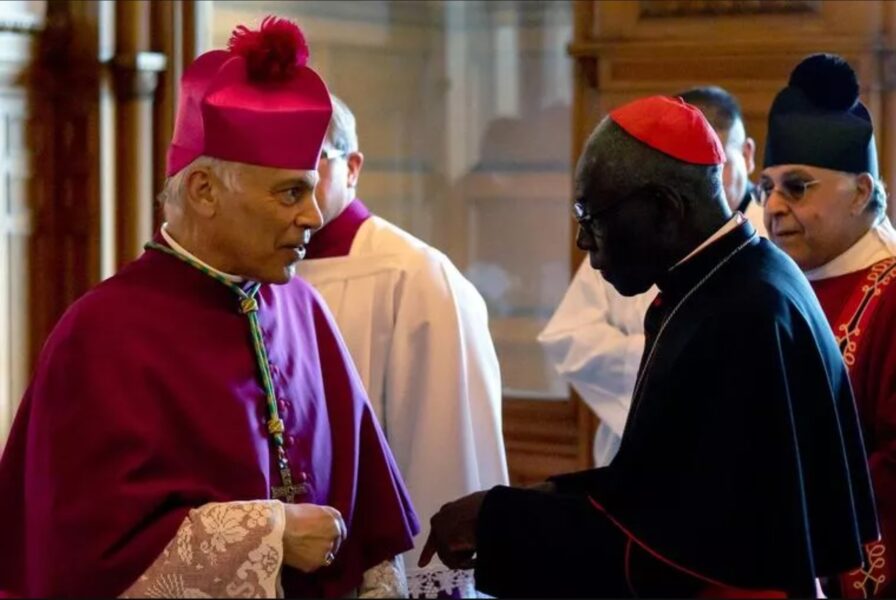
The Pope appoints seven new members to the Supreme Tribunal, including two Spanish canonists from Opus Dei and a markedly technical profile. The incorporation of the Archbishop of San Francisco, barely three weeks after his statements on the traditional Mass and the FSSPX, is the most eloquent detail of the batch. For his part, Cardinal Müller’s five-year term concludes.
The Holy See Press Office announced this Saturday, July 25, the appointment of seven new members of the Supreme Tribunal of the Apostolic Signatura, the Church’s highest judicial body, presided over by Cardinal Dominique Mamberti. Leo XIV has designated the archbishops and bishops Salvatore Joseph Cordileone (San Francisco), Krzysztof Nitkiewicz (Sandomierz, Poland), Juan Ignacio Arrieta Ochoa de Chinchetru (secretary of the Dicastery for Legislative Texts until last June) and Edward M. Lohse (Kalamazoo, United States), along with the priests Eduardo Baura de la Peña (Pontifical University of the Holy Cross), Gianpaolo Montini and the Jesuit Ulrich Rhode (both from the Gregorian).
The renewal comes as the five-year term of the members appointed by Francis in June 2021 expires: Cardinals Müller, Tobin, Grech and Harvey thus conclude their mandate on the tribunal, in an ordinary transition that gives way to a new generation of canonists.
Cordileone, a canonist returning home
The appointment of the Archbishop of San Francisco is, by far, the one with the greatest ecclesial significance. Cordileone is no newcomer to the Palazzo della Cancelleria: a canonist by training, he worked as an official of the Apostolic Signatura itself in the 1990s, before his episcopate, so he knows from within the machinery of the tribunal to which he now returns as a judge.
But it is the context that turns the appointment into a gesture. Cordileone is one of the few diocesan ordinaries in the world who regularly celebrates the traditional Roman rite. On July 2, he conferred the subdiaconate and diaconate on fourteen seminarians of the Institute of Christ the King Sovereign Priest in Gricigliano, in ceremonies that were completed the following day by Cardinal Burke—former prefect of the same Signatura—with the ordination of four new priests.
Just days later, the archbishop publicly reacted to the episcopal consecrations of the Society of Saint Pius X in Écône, stating that they reflect “a growing lack of trust that has been building for a long time,” calling for “sincere and honest” dialogue between Rome and the Fraternity and requesting that access to the traditional Mass be facilitated “so that our faithful do not feel obliged to seek spiritual nourishment outside the family in communion with Rome.”
That Leo XIV incorporates him into the Church’s supreme tribunal three weeks after those statements admits few ambiguous readings: far from placing him outside the perimeter of pontifical trust, that discourse has not been an obstacle to entrusting him with a function of legal guarantee at the heart of the Curia. At the most delicate moment in the relationship between Rome and the traditional world since 1988, the Pope seats on the Signatura an archbishop who celebrates the ancient rite, ordains for an ex Ecclesia Dei institute and calls for a review of the liturgical status quo.
What the Signatura is and what Cordileone will be able to vote on
The Apostolic Signatura operates in three areas, in accordance with its Lex Propria. As the supreme judicial tribunal, it judges complaints of nullity against judgments of the Roman Rota and conflicts of jurisdiction between tribunals. As a contentious-administrative tribunal—its most sensitive function—it resolves appeals against singular administrative acts of the dicasteries of the Curia for violation of law in the procedure or in the decision: through this channel pass parish suppressions, expulsions from religious institutes, penal decrees against clerics and, potentially, dicasterial decrees affecting communities linked to the traditional liturgy. It also exercises oversight over the proper administration of justice in all the Church’s tribunals.
The members do not reside in Rome nor govern the dicastery—that corresponds to the cardinal prefect—but they judge in colleges of five that definitively decide contentious appeals and in the plenary that resolves conflicts between dicasteries. That is: Cordileone will vote, case by case, on the legality of acts of the Roman Curia, including those of the Dicastery for the Doctrine of the Faith and the Dicastery for Divine Worship when they arrive by way of appeal. A control of legality, not of merit, and from which acts approved by the Pope in specific form are excluded; but a guarantee mechanism of no small importance in the canonical order.
A batch of jurists, not ideologues
The rest of the appointments confirms the imprint: technical rather than political. Juan Ignacio Arrieta, a priest of Opus Dei and doctor from Navarra, has been for nearly twenty years secretary of Legislative Texts and the main architect of the 2021 reform of canonical penal law; his move to the Signatura is almost a natural career move. Eduardo Baura, also of Opus Dei and professor at the Holy Cross, is one of the great specialists in canonical administrative law—precisely the subject matter of the tribunal’s second section—and once signed very critical analyses of the legislative technique of Traditionis custodes.
Gianpaolo Montini, professor at the Gregorian and for years promoter of justice of the Signatura itself, is probably the greatest living expert on the tribunal’s contentious-administrative process. Completing the list are the German Jesuit Ulrich Rhode, professor at the Gregorian; the Polish bishop Krzysztof Nitkiewicz, a canonist and former undersecretary of the then Congregation for the Oriental Churches; and Edward Lohse, bishop of Kalamazoo and apostolic administrator of Steubenville, doctor from the Gregorian with years of service in the Congregation for the Clergy.
There is not a single name on the list identifiable with the progressive wing of the College. Two priests of Opus Dei, a traditional archbishop, three canonists of the classical school and a bishop in the line of the Polish episcopate: the photograph is that of a tribunal reinforced with jurists of profession and classical sensibility.
The replacement of Müller, an ordinary change
Among those concluding their service on the tribunal is Cardinal Gerhard Ludwig Müller, prefect emeritus of the Doctrine of the Faith and member since 2021. His departure should not be read in a political key: the mandates of that batch expired by law this year and the German cardinal, who has passed the age of 78, leaves the tribunal together with Cardinals Tobin, Grech and Harvey, of sensibilities quite distinct from one another. It is an ordinary generational transition, which in no way affects the doctrinal weight of Müller, whose voice—as he demonstrated a month ago at the extraordinary consistory—remains one of the most listened to in the College of Cardinals.
With Mamberti at the head and this new composition, the Signatura is configured for a pontificate in which canonical contentious-administrative matters—from appeals by traditional communities to penal proceedings against clerics—promise to be anything but irrelevant.