


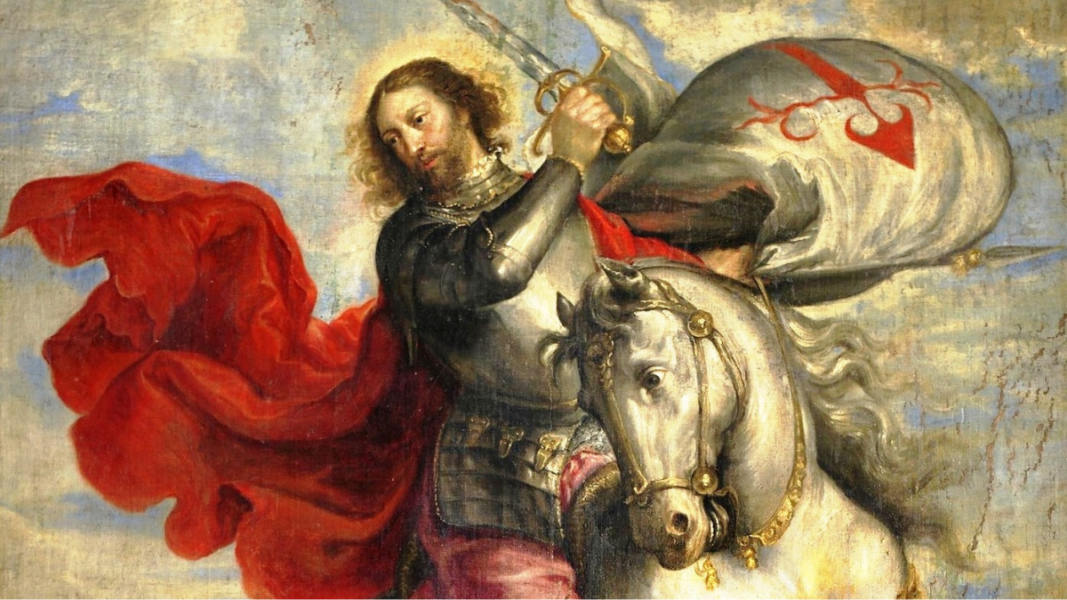
Few festivities resonate as deeply in the history of the Church and of Spain as that of Saint James the Apostle. Each July 25th, the liturgy turns its gaze toward that fisherman from Galilee whom Christ called beside the shores of the Sea of Tiberias and who would ultimately become the first of the Twelve to shed his blood for the Gospel. For more than a millennium, his memory has been inseparably linked to Compostela, one of the great pilgrimage centers of Christendom and the destination of countless faithful who, generation after generation, have walked the roads of Europe to venerate his relics.
Yet before becoming the patron of Spain or the saint to whom pilgrims are drawn, James was one of the disciples closest to the Lord, a witness to His glory on Mount Tabor and to His agony in Gethsemane. The richness of his cult, developed over centuries in liturgy, art, and Christian tradition, explains why the Church continues to honor him as one of the great pillars of the apostolic college.
One of the three disciples closest to Christ
James, son of Zebedee and Salome, was the brother of Saint John the Evangelist. Both worked as fishermen on the Sea of Galilee when Jesus called them to leave their nets and follow Him.
The Gospels always place James among the Lord’s most intimate circle. Together with Saint Peter and Saint John, he forms the group of three disciples who accompany Christ in the most solemn moments of His public life. Only they witnessed the raising of Jairus’s daughter, beheld the Transfiguration on Mount Tabor, and remained near the Master during the agony in the Garden of Olives.
Saint John Chrysostom called this small group the “princes of the Apostles”, not to establish a hierarchy among them, but to highlight the special trust Christ placed in those three privileged witnesses.
Saint Mark adds another revealing detail: Jesus gave James and John the nickname Boanerges, “Sons of Thunder.” The epithet reflects the ardor of their character. When a Samaritan village refused to receive the Lord, both asked whether they should call down fire from heaven upon its inhabitants. Christ rebuked them, reminding them that the Son of Man had not come to destroy souls, but to save them.
That same temperament reappears when, through their mother Salome, the two brothers requested the foremost places in the Kingdom of God. Christ’s reply contained a prophecy: “You will indeed drink My cup.” In James those words would be fulfilled a few years later.
The first of the Twelve to give his life for Christ
The Acts of the Apostles recount with sobriety the end of his earthly life. Around the year 44, Herod Agrippa I launched a persecution against the nascent Church and “killed James, the brother of John, with the sword.” The former fisherman of Galilee thus became the first Apostle to seal with his blood the faith he had proclaimed.
The tradition preserved by Eusebius of Caesarea, drawing on an earlier account by Clement of Alexandria, adds an episode of extraordinary spiritual power. The man who led James before the tribunal was so impressed by the serenity with which he confessed Christ that he ultimately proclaimed himself a Christian as well. On the way to execution he asked the Apostle for forgiveness; James embraced him with the kiss of peace, and both were beheaded together.
The scene encapsulates the entire transformation wrought by grace. The “Son of Thunder,” who one day had wished to invoke fire from heaven against the Samaritans, died forgiving the one who had helped bring him to death.
The apostolic tradition of James in Hispania
Sacred Scripture does not recount a mission of James in Hispania before his martyrdom. Nevertheless, from the earliest centuries a tradition took shape presenting him as proclaiming the Gospel in the Iberian Peninsula after the Lord’s Ascension.
According to that tradition, his preaching met with scant initial fruit, and the Apostle returned to Jerusalem, where he would suffer martyrdom. Before departing he is said to have left disciples entrusted with continuing the evangelization, later identified with the Seven Apostolic Men, regarded as the first bishops and evangelizers of various regions of Hispania.
To this same tradition belongs one of the episodes most deeply rooted in Spanish piety: the Coming of the Virgin of the Pillar. While James was preaching in Caesaraugusta—the present-day Zaragoza—and passing through moments of discouragement, the Blessed Virgin, still living in Jerusalem, appeared to him upon a pillar of jasper to encourage him in his mission. Tradition holds that this was the first Marian apparition in history and the origin of the sanctuary of the Pillar, one of the principal centers of Marian devotion in the world.
Compostela, one of the great beacons of Christendom
According to tradition, between the years 813 and 820 a hermit named Pelayo beheld mysterious lights over the forest of Libredón in Galicia. Informed of this, Bishop Theodomirus of Iria Flavia conducted investigations that led to the discovery of a tomb identified as that of the Apostle.
Over that site rose the Cathedral of Santiago de Compostela, destined to become one of the three great pilgrimage centers of Christendom, alongside Rome and Jerusalem.
From Scandinavia to Sicily, from Ireland to Eastern Europe, routes began to emerge that converged on Galicia. For centuries, kings, peasants, monks, knights, and saints undertook the Way moved by penance, gratitude, or the desire to venerate the relics of one of the Apostles.
James and the history of Spain
Devotion to the Apostle became deeply intertwined with the history of Christian Spain during the Reconquista.
Popular tradition spread the title of Santiago Matamoros (“Saint James the Moor-slayer”), depicting him as a knight who came to the aid of Christian armies against Muslim dominion.
Beyond the historicity of that episode, the figure of Santiago Matamoros expresses an undeniable historical reality: for centuries the Christian kingdoms invoked the Apostle as the protector of Spain and a symbol of the defense of the faith. The cry of “¡Santiago y cierra, España!” (“Saint James and close ranks, Spain!”) accompanied for generations those who entrusted their patron with the military enterprises of the Reconquista.
Much more than a path
In recent decades, millions of people have walked the Camino de Santiago for cultural, sporting, or touristic reasons. Yet to reduce Compostela to a tourist phenomenon is to forget what gave rise to one of the greatest pilgrimages in history.
For more than a thousand years, men and women walked toward Galicia because there they venerated the relics of one of the Apostles of Christ. They sought not merely to reach a geographical destination, but to undertake a journey of conversion, penance, and encounter with God.
That is the true meaning of the feast the Church celebrates each July 25th. James is not remembered solely for the traditions that grew up around his figure or for the extraordinary history of Compostela. He is venerated because he was one of the first called by Christ, beheld His glory on Tabor, remained with Him in the night of Gethsemane, and was the first among the Twelve to seal with his blood the truth of the Gospel.
That is why, when the ancient liturgy acclaims him as the “light and glory of Spain”, it exalts not only the patron of a nation, but the Apostle whose memory continues to illumine, two thousand years later, the path of the Church.