


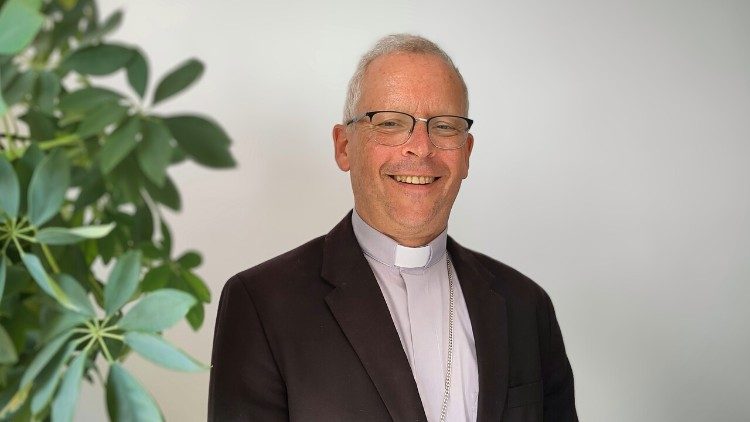
Archbishop Hubertus van Megen officially began his mission as apostolic nuncio to Germany this Thursday by presenting the credentials accrediting him as the representative of Leo XIV to Federal President Frank-Walter Steinmeier during a ceremony held at Villa Borsig in Berlin.
After the delivery of the pontifical document, the German head of state and the new representative of the Holy See held a brief private meeting. This act concludes a process that began last April, when Leo XIV appointed Van Megen as successor to Archbishop Nikola Eterović, who had submitted his resignation upon reaching the age limit established by Canon Law.
Replaces Nikola Eterović after more than a decade in Berlin
Eterović served as apostolic nuncio to Germany since 2013 and, by tradition, also held the position of dean of the Diplomatic Corps accredited to the German State, a role that usually corresponds to the representative of the Holy See in that country.
Van Megen arrived in Berlin in mid-June and was received by the vice-president of the German Bishops’ Conference, Msgr. Michael Gerber, and by the Archbishop of Berlin, Msgr. Heiner Koch, before officially assuming his duties.
A long diplomatic career in Africa
Born in 1961 in Eygelshoven, a Dutch town located near the German border, Hubertus van Megen was ordained a priest in 1987 for the diocese of Roermond and entered the diplomatic service of the Holy See in 1994.
During his early years he served in missions in Somalia, Brazil, Israel, Slovakia and the Holy See’s permanent representation to the United Nations in Geneva.
In 2014, Pope Francis appointed him apostolic nuncio to Sudan and later to Eritrea. Since 2019 he has served as nuncio to Kenya and South Sudan, as well as permanent observer to the United Nations agencies for the environment and human settlements based in Nairobi.
A profile arriving at a delicate moment for the German Church
The new nuncio assumes the post at a significant time for relations between the Holy See and the Church in Germany. Among the matters he will have to follow closely is the planned Synodal Conference, whose development still requires the corresponding recognitio from Rome.
The initiative follows the German Synodal Way, a process that maintains an atmosphere of tension between the Roman Curia and part of the German episcopate regarding some of the proposed reforms.
In statements given last year to Vatican News, Van Megen acknowledged that the service of a nuncio requires acting as a “bridge-builder” between the Holy See and local Churches when differences arise. At the same time, he stressed that “in the end it is about obedience to Peter, and that is my first responsibility.”
With the presentation of his credentials, the Dutch diplomat officially begins a mission in which he will combine the representation of the Holy See before the German authorities with the monitoring of the ecclesial life of one of the most influential countries in European Catholicism.