


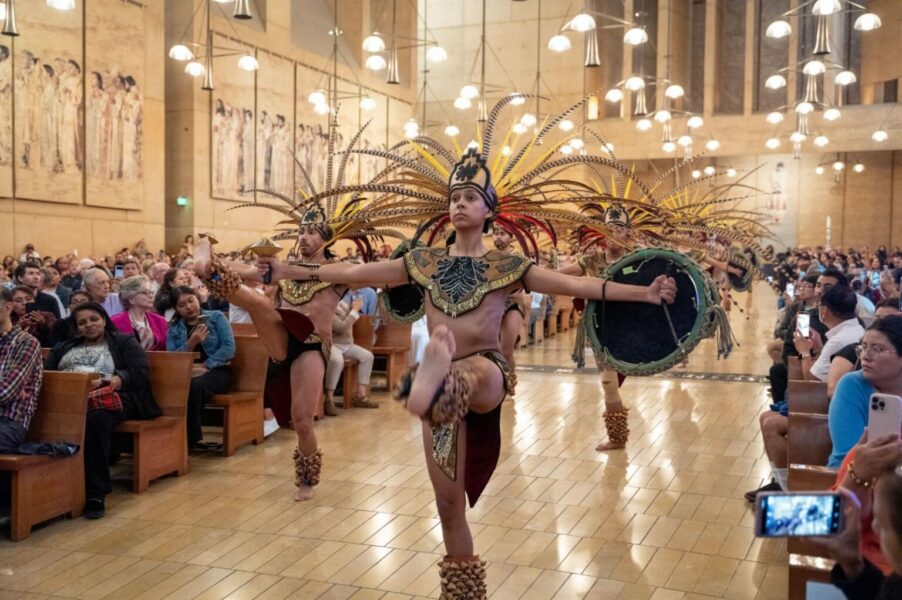
The Cathedral of Our Lady of the Angels, seat of the Archdiocese of Los Angeles (California, United States), hosted on June 27 a musical and theatrical spectacle titled «Aztec Mass». It was not a Eucharistic celebration, but a concert performed in the cathedral’s sanctuary, where the altar area served as the stage for a production that fused the text of the Ordinary of the Mass with Nahuatl poetry, theater, dance, and indigenous instruments.
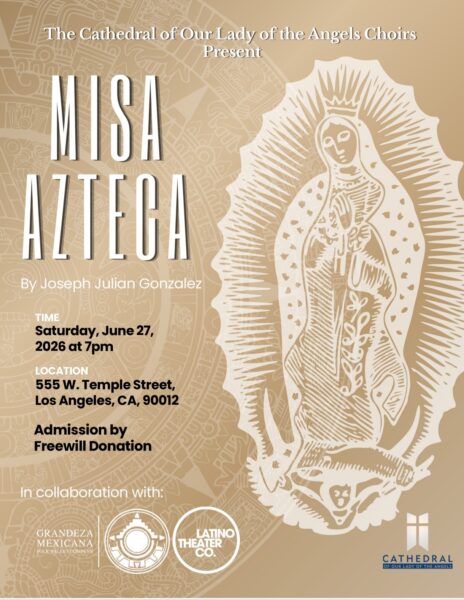
The production, organized by the cathedral’s own choirs as the closing concert of the 2025-2026 musical season, featured the collaboration of the Grandeza Mexicana Folk Ballet Company and the Latino Theater Company. The official program describes the work as an oratorio that combines the prayers of the Roman Missal with the Cantares Mexicanos, a collection of pre- and post-conquest indigenous poetry, with the aim of “uniting two worlds.”
A spectacle performed in the cathedral’s sanctuary
The evening began with a ceremonial entrance of dancers wearing large headdresses and costumes inspired by pre-Hispanic cultures, followed by a theatrical representation of the apparitions of the Virgin of Guadalupe. This was followed by various choreographies and dance numbers—including “Aztec Dance,” “The Missionaries,” “The Apparition,” “The Procession,” “Concheros,” and “Huapango”—before the performance of the eight movements of the so-called «Aztec Mass», from the Kyrie to the Ite, missa est.
The performance was directed by José Juan Delgadillo and brought together the Cathedral Choirs, a chamber orchestra, and soloists Dalia Rosibel, Delia Ríos, and Joey Molina. In the concert program, the director himself invites the audience to contemplate the story of Our Lady of Guadalupe “through song, music, and dance,” presenting the production as the culmination of the cathedral’s concert season.
The composer claims the work was born of an inspiration “from heaven”
The composer of the work, Joseph Julián González, explained that he began to conceive the piece in the early 1990s while driving from Los Angeles to California’s Central Valley.
As he told the weekly Angelus, he began to hear mentally the Kyrie of the Latin Mass accompanied by Aztec dance rhythms, an experience he interpreted as a supernatural inspiration.
“I have been working for thirty years as a professional composer for film and television and had never experienced an entire work arriving in my mind all at once. I am convinced it came from heaven,” the composer stated.
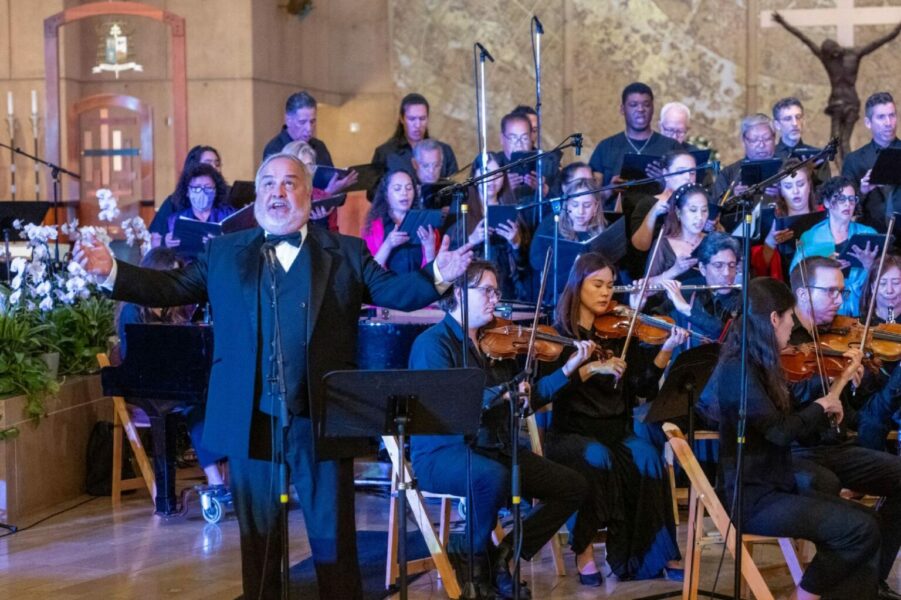
The Ordinary of the Mass mixed with elements of Nahua religiosity
The libretto distributed by the cathedral itself shows that the work is not merely a musical setting of the Ordinary of the Mass. The liturgical texts are interwoven with compositions taken from the Cantares Mexicanos and with references drawn from the Nahua religious tradition.
Thus, the Kyrie incorporates invocations to Ipaltinemi, a term translated as “the Giver of Life,” while the seventh movement is titled «Salve Regina Tonantzin», combining the traditional Marian antiphon with references present in the pre-Hispanic world. All of this forms part of the artistic approach with which the program presents the work as the union of two cultural traditions arising from the Guadalupian event.
The problem is not culture, but the loss of the sense of the sacred
The cultural richness of evangelized peoples has for centuries found a place in the life of the Church. The use of Nahuatl, traditional melodies, or Guadalupian devotion does not in itself constitute a break with Catholic tradition. The question is whether these elements remain at the service of the liturgy or whether they end up altering the meaning of the church and the space reserved for worship.
An example was offered by the Mass of the Americas, composed by Frank La Rocca and promoted by Archbishop Salvatore Cordileone. The work incorporated Mexican Marian hymns and even an Ave Maria in Nahuatl, but did so while fully respecting the liturgical celebration and the sacred character of the church. The music accompanied divine worship and enriched the liturgy without invading the space reserved for the holy mysteries.
What took place at the Cathedral of Los Angeles follows a different logic. There was no Eucharistic celebration, but a theatrical concert developed entirely in the sanctuary. The official program included a succession of dances, theatrical representations, and choreographies in the altar area before the performance of the musical work, whose libretto interweaves the prayers of the Ordinary with texts from the Cantares Mexicanos and introduces references such as Ipaltinemi and a movement titled “Salve Regina Tonantzin.”
The Church has always evangelized cultures, incorporating into sacred music expressions proper to different peoples without ever losing the sense of divine worship. Precisely for this reason, the difference is significant between a work conceived to accompany the liturgy and a spectacle performed in the place where the Eucharistic Sacrifice is usually celebrated.
At the Cathedral of Los Angeles, a Mass was not celebrated, but a concert. However, the choice of the sanctuary as the stage, the use of the altar area for choreographies and representations, and the use of the text of the Ordinary of the Mass as part of a theatrical and musical production blur the proper character of a space reserved for worship. When the sanctuary of a cathedral becomes the stage for a spectacle, the church ceases to clearly manifest that for which it was consecrated. Culture can and must find its place in the life of the Church, but without relegating to a secondary plane the sacredness of the space where the central mystery of the Catholic faith is celebrated.