


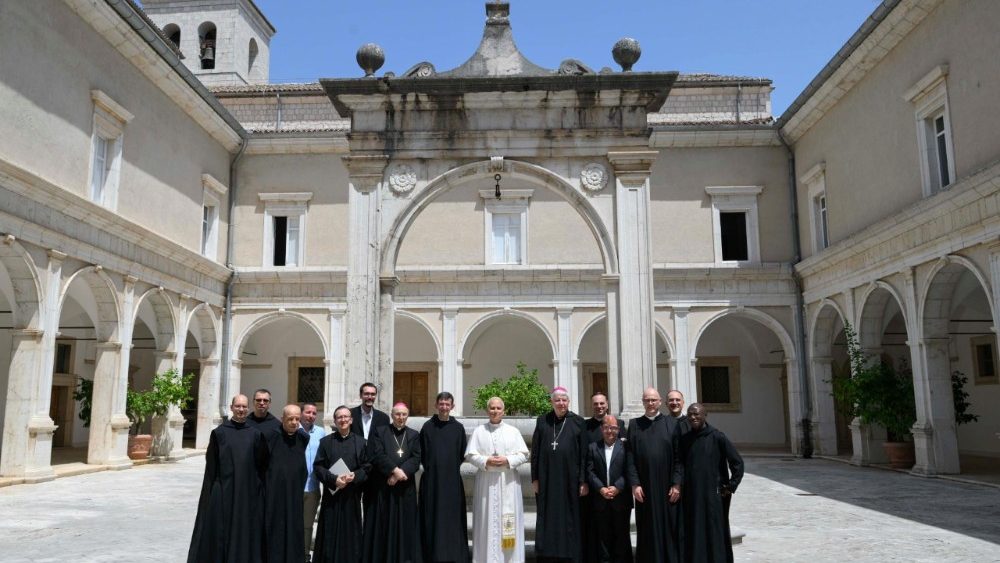
Pope Leo XIV made a private visit on Monday, July 20, to the Abbey of Montecassino, where he met with the monastic community and prayed before the tomb of Saint Benedict for peace in regions of the world affected by violence and war.
According to the Holy See Press Office, the Pontiff “paused to pray before the tomb of Saint Benedict, entrusting to him his plea for peace in those regions of the world marked by bloodshed and conflict.”
After the prayer, Leo XIV shared lunch with the religious and returned to Castel Gandolfo, where he will remain during his summer stay until July 27.
Montecassino, cradle of Western monasticism
The Abbey of Montecassino lies between Rome and Naples and was founded by Saint Benedict around the year 529. There he established the community in which he wrote his Rule, which over the centuries became one of the foundational texts of Western monasticism.
The basilica preserves the tombs of Saint Benedict and his sister, Saint Scholastica. From there, the Benedictine tradition spread throughout Europe through monasteries that played a decisive role in evangelization, the preservation of classical culture, education, and the development of numerous communities.
The history of Montecassino is also marked by several destructions and reconstructions. The best-known occurred during the Second World War, when the abbey was razed in February 1944 during the fighting of the Battle of Montecassino.
The monastery was later rebuilt, largely respecting its previous layout.
Paul VI consecrated the rebuilt basilica
On October 24, 1964, Paul VI went to Montecassino to consecrate the abbey church rebuilt after the war.
That same day, through the apostolic letter Pacis nuntius, he proclaimed Saint Benedict the principal patron of Europe, presenting him as a “messenger of peace,” builder of unity, teacher of civilization, and founder of monastic life in the West.
The visit thus linked the material reconstruction of the abbey with the spiritual recovery of a Europe still striving to overcome the wounds of the Second World War.
The visits of John Paul II
John Paul II visited Montecassino on September 20, 1980, during the year dedicated to Saint Benedict. He celebrated Mass in the abbey and held meetings with priests, religious, laity, young people, and local authorities.
In his addresses he highlighted the enduring relevance of the Benedictine legacy and presented the saint as a reference point for the mission of Christians in society.
The visit took place in a context in which the Polish Pope insisted on recovering Europe’s Christian roots and on the responsibility of the baptized in the face of the continent’s cultural and social challenges.
Benedict XVI prayed for those fallen in war
Benedict XVI made a pastoral visit to Cassino and Montecassino on May 24, 2009.
During the day he celebrated the Eucharist in Cassino, had lunch at the abbey, presided over Vespers with abbots, abbesses, and Benedictine communities, and visited the Polish military cemetery, where he prayed for those who died during the Battle of Montecassino and for peace.
The Pontiff then emphasized prayer as the path that leads to the heart of God and restores peace “amid the storms of life.”
For his part, Francis did not visit Montecassino during his twelve years as pontiff, although he intervened in the abbey’s institutional life through various appointments. Leo XIV’s visit thus revives a tradition followed by Paul VI, John Paul II, and Benedict XVI.
His prayer before the tomb of Saint Benedict once again unites the abbey with one of the central concerns of recent pontificates: the pursuit of peace in the face of conflicts that continue to cause death and suffering in different parts of the world.