


Olmedo, a municipality located in the diocese and province of Valladolid, is known as “the town of the seven sevens,” because it has seven gates in its wall, seven parishes, seven convents, seven hermitages, seven villages, seven royal lineages (or kings who shaped the destinies of Olmedo in the fifteenth century) and seven family lines.
One of these seven lineages is that of the Cotes.
Since 2020 we have been researching the figure of fray Lope de Olmedo (1370 – 1433), a monk who went down in history for having attempted a reform of the Order of Saint Jerome. Between February 2024 and September 2025, InfoVaticana published in installments the results of the research on his life and monastic work. We could well say that Lope de Olmedo lived three lives, such were the very distinct stages of his biographical trajectory. His life as a monk is well known, although existing accounts are full of interested falsehoods stated by fray José de Sigüenza, chronicler of the first centuries of the Order. Less well known is the monastic order he founded after failing to reform the Order of Saint Jerome. And his life before entering religion in 1415 is only partially known.
Thanks to Josemaría Revuelta Somalo, we know that Lope was ambassador of the infante Fernando de Antequera to Benedict XIII during the preliminaries of the Compromise of Caspe, sent to convince the pontiff of his succession rights to the throne of Aragon.
But how he became such a close collaborator of the infante and later King Fernando I of Aragon and what his family origins were is a completely unknown question. In her unpublished 1994 doctoral thesis, a copy of which is preserved in the Library of the Monastery of Santa María de Guadalupe, Sophie Coussemacker stated that the early years of the life of fray Lope de Olmedo needed to be studied again, since there was information that his seventeenth- and eighteenth-century biographers had not managed to know.
Following these indications, we observed that his figure had only been researched under his religious name, fray Lope de Olmedo, and not under his civil name, which he himself indicated in his will when he professed at Guadalupe in 1415: Lope González de Cotes.
Attentive, therefore, to this documentary source that is the will, also preserved in the Library of the Monastery of Santa María de Guadalupe, we were able to observe that, in addition to himself, Lope also named his father, García González, still alive in 1415, of whom only three years later, in 1418, in a letter to the archbishop of Toledo, he would claim to have died.
Following the thread of his surname, “González de Cotes,” we found that the church of San Juan Bautista in the town of Olmedo, today in the diocese of Valladolid (although it belonged to Ávila in the fifteenth century), had housed the well-known tomb of the Cotes, “notable funerary monument of Spanish Gothic – as can be read on the official Ceres website – made in stone between 1476 and 1500.” The website states that the remains buried in the double tomb “belong to don García de Cotes (councillor of Olmedo, Atienza and Cuéllar) and his wife, doña Catalina Rodríguez Becerra.”
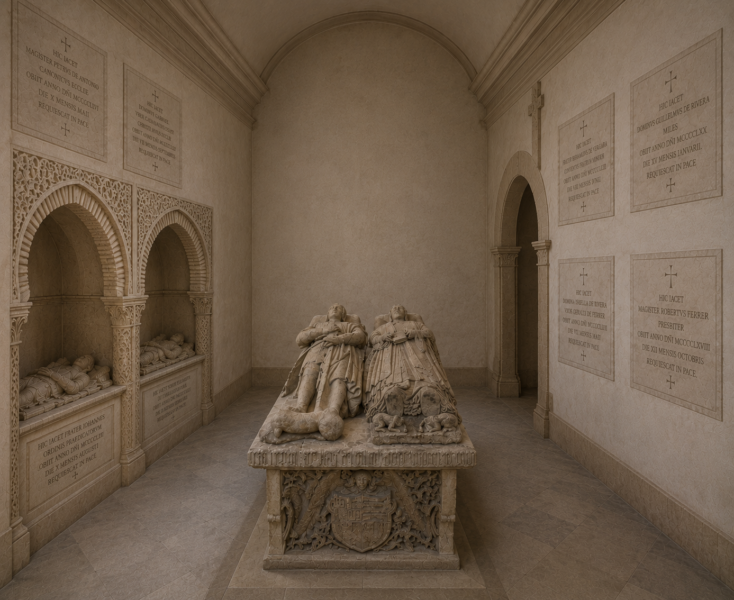
The image that accompanies this text, created with artificial intelligence, proposes the original location of this tomb, which is currently exhibited in the Museo Nacional de Escultura in Valladolid.
On the other hand, in the church of San Juan there remains in situ, to this day, a funerary slab on which the name of Garci González de Cotes can be read. This, as we can read on the digital portal of the Archivo Epigráfico de Hispania Carolingia y Medieval (AEHTAM®), “is a plaster plaque measuring 135 x 143 cm, accompanied by the family coat of arms (crowned by a helmet and episcopal attributes). The writing on the slab is painted humanistic minuscule in black and the inscription reads: ‘Here lies the honored knight Garci González de Cotes and his wife Theresa Rodríguez. He was knighted by the infante D. Fernando while besieging Setenil in the year 1407. He died on 19 September in the year 1413. This arch with this church was rebuilt by his descendant Hernando de Bega y Cotes, president of the councils of Finance, the Indies and Bishop of Córdoba’”1.
Based on these data, and despite the discrepancy in the date of Garci González de Cotes’s death with respect to the documents of fray Lope, we put forward the hypothesis that this knight was the father of fray Lope de Olmedo, a hypothesis we set out in an article co-authored with Peru Amorrortu published in issue 15 (2025) of the Revista de Genealogía e Historia de la Universidad de Córdoba, which can be read here (https://journals.uco.es/hyg/article/view/18257/16845). We believe it is possible that the discrepancy in the date of Garci González’s death may be due to an error in the restoration carried out in the church, as the plaque reads, in 1591.
During the research on the family origins of fray Lope de Olmedo, another question arose that remained pending, and which we propose to set out here: the confusion surrounding the tombs of the Cotes lineage preserved in the church of San Juan Bautista in Olmedo and the Museo Nacional de Escultura in Valladolid.
The Cotes tombs and the origin of the historiographical error
Consulting late-nineteenth- and early-twentieth-century bibliography, as well as late-twentieth-century studies, we observed that Vicente Poleró, in his work Estatuas tumulares de personajes españoles de los siglos XIII al XVII, copiadas de los originales (Madrid, 1902), associated the funerary slab of Garci González de Cotes with a double tomb whose description is identical to the tomb now preserved in the Museo Nacional de Escultura in Valladolid (inventory number CE072933), which is dated between 1476 and 1500.
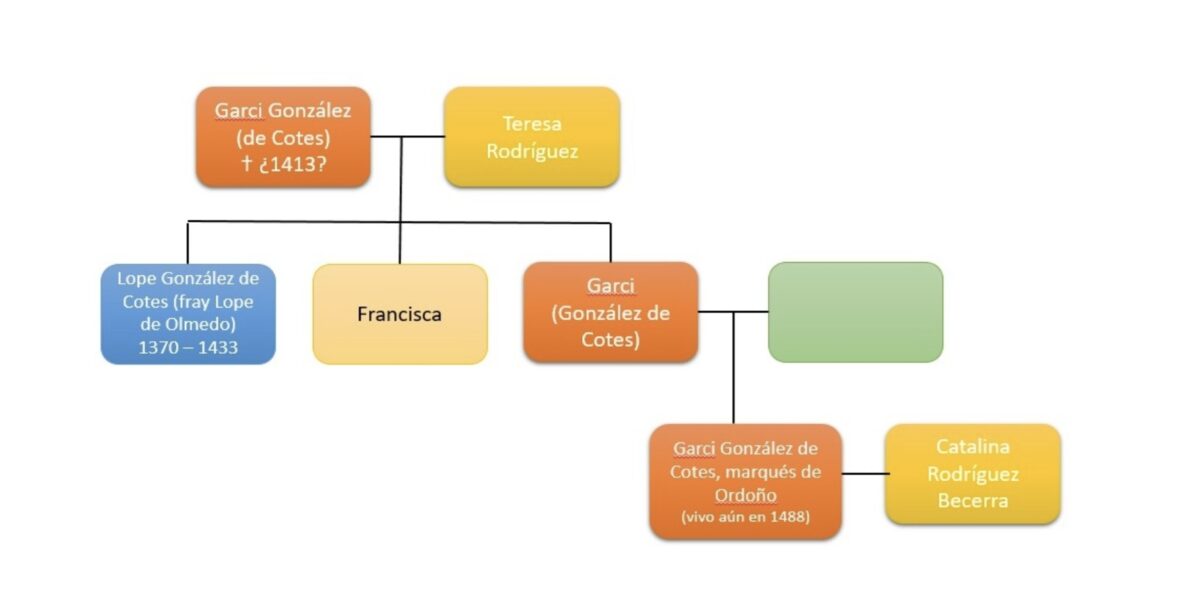
Given the different dates of the funerary slab and the tomb, it is not difficult to suppose that they are in fact two distinct tombs of two different homonymous men: Garci González, Garci González de Cotes or Garci de Cotes. Our hypothesis, taking the dates into account, is that the Garci González buried in the tomb preserved in the Museo de Valladolid would be the grandson of the Garci González referred to on the funerary slab located in the church of San Juan in Olmedo. The latter, as we said, would be the father of fray Lope de Olmedo, and the second would be his nephew (son of a younger brother of fray Lope, whom he also mentions in his cited 1418 letter to the archbishop of Toledo).
Thus, we proposed this first sketch of the genealogical tree of this lineage belonging to these three generations:
However, the error that identifies both tombs persists in historiography, and we believe that the historiographical confusion may have arisen in the following way: D. Vicente Poleró, in his cited 1902 work (p. 49), reproduces in an illustration the recumbent statue of this knight, and after a brief description, states: ‘The recumbent effigy of this knight has complete armor, except on the feet, which appear shod in mail. Over the armor, up to the middle of the arms and thighs, he wears a coat of very fine and well-wrought mail; with the gauntlets he holds a broad sword and at his feet a dog, as a sign of fidelity and nobility. His sympathetic countenance is given singular charm by the hair cut across the forehead, falling in locks on both sides and covering his head with a simple bonnet. This effigy, carved in stone and life-size, is, as a work of art, the best that was made in Castile in the mid-fifteenth century’. According to the description, this tomb was located in the presbytery of the church of San Juan, on the Gospel side, beneath an arch supported by several columns, and on the wall of the arch the already mentioned inscription.
The confusion would have been maintained over time when later authors who referred to these tombs reproduced Poleró’s statements without verification. For example, Moreno Guerra, in an article on the Cotes lineage that appeared in the Revista de Genealogía Española in 1912, states: “(…) I will begin the account of the most noble and ancient lineage of Cotes, one of the most illustrious of Olmedo and even of all Old Castile”2, and reproduces the description that Poleró makes of the Cotes tomb. He states that “Garci González de Cotes is the first of the family (of the Cotes) of whom I found news in the order files for the crossing of his descendants, and of whom there exists a notable memory in the magnificent tomb that holds his remains in the parish church of San Juan” and provides valuable descriptive information on it, citing two sources: D. José María Cuadrado, who in the note on p. 207 of the volume referring to Valladolid, Palencia and Zamora, which he wrote for the work España, sus monumentos y artes, copied the inscription of this tomb and describes the church in the text, saying: This parish was renovated when the Renaissance was struggling with the last traditions of Gothic art, by a bishop of Córdoba, to whose illustrious Cotes family a chapel served as a pantheon, today used as a sacristy, with a dome for a ceiling and with plateresque tombs in its corners.
For their part, the García Carraffa brothers, in volume XXV of their Diccionario heráldico y genealógico de apellidos españoles y americanos of 19273, state that “García de Cotes was Master of the Household of Don Juan II of Castile and that he founded a chapel and a mayorazgo in Olmedo (Valladolid).” Addressing the debate on the geographical origin of the lineage, they state that “it is certain that the Cotes lineage was established in Olmedo from the beginning of the fifteenth century, being one of the most illustrious of that city and possessing in it the patronage of the parish church of San Juan and two manor houses: one in the square called de Cotes, which was that of the mayorazgo, and another located opposite the church of San Andrés, which was that of the mayorazgo of the second sons of the family (…). The genealogical information on the Cotes of Olmedo, verified with data from military order files, goes back to Garci González de Cotes, who is the first we cite in the filiation we give in a note. The arms used by this family consisted of a quartered shield, first and fourth argent, a voided cross gules; second and third gules, a castle or; arms that are found in different places in the parish church of San Juan de Olmedo, patronage of this family, in which is found the tomb of Garci González and his wife Teresa Rodríguez; and in the house of the mayorazgo (or palace, in Moreno Guerra’s words4), located in the plazuela de Cotes of the town of Olmedo.”
In 1988, Matamala and Urrea5 attest in their work “La nobleza y su patronato artístico en Olmedo,” incurring in the same identification between the two tombs that “the inscription surrounding the double tomb of the Museo de Escultura (kept in the museum of Valladolid) mentions the year 1485.” Matamala and Urrea mention something fundamental referring to documentation “that states that the masons Hernando and Francisco de Moradillo, in addition to lowering the height of the temple’s roof, undertook in 1591 to ‘dress an arch in the Cotes chapel’”6. This is probably the same renovation commissioned by Hernando de Vega y Cotes in which the slab was restored.
A prospecting visit and institutional inquiries
Given the suspicion that Poleró’s error had not been resolved, once the working hypothesis was posed, together with the consultation of bibliography a prospecting visit was made to the church of San Juan Bautista in Olmedo and the Museo Nacional de Escultura in Valladolid, on 15 and 16 May 2025.
On this visit it was possible to observe, on the one hand, the neglect in which the Cotes tombs are found and the lack of knowledge of them on the part of the town council of Olmedo, beyond the double tomb now exhibited in the Museo de Valladolid and that the sacristy was, as its evident remains attest, a funerary chapel of the Cotes lineage.
The church of San Juan Bautista is closed to worship. In 2024 the archbishopric of Valladolid ceded it for a period of 50 years to the town council of Olmedo to convert it into a museum of Holy Week and headquarters of the activities of the Junta de Cofradías and the Agrupación Musical de la Oración del Huerto. I have tried unsuccessfully to have the town council of Olmedo provide me with information on what was to be done with the sacristy of the temple, where most of the tombs are located, as well as in the presbytery. At the time of my visit I was able to count at least a dozen tombs between the sacristy and the presbytery, all of them in a deplorable state of conservation.
The Cotes funerary chapel would have been on the epistle, or south, side, where Garci González III would have ordered to be buried; while the tomb of his grandfather, the first Garci González buried in the church of San Juan, would have been located at the opposite end of the presbytery, on the gospel side, where the funerary slab and the coat of arms are still preserved.
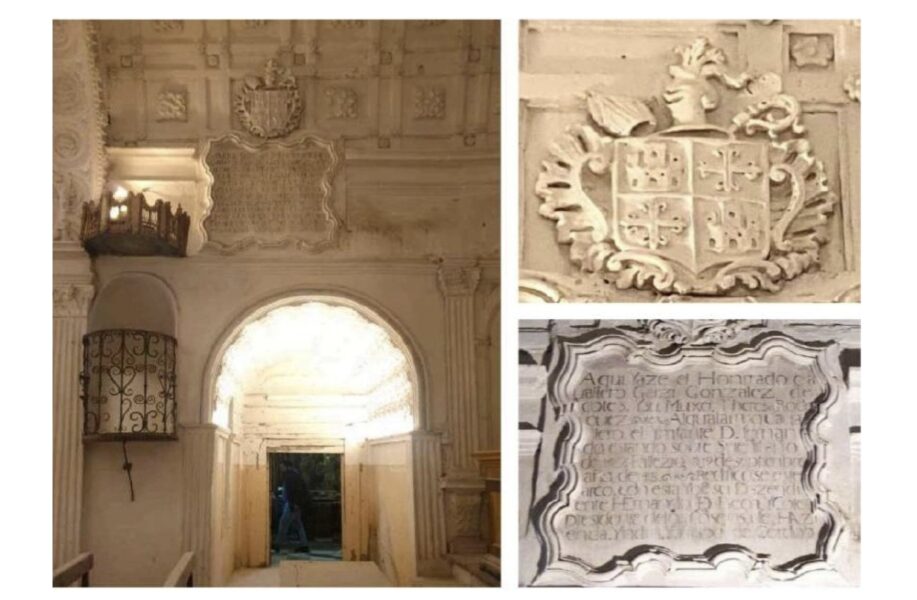
*Left: Church of San Juan Bautista in Olmedo. Location of the funerary slab of Garci González and Teresa Rodríguez above the chapel on the Gospel side.
*Upper right: coat of arms of the Cotes
*Lower right: text of the funerary slab
Once the prospecting in the church of San Juan was completed, the original location of the double tomb of the lords of Cotes, I visited the Museo Nacional de Escultura in Valladolid to observe it in detail. The visit brought several surprises: first, the location of the tomb, in a small chapel within the museum grounds, completely decontextualized. Second, the information on the record that the origin of this magnificent late-fifteenth-century stone tomb was the art trade, with a date of 1968. That is, that the tomb had been acquired by the government; which indicates that at some point between 1912, when Moreno Guerra places it in the church of San Juan in Olmedo, and 1968, when the government bought it, the tomb had been missing. The third surprise was to find, in the same corner as the double tomb, two other tombs, these individual and arcosolium, of “recumbent effigies of knights,” as the record indicated, also originating from the church of San Juan in Olmedo and presumably acquired together with the previous one, in the same year of 1968.
Consulting the documentation department of the MNE7, I received the response that “in 1968 the Ministry of Culture of the time (which, as such, did not exist, was actually called the Ministry of Education and Science) through the Dirección General de Bellas Artes with Gratiniano Nieto as Director General at its head, was the one who acquired the Tomb of the Lords of Cotes, along with other works.”
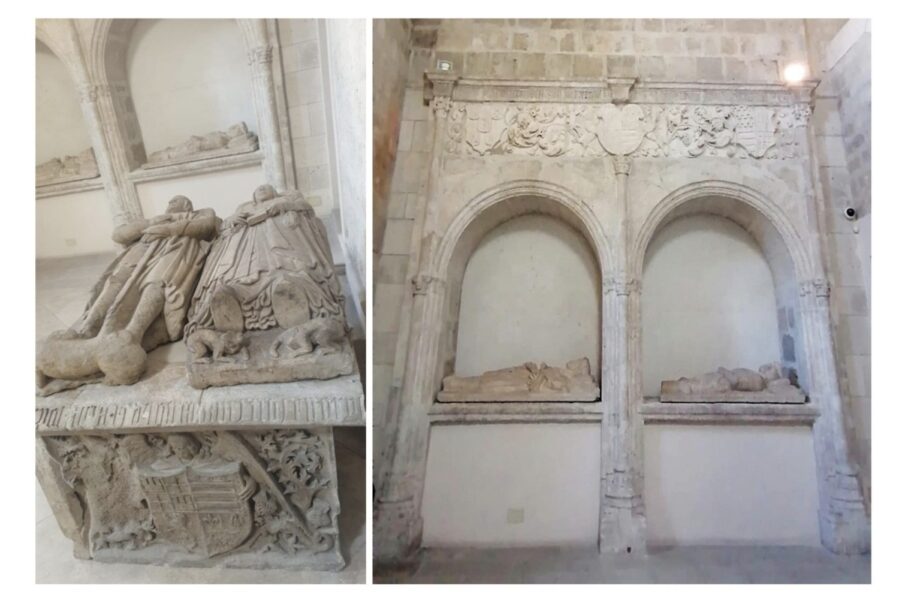
*The Cotes tombs in the Museo Nacional de Escultura in Valladolid.
The factory books of the church of San Juan in Olmedo preserved in the Archivo Diocesano de Valladolid also shed no light on the matter, beyond the important confirmation that the name Garci or García was used recurrently in the Cotes lineage, as can be deduced from baptismal records from the late sixteenth century.
Did an original tomb of the first Garci González de Cotes exist in the church of San Juan?
Taking into account the information presented, the fundamental question was raised of whether there really existed a double tomb of Garci González, knighted in 1407, and his wife that remains missing: the possibility that has always seemed most evident to us is that the double tomb of Garci III was made in continuity with that of his grandfather and placed on the opposite side.
In fact, the arch shown in the upper image leads to a side chapel with a baroque altarpiece and an eighteenth-century slab on the floor. That chapel, an extension of the side nave, could well have originally been the funerary chapel of the first Garci González and his wife, which his grandson Garci III would have replicated.
However, this presumption could be based on Poleró’s error, and it is therefore possible that such a tomb never existed, and that the place of burial of the first prominent member of the lineage was only marked with the funerary slab and the coat of arms.
It is a question that necessarily remains unanswered.
The Cotes. The birth of a lineage of the Castilian lower nobility (15th c.)
The question about the family origins of fray Lope de Olmedo led to another question, that of the tombs of that family. And the question about those tombs necessarily leads to the question about the lineage itself. Who were the Cotes of Olmedo, considered one of the seven principal lineages of the town?
Very little is known about this family. Toponymic studies reveal that Cotes would be originally from Valencia, and nothing is known of them prior to fray Lope de Olmedo, born in 1370, and the reference to whom we believe is his father, Garci González de Cotes, buried in the church of San Juan.
In the absence of data placing them in the place beforehand, we can venture the hypothesis that some member or members of this family arrived in Olmedo in the mid-fourteenth century attracted by its condition as a royal town under the new Trastámara dynasty.
The first Garci González de Cotes would have entered the service of the infante Fernando de Antequera and would have participated with him in the siege of Setenil, which earned him being knighted in 1407. Such distinction may have marked the birth of a lineage of the lower nobility, from then on closely linked to the infante Fernando.
On the funerary slab located in the church of San Juan we read about him the following inscription: “Here lies the honored knight Garci González de Cotes and his wife Theresa Rodríguez. He was knighted by the infante D. Fernando while besieging Setenil in the year 1407. He died on 19 September in the year 1413. This arch with this church was rebuilt by his descendant Hernando de Bega y Cotes, president of the councils of Finance, the Indies and Bishop of Córdoba”.8
This would help to understand the subsequent service of Lope de Olmedo to the infante, as well as the fact that a grandson of Garci González de Cotes, of the same name and son of a homonymous brother of fray Lope, came to be councillor of Olmedo, Privy to Isabella the Catholic, her Vassal and Continual of the Royal Household, obtaining favor by Royal Decree on 23/7/1503 given in Olivares. To him and his wife, Catalina Becerra, corresponds the double tomb preserved in the MNE.
The prosperity of the lineage, probably from the third Garci, who obtained the county of Ordoño, would explain the mayorazgo over the church of San Juan, converted into a family pantheon, as well as that the square in which said church is located was known at the beginning of the twentieth century, as Moreno Guerra indicates, as “plazuela de los Cotes,” and that in said square was also located the manor house of the lineage, today disappeared, in addition to a house for the second sons of the lineage since the fifteenth century9; the latter, according to the García Carraffa brothers, opposite the church of San Andrés.
In 1703, Felipe V granted the lordship and the title of Marquis of Ordoño to García Manuel de Cotes, whose descendants held positions of authority in the area until the eighteenth century.
Conclusions
It remains to mention the uncertain future of the tombs of the church of San Juan in Olmedo, since in the entire year that has passed since the visit we have received no institutional response to our questions about the role they occupy in the restoration plan of the temple.
That, together with the rescue from oblivion of the Cotes lineage, and the confirmation of the belonging of fray Lope de Olmedo to that family, is the reason for this writing.
Given the use that is to be given to the church of San Juan as a museum of the Holy Week brotherhoods, and that it has been ceded for such use by the archbishopric to the town council, the risk that the tombs continue to deteriorate or be covered is a real possibility. We believe, however, that their patrimonial interest, on the one hand, is relevant, and that, moreover, it points to the birth and historical development of a lineage of the Castilian lower nobility such as the Cotes, one of the seven most important family lineages of the town of Olmedo in the Late Middle Ages and the modern era (García-Murillo Basas, 1986, pp. 101 – 104).
Therefore, it is of patrimonial, historical and cultural – tourist interest for the town of Olmedo to deepen the research on this lineage and to restore and conserve its tombs.
1 http://hesperia.ucm.es/consulta_aehtam/Generalidades.php?id=4633. Accessed May 2025.
2 MORENO GUERRA, J., “Antiguos linajes de Castilla la Vieja. Los Cotes”, Revista de Historia y Genealogía Española, year 1. No. 8 (1912), p. 353.
3 GARCÍA CARRAFFA, A. & A., Diccionario heráldico y genealógico de apellidos españoles y americanos, volume XXV, pp. 242 – 243, 1927.
4 MORENO GUERRA, J., “Antiguos…”, op. cit., p. 357.
5 MATAMALA, P., URREA, J., La nobleza y su patronato artístico en Olmedo, Valladolid, p. 91, 1998.
6 MATAMALA, P., URREA, J., La nobleza…, op. cit., pp. 92-93.
7 Museo Nacional de Escultura, Valladolid.
8 Available at: http://hesperia.ucm.es/consulta_aehtam/Generalidades.php?id=4633.
9 MATAMALA, P., URREA, J., La nobleza y su patronato artístico en Olmedo, Valladolid, p. 91, 1998.