


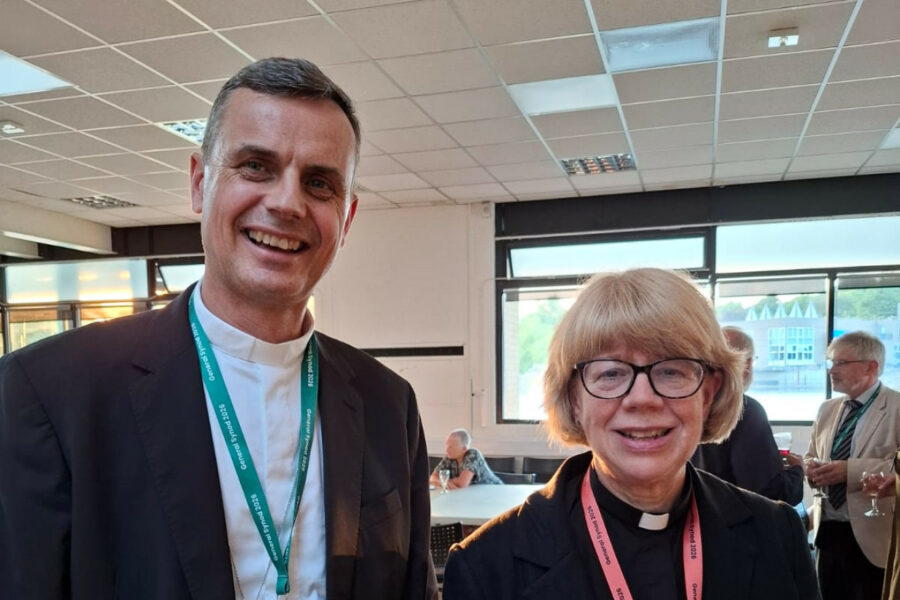
The Archbishop of Mechelen-Brussels, Msgr. Luc Terlinden, has defended opening a debate on the ordination of married men in the Latin Church after taking part as a guest at the General Synod of the Church of England, held in York from 10 to 12 July. In an interview given to the Dutch daily Nederlands Dagblad, the prelate stated that “married priests would be an enrichment for the Church” and recalled that the Belgian episcopate had already forwarded this proposal to Rome during the 2023 Synod on Synodality.
Terlinden’s presence in York was in response to an invitation from the Anglican Archbishop of York, Stephen Cottrell, and forms part of the historic relationship between the archdioceses of York and Mechelen-Brussels, heir to the so-called Malines Conversations (1921–1927), one of the first Catholic–Anglican dialogues of the twentieth century. According to the Archdiocese of Mechelen-Brussels itself, the aim of the visit was to observe how the Anglican synod operates and to strengthen ecumenical ties between the two sees.
The Belgian episcopate keeps the proposal to ordain married men open
Asked about the possibility of ordaining married men, Terlinden recalled that the Belgian bishops sent a document to Rome during the 2023 Synod on Synodality expressing their willingness to discuss that possibility.
Alongside that proposal, the episcopate requested “a certain decentralisation” that would allow local Churches greater autonomy in studying specific pastoral questions.
“For me, married priests would be an enrichment for the Church,” the archbishop affirmed. As evidence, he cited the experience of the Eastern Catholic Churches, where a long-standing tradition of married clergy exists. He recounted that a Greek-Catholic bishop had told him that around 90 % of the priests in his Church are married. “In the West we do not always show sufficient respect for that Eastern tradition, which is also Catholic,” he added.
The prelate stressed, however, that any change to the current discipline requires the Pope’s authorisation and recalled that no bishop may ordain married men on his own initiative.
A synod that functions like a parliament
During the interview, Terlinden described the General Synod of the Church of England as an organ that operates “like a parliament,” reflecting, he said, the British political tradition. He explained that it is composed of three houses—bishops, clergy and laity—that deliberate and vote on the various proposals.
He noted that the sessions addressed issues related to church governance, procedures for the appointment of bishops and various pastoral matters, including the recognition of same-sex relationships.
The archbishop welcomed the broad participation of those present, who may speak and ask questions of the leaders of the Church of England, although he felt that this system leaves less room for what the Catholic Church calls “discernment in the Spirit.”
“Several Anglicans told me they have much to learn from our experience of synodality,” he said.
During his stay in York, Terlinden also held various meetings with Anglican leaders, including Archbishop Stephen Cottrell. He explained that they discussed the possibility of organising future ecumenical pilgrimages and of continuing to strengthen the relationship between the dioceses of York and Mechelen-Brussels.
He also calls for greater participation in the appointment of bishops
Beyond the debate on priestly celibacy, the archbishop addressed other questions related to the synodal process in the Catholic Church. He argued that a balance must be found between the participation of all the faithful and the proper responsibility of the episcopal ministry, recalling that it is ultimately the Pope who makes the decisions.
In that context, he expressed support for broadening consultation with the faithful in the processes of appointing bishops, a possibility included in a recent report by a Vatican study commission. At the same time, he suggested that, in addition to the apostolic nuncio, the bishops of the country and other representatives of the local Church should also be able to participate in drawing up the synthesis that is later sent to Rome.
A debate already open in the Belgian episcopate
Terlinden’s statements come only a few months after the Bishop of Antwerp, Msgr. Johan Bonny, announced his intention to work towards the ordination of married men in his diocese from 2028 onwards, provided the Holy See authorises a change in the current discipline.
In a pastoral letter published last March, Bonny maintained that the debate on priestly celibacy had ceased to be a merely theoretical question and proposed preparing married candidates for a possible disciplinary change. The prelate justified his proposal by citing the vocations crisis affecting Western Europe and placed it within the synodal process, also advocating greater decentralisation so that local Churches can respond to their pastoral needs.
Terlinden’s remarks show that this position is not an isolated initiative by the Bishop of Antwerp but forms part of a reflection shared by the Belgian episcopate. The archbishop himself recalled that the country’s bishops sent a document to Rome on the occasion of the 2023 Synod on Synodality expressing their willingness to discuss the ordination of married men and requesting greater autonomy for local Churches to study certain pastoral questions.